
“Where does your IUL premium go? Does the insurer put my money in stocks? What if the market crashes or the company fails?” These are exactly the right questions, and buyers should ask them before signing.
The short answer: your premium does not go straight into the stock market. It travels through 3 stops: charges come out, the rest goes into your account value, and the insurer manages the money in its general account under many state rules. This guide follows each stop, explains how index credits are created, and shows the layers of protection behind them.

Stop 1: what comes out of your IUL premium?
To see where your IUL premium goes, start with the Policy Charges table in your illustration. Every premium dollar has some charges taken out before it becomes account value. Names vary by carrier, but they usually include:
| Charge | What it is |
|---|---|
| Premium charge | A percentage of each payment, only while you pay premiums |
| Cost of insurance (COI) | The cost of the death benefit protection, rising with age |
| Policy fee | A fixed monthly amount |
| Early-year expense charge | Often applies only in roughly the first 10 years |
| Rider charges | If you add benefits such as a child rider or waiver of premium |
Each charge is covered in IUL fees explained. The key point: costs are highest in the early years and then come down.
Example: where does the first-year premium go?
From a sample illustration (female age 46, paying $304.80 a month):
- Total first-year premium: $304.80 × 12 = $3,658.
- Total first-year policy charges: about $1,345.
- Added to account value: $3,658 − $1,345 = $2,313, about 63%.
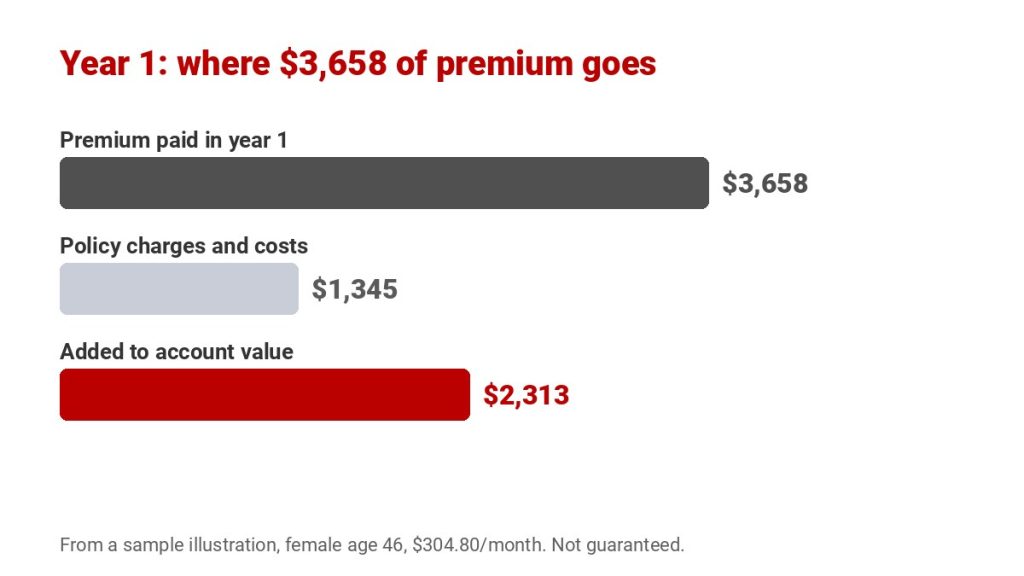
The same illustration shows charges falling to about $671 by year 11, while interest credits grow because the account is larger. That is why IUL needs time, and why surrendering early usually means a loss.
Calculator: how much of your premium actually reaches the IUL account each year?
Stop 2: how is your account value credited?
What remains after charges sits in your account value. You choose how to split it among strategies:
- Index strategies: interest based on the growth of an index such as the S&P 500, with a cap, a participation rate and a floor (often 0%).
- Fixed account: a rate declared by the insurer, with a guaranteed minimum.
A common misunderstanding: you do not own any stocks or index funds. The index is only a measuring stick for crediting interest. When the index falls, the index credit is 0%, not negative. Monthly charges still come out, though, so the account value can dip slightly that year. See IUL cap rate and participation rate.
Stop 3: what does the insurer do with your IUL premium?

This is the part few people have explained to them. Your money and that of many other policyholders is pooled in the insurer’s general account. The insurer invests it conservatively because it must always be able to pay benefits:
- Mostly high-quality bonds (government and large corporate).
- Commercial mortgage loans and some real estate.
- Only a small share in stocks and riskier assets, limited by state law.
Where does your IUL premium go to create index credits?
The insurer takes part of the interest it earns on bonds and buys index options. An option works like a “ticket” to the index’s growth over a set range.
Simplified hypothetical example: your account value is $10,000 in an index strategy. The insurer expects to earn about 4% on bonds, or $400 a year. It uses most of that to buy index options with a set cap.
- The index rises: the options pay off, and the insurer uses that to credit your account, up to the cap.
- The index falls: the options expire worthless, and the insurer loses only the “ticket” cost. Your $10,000 is not reduced by the index drop; the index credit that year is 0%.
This is also why caps can change. When bond yields fall or options get more expensive, the insurer has a smaller “budget” and may lower caps, but not below the minimum in your contract. When rates rise, caps can rise too.
How is IUL different from VUL?
With VUL (Variable Universal Life), money sits in a separate account and is invested directly in funds you pick, so it can lose value with the market. With IUL, money sits in the insurer’s general account and is protected by the floor. See also IUL vs Whole Life.
Is your IUL premium safe? 4 layers of protection

Layer 1: state law and supervision
Life insurers must hold reserves large enough to meet future obligations, keep minimum capital based on their risks, file annual financial statements, and be examined regularly by the state insurance department. State law also limits how much they can put into risky assets.
Layer 2: the insurer’s financial strength
Independent rating agencies such as A.M. Best, S&P, Moody’s and Fitch grade each insurer’s ability to pay claims. Highly rated insurers usually have strong general accounts and lower risk. Learn how to check in how to check if an insurance company is legit.
Layer 3: state guaranty associations
All 50 states, Washington D.C. and Puerto Rico have a life insurance guaranty association. If an insurer becomes insolvent and is liquidated, the association protects policyholders up to limits set by law:
| Typical level | Some states |
|---|---|
| At least $300,000 in death benefits | New York, Connecticut, Washington: $500,000 |
| At least $100,000 in cash value | New York, Connecticut, Washington: $500,000 |
California uses $300,000 and $100,000 but covers 80% of each. Coverage follows the state you live in when the insurer is liquidated, and there is usually an overall limit per person. Amounts above the limit become a claim against the insurer’s estate. Note: this is the last safety net, not a reason to choose a company. Pick a financially strong insurer from the start.
Layer 4: how you manage the policy
Most real IUL risk does not come from an insurer failing but from the policy itself: underfunding, borrowing too much, or not monitoring it. When the account value cannot cover charges, the policy can lapse. So:
- Pay the planned premium, especially in the first 10 years.
- Read your annual statement and request an updated in-force illustration every few years.
- Look at the guaranteed column, not just the assumed-rate column. See guaranteed vs non-guaranteed values.
- Borrow with a plan. See IUL policy loans.
Common misunderstandings
- “My principal is always 100% safe”: not true. The floor keeps the index credit from going negative, but charges still come out, and early surrender has surrender charges.
- “IUL is FDIC insured like a bank account”: not true. There is no FDIC coverage; protection comes from state law and guaranty associations, with limits.
- “If the market gains 25%, I get 25%”: not true. Index credits are limited by the cap and participation rate.
- “The cap I bought with is fixed forever”: not true. Current caps can change over time within contract limits.
Questions to ask your agent about where your IUL premium goes
A good advisor should be able to answer these clearly, using your own illustration:
- What percentage of each premium goes to the premium charge, and for how many years?
- What are the total policy charges in years 1, 5, 10 and 20?
- Which index strategies are available, and what are the current and guaranteed minimum caps?
- What are the insurer’s current financial strength ratings?
- How long does the policy stay in force on the guaranteed column if I pay as planned?
If an answer sounds like a promise of returns, ask to see where it is written in the illustration.
Bottom line: where does your IUL premium go?
Your IUL premium goes through 3 stops: charges come out, the rest becomes your account value, and the insurer manages it in a general account made up mostly of high-quality bonds, using part of the interest to buy index options. Behind that stand state law, financial strength ratings and state guaranty associations. The most important layer is still you: pick a strong insurer, fund the policy as planned, and review it every year.
Frequently asked questions
Where does your IUL premium go?
Part pays charges and insurance costs, and the rest becomes your account value. On the insurer’s side, the money sits in its general account, mostly invested in high-quality bonds.
Does the insurer buy stocks with my IUL premium?
Not on your behalf. It uses part of the interest earned on bonds to buy index options, which fund your credit when the index rises, up to the cap.
What happens to my IUL if the insurer fails?
State guaranty associations protect policyholders up to limits, usually at least $300,000 in death benefits and $100,000 in cash value; some states are higher, and California covers 80%. Amounts above the limit become a claim against the insurer’s estate.
Is IUL FDIC insured?
No. FDIC covers bank deposits. IUL is protected by state law, the insurer’s financial strength and state guaranty associations.
Why can IUL caps go down?
Index credits are funded by buying options with bond interest. When rates fall or options cost more, the insurer may lower caps, but not below the minimum in the contract.
Want to see where your IUL premium is going?
Thinksmart Insurance helps you read the Policy Charges table and annual statement in English or Vietnamese, compares several carriers and charges nothing for advice. Contact us →









 Thinksmart Insurance