
An IUL policy loan is one of the most talked-about features of indexed universal life insurance. Once the policy has cash value, you can take money out as a loan with no credit check, no reason required and no fixed repayment schedule.
That sounds easy, but it is still a debt with interest. This guide explains how borrowing from an IUL works, how it differs from a withdrawal, how loan interest plays out even in a 0% index year, and when taxes can apply.

How does an IUL policy loan work?
When you borrow, you are not pulling money out of your account in the usual sense. The insurer lends you its own money and uses your policy cash value as collateral. That means:
- No credit check or proof of income, and no need to explain what the money is for.
- The maximum loan is usually a portion of the cash surrender value, set by the insurer. In early years, surrender charges lower the amount you can borrow.
- No required repayment schedule. You can repay part, all or none of it.
- Any unpaid balance is subtracted from the death benefit when the insured dies.
People borrow from an IUL for emergencies, a home down payment, business capital, a child’s college costs or retirement income (see max funded IUL for retirement).
Policy loan vs withdrawal
| Feature | Policy loan | Withdrawal |
|---|---|---|
| Interest | Loan interest every year | No interest |
| Effect on account | Account stays as collateral; depending on loan type it may still earn credits | Account is permanently reduced |
| Tax (non-MEC policy) | Not income while the policy is in force | Not taxed up to your total premiums paid |
| Death benefit | Reduced by the unpaid loan | Usually reduced by the amount withdrawn |
| Paying back | Can be repaid anytime | Not repaid; you can only add premium |
Two common loan types
- Fixed or standard loan: an amount equal to the loan is moved into a collateral account that earns a fixed rate, often slightly below the loan rate. The cost is clear and predictable.
- Indexed, participating or variable loan: your account stays in the index strategies. In a strong year, credits can beat the loan rate. In a 0% year, you still pay loan interest with nothing to offset it.
Insurers use different names and rules, and some let you switch loan types. Ask for the current loan rate, the maximum loan rate in the contract and which loan type applies.
Hypothetical example: an IUL policy loan in good and 0% years
Mai (a hypothetical person) borrows $50,000 from her IUL using an indexed loan. The loan rate is assumed to be 5.5% a year.
- Yearly loan interest: $50,000 × 5.5% = $2,750.
- Good index year, 8% credit: $50,000 × 8% = $4,000. Spread: $4,000 − $2,750 = +$1,250.
- Negative index year, 0% credit: $0 − $2,750 = −$2,750.
- If every 4 years have 3 good years and one 0% year: (3 × $1,250 − $2,750) ÷ 4 = $1,000 ÷ 4 = +$250 a year.
- With two 0% years in every 4: (2 × $1,250 − 2 × $2,750) ÷ 4 = −$750 a year.
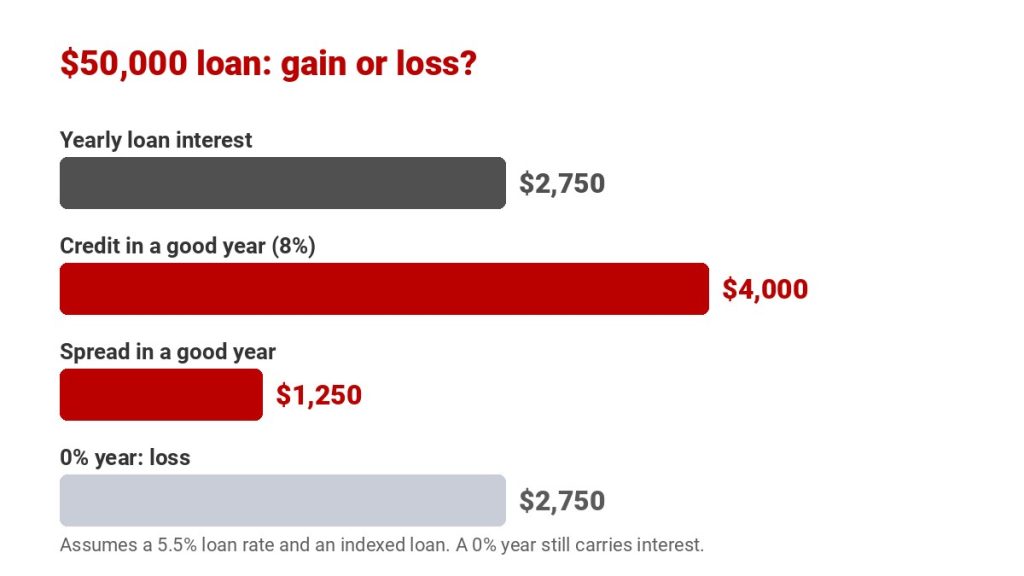
The example shows that the spread between credits and loan interest can be positive or negative, and just a few 0% years can flip the result. Do not treat a loan as “guaranteed profit”. Learn more about cap rates and participation rates, because a lower cap makes it harder for good years to cover 0% years.
Calculator: index credit vs loan interest (hypothetical)
Taxes on an IUL policy loan

- Policy in force and not a MEC: loan proceeds are not income and are not taxed.
- Policy is a MEC (funded beyond the 7702A limit): loans are taxed gain-first and may carry a 10% penalty before age 59½.
- Policy lapses or is surrendered with a loan outstanding: the forgiven loan is treated as money you received. Any amount above your total premiums paid can be taxed as income, even though you receive no new cash. This is the biggest tax risk.
5 risks of borrowing from an IUL
- Compounding interest: unpaid interest makes the balance grow every year.
- 0% index years: with an indexed loan, you still owe loan interest in a 0% year.
- Rising insurance charges: the cash value must cover monthly charges and serve as collateral. See IUL fees explained.
- Lapse: when the loan plus charges exceed the cash value, the insurer asks for more premium; if you do not pay, the policy lapses.
- A smaller death benefit: your family receives less if the loan is unpaid when the insured dies.
How to borrow more safely

- Borrow only after the policy has built enough cash value, usually after many years of premiums.
- Borrow less than the maximum to leave a cushion for bad market years.
- Pay the interest each year if you can, or pay down the balance when you have extra cash.
- Request an updated illustration every year and read it closely (see how to read an IUL illustration).
- Ask about an overloan protection rider if you plan to borrow for many years.
New to IUL? Start with our indexed universal life page.
Pay the loan interest or let it accrue?
With an IUL policy loan, most carriers let you either pay the interest each year or let it be added to the loan balance. Letting it accrue feels easier at first, but the balance grows quickly. Hypothetical example: a $50,000 loan at 5.5% loan interest, with nothing paid back:
| After | Balance if interest accrues | Balance if interest is paid yearly |
|---|---|---|
| 1 year | $52,750 | $50,000 |
| 5 years | $65,348 | $50,000 |
| 10 years | $85,407 | $50,000 |
How it is calculated: $50,000 × 1.055 = $52,750 after the first year; multiply by 1.055 again each year and the balance reaches about $85,407 after 10 years. If you pay the $2,750 of interest each year, the balance stays at $50,000. The larger the loan grows, the thinner the remaining cash value becomes, and the closer the policy gets to a lapse.
Paying the interest does not have to be all or nothing. Some owners pay part of it in good years and skip it in tight years. What matters is checking the balance against the cash value at least once a year, so a small gap never turns into a large one without you noticing.
When to borrow and when to withdraw
There is no single answer for everyone, but a few simple rules help:
- You need money for a short time and will pay it back (for example, while waiting to sell a house or for a tax refund): a policy loan is usually the better fit, because once repaid the policy is back where it was.
- You need income for many years and do not plan to repay (for example, retirement income): many owners withdraw up to the premiums they paid first, then switch to loans for the rest, to keep loan interest lower.
- The policy is still young and the cash value is small: look for another source of money first, because borrowing early slows down growth.
The right order of withdrawals and loans depends on your contract and your tax situation. Ask an advisor to run an illustration for both approaches before you decide, and compare how much death benefit is left for your family in each case.
Frequently asked questions
Does an IUL policy loan require a credit check?
No. The loan uses the policy cash value as collateral, so there is no credit check, no proof of income and no need to explain why you are borrowing.
How much can I borrow from my IUL?
Usually a portion of the cash surrender value, set by the insurer. In early years, surrender charges lower the amount you can borrow.
What happens if I never repay the loan?
There is no required repayment schedule. Interest is added to the balance, and any unpaid loan is subtracted from the death benefit. If the loan grows beyond the cash value, the policy can lapse.
What happens to my loan in a 0% index year?
With a loan type where the account stays in index strategies, a 0% year earns no credit but loan interest is still charged, so the net value of the policy goes down.
Is an IUL policy loan taxable?
Not while the policy is in force and not a MEC. MEC loans are taxed gain-first. A lapse with a loan outstanding can create taxable income.
Have an IUL and not sure whether to borrow or withdraw?
Thinksmart Insurance reviews your policy and explains loan rates, loan types and risks clearly, in English or Vietnamese, at no cost. Contact us →






 Thinksmart Insurance