
This guide covers the max funded IUL pros and cons as plainly as possible: what it does well, where it falls short, and most importantly who should buy it and who should skip it. A max funded IUL is an Indexed Universal Life policy funded close to the maximum the tax law allows, with the death benefit kept as low as allowed. The goal is to send most of each premium into cash value instead of insurance costs.
That sounds attractive, but it only works well for certain people. If you are not sure how the policy works yet, start with how max funded IUL works. This article skips the mechanics and goes straight to the question: should you buy one?

Max funded IUL pros and cons at a glance
| Pros | Cons |
|---|---|
| Cash value grows tax-deferred | High fees and charges in the early years |
| Potentially tax-free access (withdraw up to basis, then borrow) | Surrender charges in roughly the first 10 years can mean a loss |
| 0% floor: index credit never goes negative | Upside limited by cap rates and participation rates |
| Death benefit is generally income-tax-free for your family | Illustrations are assumptions, not guarantees |
| Can include living benefits for serious or chronic illness | Borrowing too much can lapse the policy and trigger taxes |
| No IRS annual contribution or income limit like a 401(k) or Roth IRA | Still limited by MEC rules; overfunding costs the tax advantages on access |
| Flexible: premiums can be reduced or paused once cash value is large enough | Complex, needs yearly review; cost of insurance rises with age |
The table shows the max funded IUL pros and cons are close to balanced. What tips the scale is the buyer. The same policy can satisfy someone who funds it for 20 years and disappoint someone who walks away in year 3.
The 7 pros explained
1. Tax-deferred growth
Interest credited to the cash value is not taxed each year. You do not get a 1099 for that growth the way you would with a regular brokerage account.
2. Potentially tax-free access
With a policy that is not a MEC, you can withdraw up to the total premiums you paid (your basis) without tax, then take more through policy loans. Loans are not treated as income as long as the policy stays in force. See IUL policy loans.
3. The 0% floor
In a year when the index falls, the index credit is 0%, not negative. Keep in mind that insurance costs and policy charges are still deducted every month, so the cash value can dip slightly in a 0% year.
4. A death benefit for your family
If the insured person dies, the family receives the death benefit, which is generally free of federal income tax. A 401(k) or brokerage account does not offer that.
5. Living benefits
Many policies let you take part of the death benefit early for a critical, chronic or terminal illness. The exact rules depend on the carrier and the rider. See the chronic illness rider guide.
6. No 401(k) or Roth IRA style limits
The IRS does not set an annual contribution cap or an income limit for life insurance. High earners who already max out a 401(k) and cannot contribute directly to a Roth IRA often care about this. Premiums are still limited by insurance tax rules, explained in the MEC section below.
7. Flexible premiums
Once the cash value is large enough, you may lower or pause premiums for a while. Flexibility cuts both ways: paying less means slower growth and a higher chance the policy runs short of money to cover its costs.
The 7 cons explained

1. High early-year charges
Every policy has premium loads, admin fees, cost of insurance and rider charges, and much of the cost lands in the early years. See IUL fees explained.
2. Losses if you surrender early
For roughly the first 10 to 15 years, surrendering usually triggers a surrender charge. The example below puts numbers on it.
3. Capped upside
In exchange for the 0% floor, index credits are limited by a cap rate and a participation rate. In a strong market year you only get up to the cap, and the carrier can change caps over time within contract limits. See IUL cap rate and participation rate.
4. Illustrations are not promises
Illustrations use an assumed rate, usually the same average every year. Real returns move up and down, and only the guaranteed column is a commitment. Read both the guaranteed and non-guaranteed columns. Learn how in how to read an IUL illustration.
5. Loan and lapse risk
If the loan balance and loan interest grow until the cash value can no longer cover policy costs, the policy can lapse. The gain you took out through loans may then become taxable, even though you receive nothing more.
6. MEC limits
Pay in more than the law allows and the policy becomes a MEC. The death benefit is still generally income-tax-free, but most of the tax advantages on lifetime access are lost.
7. Complexity and ongoing review
A max funded IUL is not “set it and forget it”. Review the annual statement every year, compare it with the original illustration and adjust if needed. Cost of insurance also rises with age.
Hypothetical example: what does surrendering in year 3 cost?
Mike (a hypothetical person), age 40, buys a max funded IUL and pays $12,000 a year. In year 3 he wants the money for a home down payment and thinks about surrendering.
- Total premiums paid: $12,000 × 3 = $36,000.
- Surrender value (hypothetical): cash value after surrender charges is $27,000.
- Amount lost: $36,000 − $27,000 = $9,000, about 25% of what he paid.
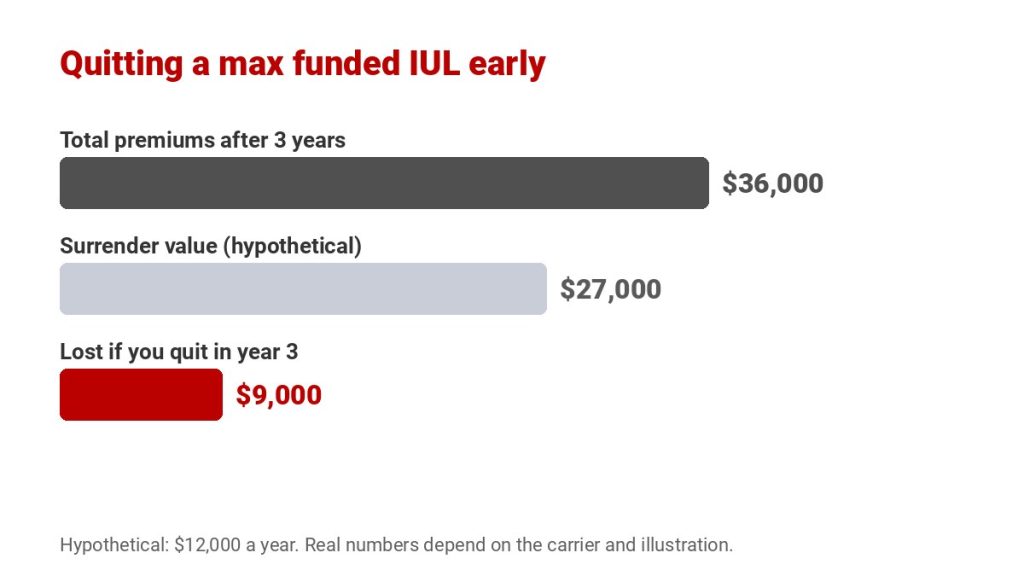
Real numbers depend on the carrier, age, health and policy design. The common thread is that max funded IUL needs time. If you know you will need the money in a few years, this is not the place for it. The max funded IUL cost guide has more cost examples.
What is a MEC and why does it shape the max funded IUL pros and cons?
A MEC (Modified Endowment Contract) is a life insurance policy funded too quickly under the tax law. The law uses the 7-pay test: during the first 7 years, total premiums cannot exceed what it would take to pay the policy up in 7 equal annual payments.
Hypothetical example: a policy has a 7-pay limit of $15,000 a year. You pay $20,000 in year one, $5,000 over the limit. The policy becomes a MEC, and:
- Money you take out (withdrawals or loans) comes from gains first, and those gains are taxed as income.
- Before age 59½, a 10% penalty on the gain usually applies too.
- The death benefit paid to your family is still generally income-tax-free.
Max funding means paying right up to the MEC line without crossing it. Carriers usually monitor this and warn you before you go over, but ask for your policy’s exact limit anyway.
Fit check: is max funded IUL right for you?
5 people max funded IUL fits
- High, steady earners who already max out or nearly max out a 401(k) and want another tax-deferred place for savings.
- Small business owners with consistent profits who want family protection plus flexible money for later.
- Healthy people aged 30 to 50 with at least 15 to 20 years before they need the money, so insurance costs are lower and growth has time.
- People who want another retirement income source that can be tax-free if handled correctly. See max funded IUL for retirement.
- People who truly need life insurance and like having a death benefit and cash value in one policy.
5 people who should skip it

- No emergency fund: if you need cash suddenly and surrender early, you lose money.
- Credit card or other high-interest debt: paying it off usually beats any savings vehicle.
- Not yet getting the full 401(k) match: that is free money from your employer, so take it first. Compare in max funded IUL vs 401k.
- Irregular income or a big expense coming in the next 5 years, such as a home purchase or tuition.
- You only need low-cost family protection: term life is usually far cheaper for the same death benefit.
Older buyers or those in poorer health should also think carefully, because higher insurance costs eat into the cash value.
Questions to ask before you sign
- How many years do surrender charges last, and what percentage applies each year?
- What is this policy’s annual MEC limit?
- What rate does the illustration assume? What happens if returns are 1 to 2% lower?
- Based on the guaranteed column, how long does the policy last if I stop paying?
- Is the loan rate fixed or variable? Is there a borrowing limit?
- Which living benefit riders are included, and what are the conditions to qualify?
For another look at benefits and risks, read is max funded IUL good.
How to compare two max funded IUL illustrations side by side
If an advisor shows you more than one carrier, line them up on the same assumptions before you compare. Ask for the same premium, the same funding period and the same assumed rate, or the comparison means little. Then look at these points in order:
- Surrender value in years 1, 5 and 10: this shows how much you could get back if plans change, which matters more than the year 30 number.
- Guaranteed column: check the age at which the policy would lapse if credits were at the minimum. A policy that lasts longer on guaranteed values has more margin for bad years.
- Lower-rate scenario: ask for the same illustration at a rate 1 to 2% lower. If the policy only works at the higher rate, it is too tight.
- Loan terms: compare loan types, loan rates and how the credited rate interacts with the loan rate.
- Riders: make sure living benefit riders are actually included and that you understand what they cost, if anything.
A higher projected number at age 65 is not automatically better. Often it simply reflects a higher assumed rate or a design with less margin for error.
Bottom line on max funded IUL pros and cons
In short, the max funded IUL pros and cons depend more on the buyer than on the product. For someone with a solid financial base, the ability to fund steadily for a long time, and a real need for life insurance, it can be a useful tool for tax-deferred growth and flexible money later. For someone with debt, no emergency fund or a near-term need for cash, the risk of losing money on an early surrender outweighs the benefits. No return is guaranteed beyond what the policy’s guaranteed column shows.
Frequently asked questions
What are the biggest max funded IUL pros and cons?
The biggest pro is tax-deferred growth with potentially tax-free access if the policy is not a MEC and stays in force. The biggest con is high early-year charges, so surrendering early often means a loss.
Can you lose money in a max funded IUL?
Index credits have a 0% floor, but charges are still deducted every month. If you surrender in the early years, the surrender value is usually lower than the premiums you paid.
How long should you fund a max funded IUL?
Plan on at least 7 to 10 years of premiums, and leave the money in place for years after that. The longer the time frame, the more the early costs are offset.
What happens if my policy becomes a MEC?
The death benefit is still generally income-tax-free, but money taken out during your lifetime is treated as gain first and taxed, with a possible 10% penalty before age 59½.
Who should not buy a max funded IUL?
People without an emergency fund, with high-interest debt, not yet getting a full 401(k) match, with irregular income, or who need the money within a few years.
Want to know whether max funded IUL fits your family?
Thinksmart Insurance compares illustrations from several carriers, explains both the upside and the risks in English or Vietnamese, and charges nothing for advice. Contact us →









 Thinksmart Insurance