
A chronic illness rider is a living benefit included with many life insurance policies in the US. If you can no longer handle basic daily activities on your own, the policy lets you receive part of your death benefit while you are alive, instead of only paying your family after you die.
Many Vietnamese-American families own life insurance without knowing their policy has this benefit. This guide explains in plain language what the six activities of daily living (ADLs) are, when the rider pays, how it pays, whether it is taxed, with a step-by-step example and a calculator.

The six ADLs in a chronic illness rider
ADLs, or activities of daily living, are the basic tasks a person needs to do each day to live independently. Most policies use these six:
| Activity | What it means |
|---|---|
| Bathing | Washing yourself and getting in and out of the tub or shower |
| Eating | Feeding yourself once food is prepared |
| Dressing | Putting on and taking off clothes, including braces or artificial limbs |
| Toileting | Getting to and from the toilet, on and off, and cleaning yourself |
| Transferring | Moving in and out of a bed, chair or wheelchair |
| Continence | Controlling bladder and bowel function |
“Unable to perform” usually means you need substantial help from another person, either hands-on help or someone standing by to keep you safe. The exact definition is in the rider section of your policy.
When does a chronic illness rider pay?
To qualify, you usually need all of the following:
- You cannot perform at least 2 of the 6 ADLs, and the condition is expected to last at least 90 days.
- Or you have a severe cognitive impairment, such as Alzheimer’s or dementia, and need regular supervision to stay safe.
- A licensed health care practitioner certifies the condition within the past 12 months.
- The policy is in force and the rider is part of the contract.
Some carriers also require the condition to be permanent. This is one of the most important differences between carriers, so read the rider or ask an advisor before you buy.
How does a chronic illness rider pay?

Unlike a death benefit, which is paid in one lump sum, a chronic illness benefit is usually paid over time:
- Monthly or yearly payments, up to a yearly maximum set by the carrier.
- A discount: because you receive money early, the amount you get is usually less than the death benefit it uses up.
- Less for your family: every dollar accelerated reduces the death benefit paid when you die.
- A lifetime cap: each carrier limits the total you can accelerate.
- Flexible use: with many policies you decide how to spend the money and do not need to submit care receipts.
With many carriers the rider is included at no extra monthly cost; the cost shows up as the discount when you actually use it. Other carriers charge a separate fee. For an overview of every type, see living benefits in life insurance.
Hypothetical example: how much can a chronic illness rider pay?
An IUL illustration for a 45-year-old man with a $250,000 face amount shows that if he qualifies for a chronic illness benefit at age 65, the estimated benefit is about $3,713 per month. That is an illustration, not a promise, and it varies by carrier, age, health and policy values.
Suppose the family pays $5,000 a month for in-home care (hypothetical) and the total amount available to accelerate is $200,000 (hypothetical):
- Yearly benefit: $3,713 × 12 = $44,556.
- Monthly gap: $5,000 − $3,713 = $1,287, or $15,444 a year the family covers.
- How long it lasts: $200,000 ÷ $3,713 ≈ 53.9 months, about 4.5 years.
- Share of the cost covered: $3,713 ÷ $5,000 ≈ 74%.
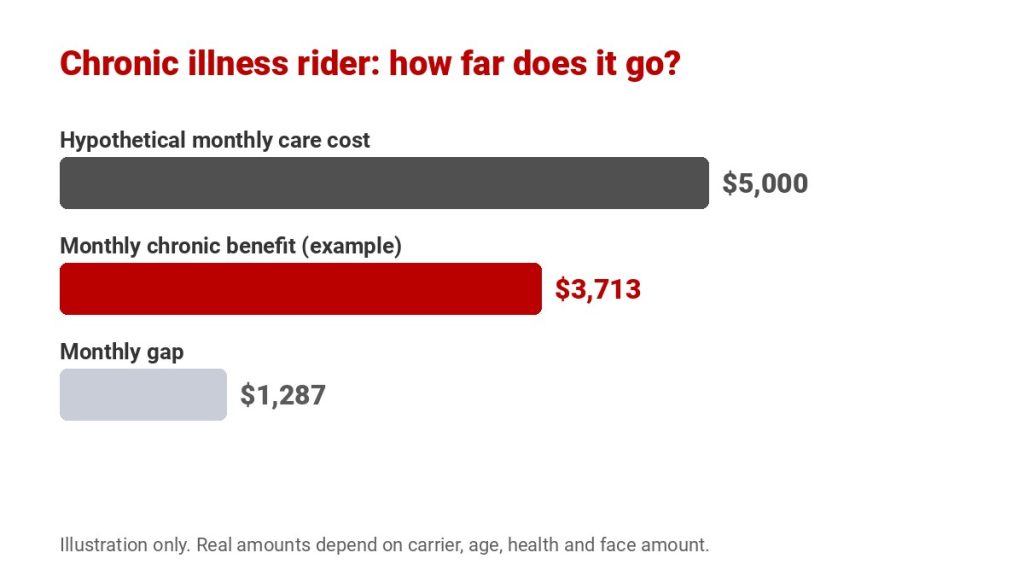
The lesson: a chronic illness rider helps a lot, but it usually does not cover every cost. Families should still plan savings or other resources for the gap.
Calculator: how long can a chronic illness benefit pay for care?
Is a chronic illness rider benefit taxable?
Under federal tax law, life insurance benefits accelerated because of a chronic illness are generally treated like a death benefit and are not subject to income tax, as long as the insured meets the definition of “chronically ill” and the policy meets the rules. For per diem style payments, there is a daily tax-free limit that the IRS adjusts every year. If you receive a large amount, ask your tax preparer to be sure.
Chronic illness rider vs long-term care insurance
| Feature | Chronic illness rider | Stand-alone LTC insurance |
|---|---|---|
| Cost | Often included, no extra monthly fee | Separate premium that may rise over time |
| If you never use it | Your family still receives the death benefit | Usually nothing is paid back |
| Benefit amount | Limited to the death benefit, with a discount | Based on the benefit you bought |
| Permanent condition required | Some carriers require it | Usually not required |
Medicare does not pay for long-term custodial care such as daily help with bathing or eating. Medicaid may pay, but only after a family has spent down most of its assets. That is why a chronic illness rider is worth considering for anyone who wants to stay in control of their care later in life.
Five things to check before you buy

- Does the policy include a chronic illness rider, and is there a charge?
- Is a permanent condition required? Riders without that requirement are more flexible.
- What are the yearly maximum and the lifetime cap?
- How is the discount calculated? Ask for an illustration showing chronic illness values at ages 65, 75 and 85.
- Your current health: some pre-existing conditions can lead a carrier to exclude the chronic illness benefit. Answer health questions honestly.
Thinksmart compares several carriers and helps you read this part of the contract. See also indexed universal life and types of life insurance to choose the right fit.
How to file a chronic illness rider claim
- Call the carrier or your advisor to start the claim and request the living benefit forms.
- Ask your doctor to complete the certification, stating which activities of daily living you cannot perform, since when, and how long the condition is expected to last.
- Send the medical records the carrier asks for. The carrier may also send someone to assess you at home.
- Review the benefit offer, which shows the discounted amount, and accept it before payment is made.
- Recertify every year to keep receiving payments.
Family members should know where the policy is kept, the carrier name and the policy number. If the insured person has memory loss, someone holding a power of attorney will find the paperwork much easier to handle.
How Vietnamese-American families can plan for long-term care
In many Vietnamese families, adult children expect to care for their parents at home. That is a beautiful tradition, but it often means a son or daughter cuts work hours or quits a job, which hurts the whole household budget. A chronic illness rider can pay for a part-time caregiver, home changes such as grab bars and a walk-in shower, or adult day care, so family members can keep working and still be there for their parents.
A practical plan usually combines three pieces: some savings set aside for care, a life insurance policy with a chronic illness rider, and clear legal documents such as a power of attorney and a health care directive. Talk with your parents about their wishes early, while everyone is healthy, so decisions are easier later.
Frequently asked questions
What is a chronic illness rider?
It is a living benefit that lets you receive part of your life insurance death benefit early if you cannot perform at least 2 of 6 activities of daily living for 90 days, or have a severe cognitive impairment.
What are the six ADLs?
Bathing, eating, dressing, toileting, transferring (in and out of a bed or chair) and continence.
Does Alzheimer’s qualify for a chronic illness rider?
Usually yes. Severe cognitive impairment such as Alzheimer’s is a separate trigger, even if the person can still do some daily activities.
Does using the rider reduce what my family receives?
Yes. The accelerated amount, usually with a discount, is subtracted from the death benefit, so your beneficiaries receive less.
Are chronic illness rider benefits taxable?
They are generally free of federal income tax if you meet the legal definition of chronically ill and the policy meets the rules. Ask a tax preparer if you receive a large amount.
Not sure whether your policy has a chronic illness rider?
Thinksmart Insurance can review your policy, request an illustration and compare several carriers, explained clearly in English or Vietnamese at no cost. Contact us →









 Thinksmart Insurance