
Nail technician health risks are real and common. Sitting bent forward for hours, repeating the same wrist motions all day and breathing salon chemicals add up. After ten or twenty years, many technicians develop lower back pain, neck and shoulder strain or numb hands. Some need months off work, and some need surgery.
For a nail technician, your hands and your back are your business. When you cannot work, income stops right away, especially if you work as a 1099 contractor or rent a station. This guide helps you spot common problems early, prevent them, and protect your family’s income if you ever have to stop working.

Five common nail technician health risks
| Problem | Signs and causes |
|---|---|
| Lower back pain | Hours leaning forward without back support; can progress to a herniated disc |
| Neck and shoulder strain | Looking down at close work with raised shoulders; stiffness and pain down the arm |
| Wrist pain and numbness | Repeated filing, painting and cuticle work; numb thumb and fingers, often at night |
| Eye strain | Constant close focus under bright lamps; dry eyes and headaches |
| Skin and breathing | Glues, removers and filing dust; itchy skin, coughing, shortness of breath, headaches |
Back pain and wrist problems are the two issues that most often force nail technicians to stop working, because severe pain makes it impossible to sit for long or hold tools precisely.
Back pain in nail technicians: when to see a doctor
Mild back pain after a long day usually improves with rest. See a doctor soon if you notice:
- Pain lasting more than a few weeks, or getting worse even with rest.
- Pain spreading to the buttocks or legs, or numbness or weakness in the arms or legs.
- Trouble standing up, bending or walking.
- Loss of bladder or bowel control, or numbness around the groin: go to the emergency room right away.
Getting checked early helps your health and any future insurance claim: clear medical records from the start make a claim easier to prove.
Wrist numbness and carpal tunnel syndrome
Carpal tunnel syndrome happens when a nerve in the wrist is squeezed. Nail technicians are at risk because the wrist bends and twists constantly while filing, painting and doing cuticle work. Signs include numbness and tingling in the thumb, index and middle fingers, and sometimes dropping things because of weakness. Left untreated, it can require a brace, injections or surgery and weeks away from work.
To lower the risk, keep your wrist straight while working, use tools with comfortable grips, rotate tasks between clients, and take a few minutes every hour to stretch your wrists.
How to prevent nail technician health risks

- Adjust your chair and table: use a chair with back support, set the height so your feet rest flat on the floor, and keep the table at elbow height.
- Pad your arms: use a cushion or arm rest so your wrists and elbows do not press on hard edges.
- Use good lighting: it keeps you from leaning in too close and reduces neck and eye strain.
- Take stretch breaks: stand for two or three minutes every hour, roll your shoulders, stretch your neck, back and wrists.
- Protect yourself: wear nitrile gloves and a suitable mask, keep chemical bottles closed, and use exhaust fans or ventilation.
- Do not rely on painkillers: they hide the pain but do not fix the cause. See a doctor if pain lasts.
If you have to stop working, who pays the bills?
This is the most practical question. W-2 employees may receive workers’ compensation if an illness is caused by work, and some states such as California have state disability insurance (SDI). But nail technicians who work as 1099 contractors or rent a station are usually self-employed, so they do not get these benefits automatically. In California, self-employed people can buy SDI Elective Coverage. See nail tech 1099 vs W-2.
Hypothetical example: six months off after surgery
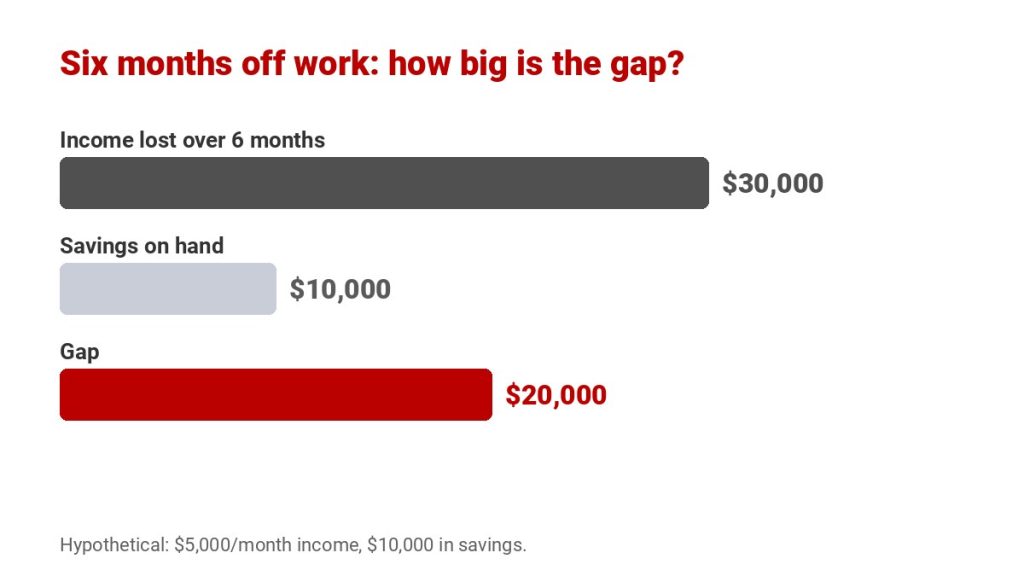
Hoa (hypothetical) is a nail technician earning $5,000 a month with $10,000 in savings. She needs back surgery and six months off.
- Income lost: $5,000 × 6 = $30,000.
- Savings: $10,000, which lasts about $10,000 ÷ $5,000 = 2 months.
- Gap: $30,000 − $10,000 = $20,000, before surgery, medicine and physical therapy costs that health insurance does not pay.
Calculator: if you had to stop working, how big is the gap?
A real story: Nga, a nail technician with a herniated disc
Kieu Nga, a nail technician for more than 20 years in Nevada, bought an IUL policy in 2019 while she was healthy. A few years later she developed a herniated disc, had two spine surgeries and could not manage daily activities on her own. Through the chronic illness living benefit in her policy, she received a total of $105,000 in three payments. Read the full story: Nga’s herniated disc insurance claim.
The key point: a herniated disc diagnosis alone is not enough. A chronic illness benefit only pays when the condition leaves you unable to perform at least 2 of 6 activities of daily living for 90 days, certified by a doctor. See the details in our guide to the chronic illness rider.
Three layers of income protection for nail technicians

- Emergency fund: aim for three to six months of expenses. This is your first layer for short time off.
- Disability insurance: pays part of your income each month if illness or injury keeps you from working. Self-employed workers can buy their own policy; the price depends on age, occupation and reported income.
- Life insurance with living benefits: pays your family if you die, and can pay part of the benefit early for a critical, chronic or terminal illness. See living benefits and insurance for nail salons.
Buy while you are healthy. Once your medical records show back pain, a herniated disc or carpal tunnel, carriers may charge more, exclude related benefits or decline coverage.
Five simple stretches between clients
No equipment needed. Each stretch takes 20 to 30 seconds and can be done right at your station:
- Chin tuck and gentle neck extension: sit tall, pull your chin straight back, then slowly tilt your head back a little.
- Shoulder rolls: roll both shoulders backward ten times to release tension in the neck and upper back.
- Wrist stretch: hold one arm straight out, gently pull the fingers back toward you with the other hand, then bend them the other way.
- Standing back bend: stand up, place your hands on your hips and lean back gently.
- Look far away: every 20 minutes, look at something about 20 feet away for 20 seconds to rest your eyes.
If any stretch makes the pain worse, stop and ask a doctor or physical therapist.
What salon owners can do
Salon owners play a big role in reducing nail technician health risks for their whole team. Investing in adjustable chairs, ventilated tables or a good exhaust system costs money up front, but it can reduce sick days and staff turnover. Owners can also schedule short breaks between appointments, keep chemical containers closed and labeled, and make gloves and masks easy to find at every station.
Owners should also review their own protection. If the owner cannot work for months, the salon may struggle to pay rent and staff. A plan that combines business savings, disability coverage and life insurance helps keep both the family and the business stable.
Frequently asked questions
What are the most common nail technician health risks?
Lower back pain, neck and shoulder strain, wrist pain and numbness (carpal tunnel), eye strain, and skin or breathing irritation from chemicals.
Do 1099 nail technicians get workers’ comp?
Usually not, because workers’ comp covers employees. Technicians who work as 1099 contractors or rent a station are self-employed and need their own emergency fund and insurance.
Can life insurance pay for a herniated disc?
It can, if the policy has a chronic illness living benefit and the condition leaves you unable to perform at least 2 of 6 activities of daily living for 90 days, certified by a doctor.
Can I still buy insurance if I already have back pain?
Often yes, but the price may be higher or some benefits may be excluded. Disclose your health honestly and ask an advisor to compare several carriers.
How can nail technicians reduce back pain?
Use a chair with back support and adjustable height, pad your arms, use good lighting, stretch every hour, and see a doctor if pain lasts or spreads to your legs.
Are you a nail technician who wants to protect your family’s income?
Thinksmart Insurance works with many people in the nail industry, explains everything clearly in English or Vietnamese, compares several insurers and charges nothing for advice. Contact us →









 Thinksmart Insurance