
When families look at permanent life insurance, a common question is IUL vs whole life: what is the difference, and which one is better? The short answer is that neither is better for everyone. Whole life is strong on certainty. IUL is strong on flexibility and growth potential, but fewer things are guaranteed. This guide compares each point in plain words, with a 5-year example.

How IUL vs whole life are alike
Both are permanent life insurance: they cover you for life as long as the policy stays in force, unlike term insurance, which only lasts 10, 20 or 30 years. Both build cash value over time that you can borrow or withdraw, and growth inside the policy is generally tax deferred. If you are new to this, start with the types of life insurance in the US.
IUL vs whole life comparison table
| Feature | Whole life | IUL |
|---|---|---|
| Premiums | Fixed for the life of the policy | Flexible, within a minimum and maximum |
| Premium for the same death benefit | Usually higher | Usually lower at the minimum |
| How cash value grows | Guaranteed rate, plus dividends if any | Index-linked credits with a cap and a floor |
| What is guaranteed | A lot: premium, minimum cash value, death benefit | Less: usually just the floor on interest credits |
| Lapse risk | Low if premiums are paid | Yes, if underfunded or heavily borrowed |
| Monitoring needed | Little | Review every year |
Premiums
Whole life has a fixed premium: you know what you pay each month, and if you pay it, you are done. In exchange, premiums are usually much higher than term insurance and higher than the minimum IUL premium for the same death benefit.
IUL lets you pay within a range: a minimum to keep the policy going, a target premium, and a maximum before the policy becomes a MEC. That flexibility helps when income goes up and down, as it does for many self-employed workers. But paying only the minimum for years means slow cash value growth, and as the cost of insurance rises with age, the policy can run short and lapse.
Cash value growth

Whole life cash value grows according to a guaranteed schedule in the contract. Participating policies from some insurers may also pay dividends, but dividends are not guaranteed and depend on the insurer’s results.
IUL does not buy stocks directly. The policy is credited interest based on the growth of an index, usually the S&P 500, using three settings: the cap (maximum credited), the floor (minimum, often 0% or 1%) and the participation rate. In a down year, a 0% floor keeps the interest credit from going negative, but monthly charges are still deducted, so the account value can still fall. See IUL cap, floor and participation rate and IUL fees explained.
A 5-year example (hypothetical)
Suppose the policy holds $10,000 and the index returns +20%, −15%, +8%, +25% and −5% over 5 years. The IUL has a 10% cap and a 0% floor. Compare that with an assumed fixed rate of 4% a year:
- IUL credit each year: 10% (capped), 0% (floor), 8%, 10% (capped), 0%.
- IUL: $10,000 × 1.10 × 1.00 × 1.08 × 1.10 × 1.00 = $13,068.
- Fixed 4%: $10,000 × 1.045 = $12,167.
- S&P 500 index without dividends: $10,000 × 1.20 × 0.85 × 1.08 × 1.25 × 0.95 = $13,082.
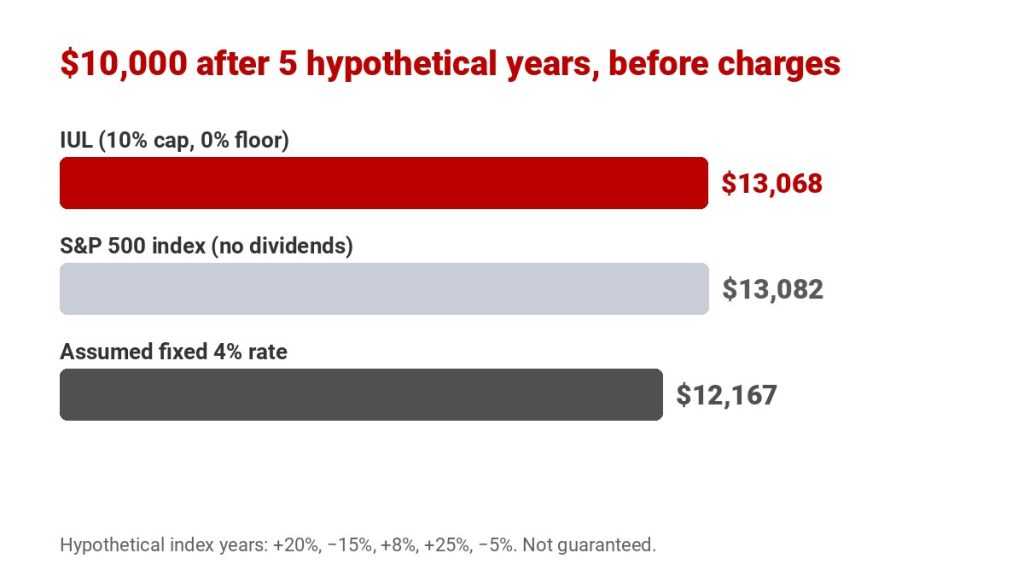
This example is before charges. In real life, both types deduct the cost of insurance and policy fees, and results depend on age, health, insurer and how you fund the policy. A different order of up and down years would also change the result.
Calculator: try a cap, floor and fixed rate
Change the cap, floor or assumed fixed rate to see how the result moves:
Calculator: $10,000 over 5 hypothetical years, IUL vs a fixed rate
IUL vs whole life: what is guaranteed?
This is the biggest difference. Whole life guarantees a lot: the premium will not rise, a minimum cash value, and the death benefit if premiums are paid. IUL usually guarantees only the floor on interest credits and the maximum cost of insurance rates listed in the contract. When you read an IUL illustration, look at the guaranteed column: that is the worst case allowed by the contract.
In practice, many families find the difference easiest to see in a bad year. With whole life, a market drop does not change the guaranteed cash value schedule at all. With IUL, the credit for that year may be zero, and the monthly charges still come out, so the account value goes down a little. Over a long period, IUL can catch up in good years, but only if the policy was funded well enough to absorb the flat years. That is why funding level matters so much more with IUL than with whole life.
Some IUL policies add a no-lapse guarantee if you pay a set premium for a certain number of years. Ask about it when you compare.
What the fixed premium really buys
A fixed premium on whole life is not just convenience. It means the insurer carries the risk that costs rise or interest rates fall. With IUL, more of that risk sits with you, which is why a yearly review with an in-force illustration is a good habit. If the review shows the policy running short, you can raise premiums early, when small changes still make a difference.
Policy loans

Both types let you borrow against cash value. Loans are generally not taxable while the policy stays in force and is not a MEC. But the loan plus interest reduces the death benefit, and if the policy lapses with a loan outstanding, it can trigger a tax bill. With whole life, a loan may affect dividends depending on the insurer. With IUL, there are fixed and indexed loan options, each with its own risks.
Who each type fits
Whole life often fits people who:
- Want a fixed premium and do not want to review the policy every year.
- Need a death benefit they can count on, for example to leave an inheritance, cover final expenses or help heirs pay estate taxes.
- Dislike ups and downs and accept slower growth in exchange for certainty.
IUL often fits people who:
- Have steady income to fund the policy at or above the minimum, as in a max funded IUL.
- Want flexible premiums and index-linked growth potential, and accept that some years credit nothing.
- Are willing to review the policy every year with their agent.

If your budget is tight and your main goal is protecting your family while the kids are young, term life may make more sense than either one. See also what whole life insurance is and Thinksmart IUL.
Whichever way you lean, ask for illustrations of both types at the same death benefit and compare three numbers side by side: the premium, the guaranteed cash value in year 20, and the age at which the guaranteed column shows the policy lapsing (if it does). Those three numbers usually make the trade-off between certainty and flexibility very clear.
Frequently asked questions
IUL vs whole life: which is better?
Neither is better for everyone. Whole life is more certain, with fixed premiums and more guarantees. IUL is more flexible with index-linked growth potential, but has fewer guarantees and needs regular review.
Can an IUL lose money when the market drops?
The interest credit does not go below the floor, often 0%. But cost of insurance and policy charges are still deducted every month, so the account value can still fall in a down year.
Are whole life dividends guaranteed?
No. Dividends are only paid on participating policies from some insurers and depend on the insurer’s results. The guaranteed part is the minimum cash value in the contract.
Why is whole life more expensive than IUL?
Whole life guarantees level premiums, a minimum cash value and a lifetime death benefit, so the insurer must charge enough to back those guarantees. IUL shifts more risk to the policyholder, so the minimum premium is lower.
Can I convert term insurance to IUL or whole life?
Many term policies let you convert to a permanent policy from the same insurer without a new medical exam, within the window stated in the contract. Ask the insurer or your agent which products are available.
Want to compare IUL and whole life for your family?
Thinksmart Insurance compares illustrations from several insurers and explains what is and is not guaranteed, in English or Vietnamese, at no cost. Contact us →








 Thinksmart Insurance