
IUL fees are the charges an insurer deducts from your policy’s account value each month to pay for the protection and for running the policy. Many people pay faithfully and are surprised that the accumulated value barely grows in the first year. The reason is that IUL fees are front-loaded. This guide explains the 6 common IUL fees, why they drop over time, and gives a hypothetical example plus a calculator so you can check the numbers yourself.

What are IUL fees and how are they deducted?
Indexed universal life (IUL) is permanent life insurance with an account value whose interest credits are linked to an index such as the S&P 500. When you pay a premium, not all of it reaches the account. Part of it pays charges and the rest becomes accumulated value. After that, the insurer keeps deducting monthly charges from the account, whether or not you pay that month.
Interest is credited to what is left after the charges. The cap, floor and participation rate decide that interest; see IUL cap rate, floor and participation rate. A common misunderstanding: a 0% floor only protects the interest credit from a negative index. Charges are still deducted, so in a 0% year the account value can go down.
The 6 IUL fees you will usually see
Names vary between insurers, but the “Policy Charges” page of an illustration usually lists the following.
1. Premium expense charge
A percentage taken from each premium payment, for example 8%. Pay $300 and about $24 is deducted before the money reaches the account. On many products this charge applies only while you are paying premiums and for a limited number of years. If you pay for 20 years and then stop, it usually stops too.
2. Cost of insurance (COI)
This is the cost of insurance for the protection itself: the death benefit and any built-in living benefits. COI is not charged on the full face amount but on the “net amount at risk”, roughly the death benefit minus the account value. It rises with age and depends on gender, health class and tobacco use. In later years it is usually the largest charge.
3. Cost of other benefits (riders)
If you add riders, such as a child rider or a waiver of premium rider, each one has its own charge. Some living benefits are included with no upfront charge, but the amount you receive is discounted when you use them. Read more in living benefits explained.
4. Policy fee
A small flat monthly charge, often a few dollars such as $6 to $8 a month, for administering the policy. It usually lasts for the life of the policy.
5. Expense charge
A charge that covers the cost of issuing the policy, often based on the face amount and collected only in roughly the first 10 years. In one sample illustration this charge was about $77.50 a month, roughly $930 a year, for the first 10 years. It is the main reason charges are high in year one.
6. Accumulated value charge
A small percentage of the account value, for example 0.04% a month (about 0.48% a year), often for a set number of years. The bigger the account, the more dollars it takes, but the rate is low.
Add these six together and you get the total IUL fees deducted in a year (Policy Charges).
Surrender charges and loan interest: not part of the monthly fees
These two are often confused with the monthly charges. A surrender charge applies only if you cancel or reduce the face amount in roughly the first 10 years; it shows up as the gap between accumulated value and cash surrender value. Loan interest applies only when you borrow from the policy. Both matter, but neither is deducted every month like the six charges above. See how to read an IUL illustration for the surrender value columns.
Why do IUL fees drop over time?
There are three reasons. First, the expense charge usually ends after about 10 years. Second, the premium expense charge stops when you stop paying. Third, as the account value grows, the net amount at risk shrinks (with a level death benefit), so COI is charged on a smaller amount.
On the other hand, COI rises with age. After many years, total charges can creep back up as the insured gets older. What matters is that by then interest credits are usually much larger than the charges, provided the policy has been properly funded.
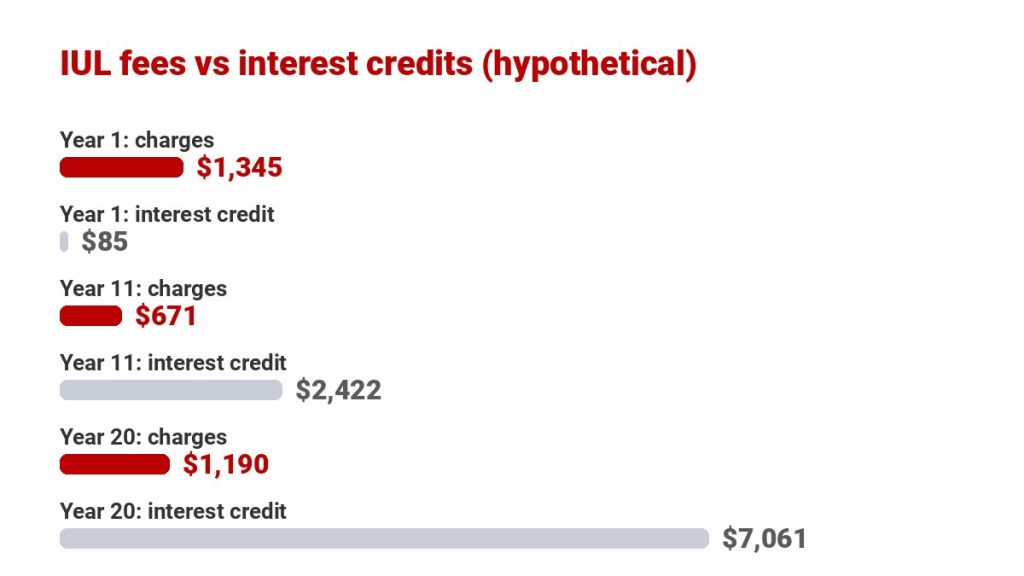
Hypothetical example: IUL fees vs interest credits
Assume Lan is 46, in good health, buys a $200,000 IUL and pays $304.80 a month (about $3,658 a year). In a sample illustration, IUL fees and non-guaranteed interest credits could look like this:
| Policy year | Total IUL fees | Interest credit | What it shows |
|---|---|---|---|
| Year 1 (age 46) | $1,345 | $85 | Charges about 16 times the interest |
| Year 11 (age 56) | $671 | $2,422 | Expense charge has ended; interest exceeds charges |
| Year 20 (age 65) | $1,190 | $7,061 | COI rises with age, but interest is about 6 times the charges |
Step by step:
- Year 1: $1,345 ÷ $3,658 ≈ 37% of the first year’s premium goes to IUL fees. That is why surrendering early usually means a loss.
- Year 11: charges fall to $671, about half of year 1, because the 10-year expense charge has ended.
- Year 20: charges rise to $1,190 because of age-based COI, but interest of $7,061 is far larger.
These are hypothetical numbers to show the trend. Interest credits are not guaranteed, and actual charges depend on the insurer, age, health and face amount.
Can the insurer raise IUL fees?
The insurer can adjust current charges, but it cannot go above the guaranteed maximums in the contract. The contract includes a “Table of Guaranteed Maximum Cost of Insurance Rates” that lists the maximum COI for each age, per $1,000 of net amount at risk per month.
Example: at age 60, assume a maximum rate of $0.41193 per $1,000 per month and a net amount at risk of $200,000.
- $200,000 ÷ $1,000 = 200 units.
- 200 × $0.41193 = $82.39 a month.
- $82.39 × 12 ≈ $988.68 a year. This is the most the insurer could charge for cost of insurance at that age, not what it actually charges.
The guaranteed column of an illustration uses these maximum charges plus the minimum interest rate. That makes it the worst-case stress test for IUL fees.
IUL fees calculator: maximum cost of insurance

Enter the net amount at risk, the maximum COI rate for your age from the contract, your monthly premium and the premium expense percentage:
IUL fees calculator: maximum cost of insurance (COI) and premium expense charge
Maximum cost of insurance (COI):
How to reduce the impact of IUL fees
- Fund the policy fully and consistently: paying less than planned makes the charges a bigger share and raises the risk of a lapse.
- Keep it long term: charges are highest in the first 10 years, so IUL suits plans of 15 to 20 years or more.
- Choose a sensible face amount: more coverage than you need means higher COI and expense charges.
- Add only the riders you need: each rider adds its own cost of insurance.
- Get the best health class you can: a better class means lower COI.
- Review every year: ask for an in-force illustration to see actual charges and credits.
Questions to ask your agent about IUL fees

- Show me the Policy Charges page: what is deducted in year 1, year 10 and at age 65?
- How many years does the expense charge last?
- What is the premium expense charge percentage and for how many years?
- What is the maximum COI at age 70 and 80?
- If the index credits 0% three years in a row, what happens to the account after charges?
IUL fees are not good or bad on their own. They are the price of the protection and of running the policy. What matters is understanding them before you sign. Read more on IUL returns, high or low and compare other types of life insurance.

Learn more on the Thinksmart IUL page.
Frequently asked questions
What fees are in an IUL policy?
Usually six: the premium expense charge, cost of insurance (COI), rider charges, a policy fee, an expense charge and an accumulated value charge. Names and amounts vary by insurer.
Why does my IUL account grow so little in the first year?
Because IUL fees are highest in the early years, especially the expense charge and premium expense charge, while the account is still small so the interest credit is small. After about 10 years charges usually fall and interest can exceed them.
Can the insurance company raise IUL fees?
The insurer can adjust current charges, but the cost of insurance cannot exceed the guaranteed maximum in the contract. The guaranteed column of the illustration shows the result if the insurer charges the maximum.
Does a 0% floor mean my IUL account can never go down?
No. The 0% floor only protects the interest credit from a negative index. IUL fees are still deducted every month, so in a 0% year the account value can drop.
If I stop paying premiums, do IUL fees stop?
No. The premium expense charge stops, but cost of insurance, the policy fee and other charges keep coming out of the account value. If the account cannot cover them, the policy can lapse.
Want to know what your IUL policy is being charged?
Send your illustration or annual statement to the Thinksmart Insurance team and we will explain every charge in plain English or Vietnamese, free and with no pressure to buy. Book a free consultation →









 Thinksmart Insurance