
The 2027 tax brackets were released by the IRS in early November 2026. Every year the IRS adjusts tax rates, the standard deduction and many other numbers for inflation. For 2027, the amount of income that is not taxed goes up, so many families will pay slightly less tax if their income stays the same.
The new numbers apply to money you earn during 2027, which means the tax return you file in early 2028. The return you file during the 2027 tax season (for 2026 income) still uses the 2026 numbers. This guide explains everything in plain language, with step-by-step examples and a calculator so you can estimate your own tax.

How much does the standard deduction go up in 2027?
The standard deduction is the amount subtracted from your income before tax is calculated. Most Vietnamese-American families take the standard deduction because it is simple and usually larger than itemizing.
| Filing status | 2027 standard deduction |
|---|---|
| Single or married filing separately | $16,600 |
| Head of household | $24,925 |
| Married filing jointly | $33,200 |
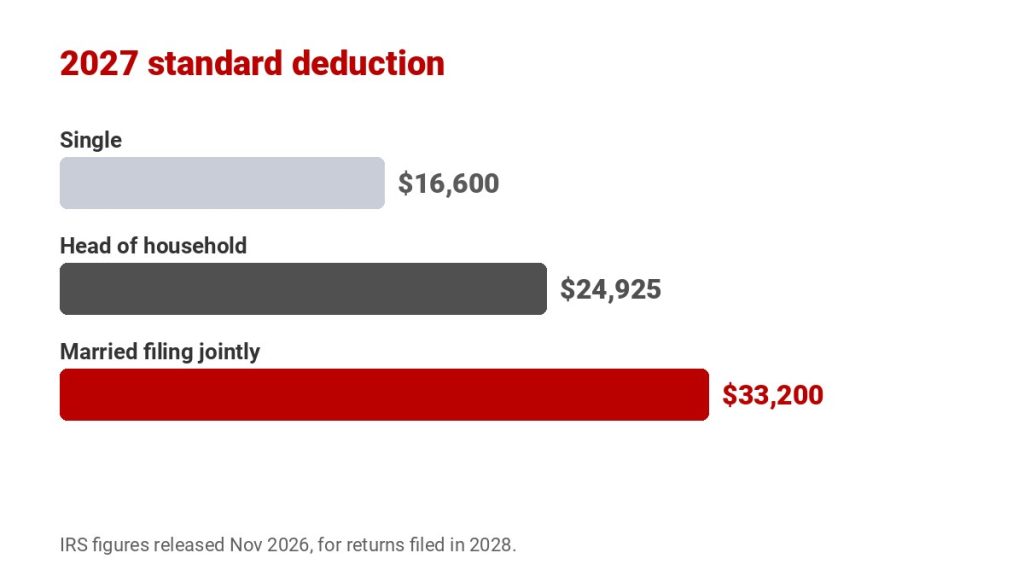
Example: a married couple filing jointly with $90,000 of total income has taxable income of $90,000 − $33,200 = $56,800. The first $33,200 is not subject to federal income tax.
The 2027 tax brackets table: seven rates
The 2027 tax brackets still have seven rates. Each rate only applies to the part of your taxable income that falls inside that range, not to your whole income.
| Rate | Single: taxable income | Married filing jointly |
|---|---|---|
| 10% | Up to $12,800 | Up to $25,600 |
| 12% | Over $12,800 | Over $25,600 |
| 22% | Over $52,025 | Over $104,050 |
| 24% | Over $109,125 | Over $218,250 |
| 32% | Over $208,325 | Over $416,650 |
| 35% | Over $264,550 | Over $529,100 |
| 37% | Over $661,375 | Over $793,650 |
Head of household filers have their own thresholds, between the single and joint columns. If you file as head of household, ask your tax preparer to confirm the exact numbers.
A common myth: “moving up a bracket costs me money”
Many people worry about a raise or overtime because they think “if I move into the 22% bracket, all my income is taxed at 22%.” That is not how it works. US income tax is calculated in layers:
- The first part of your taxable income is taxed at 10%.
- The next part at 12%, then 22%, and so on.
- Only the dollars above each threshold are taxed at the higher rate.
Example: a single filer with $53,025 of taxable income is $1,000 over the $52,025 threshold. Only that $1,000 is taxed at 22%, which is $220. Everything below is still taxed at 10% and 12%. So earning more always leaves you with more money after tax.
Hypothetical example: using the 2027 tax brackets step by step
Tuan and his wife (hypothetical) file jointly and have two children under 17. Their total 2027 income is $90,000 in W-2 wages, with no other deductions.
- Taxable income: $90,000 − $33,200 standard deduction = $56,800.
- 10% bracket: first $25,600 × 10% = $2,560.
- 12% bracket: the rest, $56,800 − $25,600 = $31,200 × 12% = $3,744.
- Tax before credits: $2,560 + $3,744 = $6,304.
- Child tax credit: 2 children × $2,300 = $4,600.
- Federal income tax owed: $6,304 − $4,600 = $1,704, about 1.9% of total income.
A second example: Lan (hypothetical) is single and earns $60,000. Her taxable income is $60,000 − $16,600 = $43,400. Her tax is $12,800 × 10% = $1,280 plus ($43,400 − $12,800) × 12% = $3,672, a total of $4,952, about 8.3% of her income. Her top bracket is 12%, but her actual tax rate is just over 8%.
Calculator: estimate your 2027 federal income tax
Child tax credit and EITC for 2027

A credit is different from a deduction. A deduction lowers your taxable income, while a credit is subtracted directly from the tax you owe, so it is worth more.
- Child Tax Credit: up to $2,300 per qualifying child, up $100 from the prior year. If your tax is smaller than the credit, up to $1,800 per child may be refunded if you meet the earned income rules.
- Earned Income Tax Credit (EITC): families with three or more children can receive up to $8,496. The amount depends on income and number of children, with its own income limits.
Children need a valid Social Security number for the child tax credit. Many families miss these credits simply because they do not know about them, so ask your preparer when you file. See our guide to US tax filing for Vietnamese Americans.
The $20,000 gift exclusion and estate tax: what it means for life insurance
In 2027, each person can give up to $20,000 to each recipient without filing a gift tax return (Form 709). A married couple can give each child $40,000 together. Gifts to a spouse who is not a US citizen have a separate limit of $201,000 per year.
Here is how this connects to life insurance:
- If you pay premiums on a policy owned by someone else, for example an adult child who owns a policy on a parent, those premiums may count as a gift. Under $20,000 per person per year usually does not need to be reported.
- The federal estate tax only applies to the part of an estate above $15,480,000 for people who die in 2027. Most families will never pay it. However, life insurance can be counted in your estate if the insured person also owns the policy. See our guide to US estate tax.
- A life insurance death benefit paid to a beneficiary is generally not subject to federal income tax.
Legal ways to lower your taxable income in 2027

Understanding the 2027 tax brackets helps you see what each pre-tax dollar is worth. Some common options:
- Contribute to a traditional 401k: the 2027 limit is $25,500. In the 12% bracket, every $1,000 you contribute cuts federal tax by $120. See the 401k contribution limit 2027.
- Health flexible spending account (FSA): in 2027 you can set aside up to $3,500 of pre-tax pay for medical costs.
- Self-employed and 1099 workers: keep full records of business expenses, and consider a SEP IRA or Solo 401k.
- Do not miss credits: the child tax credit, EITC and education credits can cut your tax more than deductions.
For long-term savings after you have used your 401k, some families choose indexed universal life because the cash value grows tax-deferred and can be accessed through policy loans. That approach has its own risks, so read about the IUL policy loan before deciding.
What to keep in mind when you read about the 2027 tax brackets
- These are federal numbers. State income tax (California, Georgia, Virginia and others) has its own rules; Texas and Washington have no state personal income tax.
- Taxable income is not total income. Always subtract the standard deduction and pre-tax contributions before you look at the table.
- Self-employment tax is separate. 1099 workers also pay Social Security and Medicare tax on self-employment income, which is not part of the bracket table.
- Update your W-4 withholding if 2027 brings a big change: marriage, a new baby or a new job.
Frequently asked questions
Which tax return do the 2027 tax brackets apply to?
They apply to income earned from January 1 to December 31, 2027, which is reported on the return you file in early 2028. Returns filed in 2027 still use the 2026 numbers.
What is the 2027 standard deduction?
$16,600 for single filers and married filing separately, $24,925 for head of household and $33,200 for married filing jointly.
Can moving into a higher bracket make me lose money?
No. The higher rate only applies to the dollars above the threshold. Earning more always leaves you with more money after tax.
What is the 2027 child tax credit?
Up to $2,300 per qualifying child, with up to $1,800 refundable if your tax is lower than the credit. The child needs a valid Social Security number.
Is life insurance taxable income?
Usually not. A death benefit paid to a beneficiary is generally not subject to federal income tax, although it can be counted in a very large estate for estate tax purposes.
Want to know how insurance and retirement planning can lower your family’s taxes?
Thinksmart Insurance explains everything clearly, in English or Vietnamese, compares several insurers and helps you choose an option that fits your budget, at no cost. Contact us →









 Thinksmart Insurance