
Max funded IUL for business owners is a question Thinksmart hears all the time from nail salon owners, restaurant owners, rideshare drivers and 1099 contractors. They have no employer 401k, no match, and income that changes month to month.
A max funded IUL can be a useful piece of the plan, but it is not the first piece and it is not right for everyone. This guide shows the order to save in, how it compares with a Solo 401k and SEP IRA, and how to pick a premium you can keep paying in a slow month.

Why do salon owners and 1099 workers ask about max funded IUL?
- No employer 401k: they must open their own Solo 401k, SEP IRA or IRA.
- High but uneven income: good years leave money they want to save beyond 401k limits.
- Too much income for a Roth IRA: in 2027 Roth IRA contributions phase out above set income levels. IUL has no income limit.
- Need for protection: if the owner dies, the family loses its income and may still owe rent and equipment loans.
A max funded IUL puts in as much as the contract allows without becoming a MEC, with the lowest death benefit possible, so more money goes to account value. See how it works in how does max funded IUL work.
Max funded IUL for business owners vs a Solo 401k or SEP IRA
| Point | Solo 401k / SEP IRA | Max funded IUL |
|---|---|---|
| Tax when you contribute | Usually deductible this year (traditional version) | Paid with after-tax money, not deductible |
| 2027 contribution limit | Solo 401k: $25,500 employee deferral, up to $75,000 total (before catch-up) | No single dollar limit; capped by Section 7702 and MEC rules relative to the death benefit |
| Money before 59½ | Usually taxed plus a 10% penalty, with exceptions | Policy loans are generally not taxed if the policy is not a MEC and stays in force |
| Death benefit for family | None | Yes |
| Market risk | Depends on funds chosen, can lose value | Floor (often 0%) but charges still apply, and credits are capped |
The two are not either-or. For most small business owners, a 401k or SEP lowers tax right away, while a max funded IUL handles protection and extra savings. A detailed comparison is in max funded IUL vs 401k.
Example: a nail salon owner earning $90,000 a year
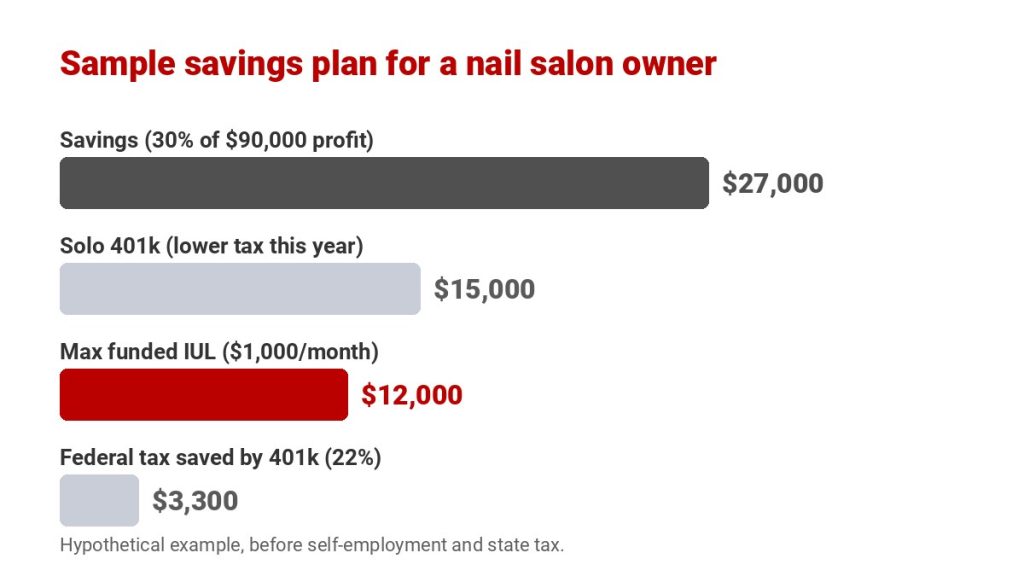
Hypothetical: Hanh is 40, owns a nail salon, nets $90,000 a year and wants to save 30%. Even in her slowest month she can reliably set aside $1,000.
- Total savings: $90,000 × 30% = $27,000 a year.
- Emergency fund first: if she does not have 3 to 6 months of expenses saved, that comes first.
- Solo 401k: she contributes $15,000. In the 22% federal bracket, that cuts about $15,000 × 22% = $3,300 of federal tax (simplified estimate).
- What is left: $27,000 − $15,000 = $12,000 a year, or $1,000 a month for a max funded IUL, exactly what she can pay even in a slow month.
If what is left is more than she can reliably pay in a slow month, she should choose the lower amount and add more in good years if the policy has room. Paying extra is easy; underfunding for several years can weaken the policy.
Calculator: how much should a business owner put into a max funded IUL each month?
Irregular income: the biggest risk with a max funded IUL

A max funded IUL needs time: charges are highest in the first 10 years and early surrender usually triggers surrender charges. With uneven income, the main risk is not the market but quitting halfway. To lower that risk:
- Set the premium by your slow months, not your busiest ones.
- Ask for the minimum and target premiums in the illustration, and how long the policy lasts if you pause payments.
- Keep a separate emergency fund so you do not have to borrow from the IUL in the early years.
- Review every year: in a strong year you can add more, but never above the MEC limit. See guaranteed vs non-guaranteed values.
The protection side: what the death benefit does for the business and family
People often focus on the savings and forget that a max funded IUL is still life insurance. For a business owner, that protection is very practical. If the owner dies suddenly, the family may face several bills at once: the rest of the lease, loans on chairs and equipment, the last payroll, the cost of selling or closing the business, plus normal household spending.
The death benefit paid to beneficiaries is generally free of federal income tax, which gives the family time to decide whether to keep or sell the business instead of rushing. Because a max funded design keeps the death benefit as low as the rules allow, check whether that amount actually covers these needs. If it does not, a low-cost term policy for the years you carry business debt can fill the gap. Review the beneficiary designation too, so the money goes where you intend.
Taxes: what business owners often get wrong

- IUL premiums are generally not deductible, even if paid from the business account, when the policy protects you and your family. Ask your CPA before booking it.
- Policy loans are generally not taxable income if the policy is not a MEC and stays in force. If the policy lapses with a loan outstanding, the gain can become taxable. See IUL policy loans.
- If it becomes a MEC (funded too fast under the 7-pay test), loans and withdrawals are taxed gains-first and may face a 10% penalty before 59½.
- 1099 workers should report all income: underreporting means fewer Social Security credits and makes it harder to qualify for higher coverage. See nail tech 1099 vs W2.
Who should skip a max funded IUL for now?
- A business open less than 2 years with unsteady cash flow.
- No emergency fund yet, or high-interest credit card debt.
- You may need most of the money back within a few years (buying a home, opening another location).
- You have not used a Solo 401k or SEP IRA and need to cut taxes.
The full list of pros and cons is in max funded IUL pros and cons and our earlier guide is max funded IUL good. For costs, see how much a max funded IUL costs.
Bottom line on max funded IUL for business owners
A max funded IUL for business owners and 1099 workers fits best once you have an emergency fund, are using a Solo 401k or SEP to cut taxes, and still have steady money left over. Set the premium by your slow months, stay under the MEC limit, and review the policy every year. Done that way, it protects your family and becomes a flexible source of money in retirement.
Frequently asked questions
Should a salon owner buy a max funded IUL?
Possibly, once there is an emergency fund, a Solo 401k or SEP IRA is in use, and there is steady extra money for at least 7 to 10 years. New businesses with uneven cash flow should wait.
Are max funded IUL premiums tax deductible for my business?
Generally no, when the policy protects you and your family. Premiums are paid with after-tax money. Ask your CPA before recording it as a business expense.
How much can I put in a Solo 401k in 2027?
Up to $25,500 as the employee, plus an employer contribution based on profit, with a combined limit of $75,000 before catch-up contributions.
How should I fund an IUL with irregular income?
Pick a premium you can pay even in a slow month, then add more in good years if the policy still has room under the MEC limit.
Can 1099 workers buy a max funded IUL?
Yes. Insurers look at reported income to decide how much coverage you qualify for, so reporting all income matters.
Want to know the right max funded IUL premium for your business?
Thinksmart Insurance helps small business owners and 1099 workers size premiums to their real income, compares several carriers in English or Vietnamese and charges nothing for advice. Contact us →









 Thinksmart Insurance