
Social Security for immigrants is a common question for families who sponsor parents to the U.S.: “My parents arrived at 60 and never worked here. Can they get any benefits?”
The short answer: there are two different programs. Social Security retirement pays based on the years you worked and paid tax in the U.S., and needs 40 credits. SSI is aid for low-income older adults, but noncitizens face extra conditions. This guide uses official 2027 figures to walk through each case.

How is Social Security for immigrants different from SSI?
| Point | Social Security retirement | SSI |
|---|---|---|
| Based on | Work history and Social Security taxes paid | Low income and resources |
| Main requirement | 40 credits, from age 62 | Age 65 or older, or blind or disabled |
| Asset limit | None | $2,000 (individual), $3,000 (couple) |
| Citizenship | Not required, but you must be lawfully present | Noncitizens must be in an eligible category and meet extra conditions |
Both programs are run by the Social Security Administration (SSA), which is why many people mix them up. But they work very differently.
In practice, the first question to ask is simple: has the person worked in the U.S. long enough, with taxes withheld, to earn their own benefit? If yes, the retirement program is the main path. If no, look at a spouse’s work record next, and only then at SSI, which has the strictest rules for people who are not yet citizens. Answering in this order saves a lot of confusion and wasted trips to the local office.
The 40-credit rule for Social Security retirement
You do not need to be a citizen. Green card holders and people with work authorization who work legally and pay Social Security tax (on a W-2 paycheck or as self-employment tax on 1099 income) earn credits just like people born in the U.S.
- One credit in 2027: $1,970 of earnings (it was $1,890 in 2026).
- Maximum per year: 4 credits. Earning $1,970 × 4 = $7,880 in 2027 gives you all 4.
- Total needed: 40 credits, or at least about 10 years of work.
Hypothetical example: Lan moved to the U.S. at 58 and works as a nail technician, reporting more than $7,880 a year of earnings subject to Social Security tax. She earns 4 credits a year and needs 10 years, so she reaches 40 credits at about 68. Her benefit will be modest because it is based on only 10 years of earnings, but it is paid for life and rises with the yearly COLA.
Note: years worked in Vietnam do not count, because the U.S. and Vietnam have no Social Security (totalization) agreement. Cash work that is not reported for tax does not earn credits either.
Calculator: how long until you have 40 Social Security credits?
Fewer than 40 credits: spousal benefits
A spouse without 40 credits may still get a spousal benefit of up to 50% of the other spouse’s full benefit if claimed at full retirement age, once that spouse has filed. Claiming early from 62 means a reduced amount. If the working spouse dies, the survivor may get a widow’s or widower’s benefit, which is higher than the 50% spousal amount.
This matters a lot for couples where only one person worked steadily in the U.S. For example, if a husband with 40 credits has a full benefit of $1,400 a month, his wife could receive up to $700 a month at her full retirement age, even with no credits of her own. Ask SSA for both estimates before either spouse files, because the timing of each claim changes the amounts.
Can older immigrants get SSI?
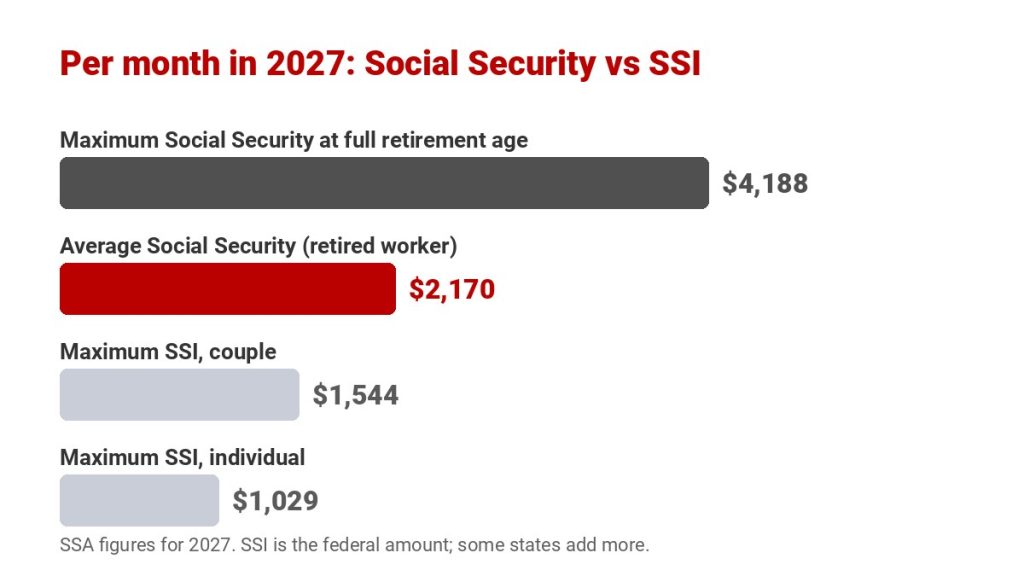
SSI is for people 65 or older, or blind or disabled, with low income and resources. In 2027 the maximum federal amount is $1,029 a month for one person and $1,544 a month for a couple. Some states add a supplement, and other income reduces the payment.
A noncitizen must meet both: be in a “qualified” category (green card, refugee, asylee, paroled for at least one year, and others) and meet a condition that allows SSI. The conditions most relevant to Vietnamese families:
| Situation | May get SSI when |
|---|---|
| Green card holder (permanent resident) | Has 40 qualifying quarters of work. If you entered on or after August 22, 1996, you usually must also wait 5 years as a permanent resident, even with 40 quarters |
| Refugee, asylee, Amerasian | Up to 7 years from the date that status was granted |
| U.S. military member or veteran | Active duty or honorably discharged; also covers spouses and dependent children |
| Lawfully living in the U.S. on August 22, 1996 | Receiving SSI since then, or blind or disabled |
Important: for SSI, a spouse’s or parent’s quarters of work can count toward the 40. That rule applies only to SSI, not to Social Security retirement.
Sponsor deeming
When an adult child sponsors parents, the child signs an affidavit of support. SSA generally counts the sponsor’s (and the sponsor’s spouse’s) income and resources as the parent’s. A sponsor with an average income is often enough to put the parent over the SSI limits. The affidavit usually lasts until the parent becomes a citizen or reaches 40 quarters of work.
Does becoming a citizen help?
Yes. As a U.S. citizen you are no longer subject to the SSI limits for noncitizens, and the sponsor’s affidavit generally ends. You still have to meet the age, income and resource rules like everyone else. For Social Security retirement, citizenship does not change the credits needed: it is still 40.
Medicare without 40 credits
Medicare Part A (hospital) is premium-free when you or your spouse has 40 credits. Without them, a permanent resident who has lived in the U.S. continuously for 5 years can buy Part A from age 65: in 2027 it costs $597 a month (under 30 credits) or $328 a month (30 to 39 credits). See Medicare open enrollment 2027.
Planning for parents who arrive later in life

For many families, the reality is that parents will have little or no Social Security, and SSI is hard to get. The best plan is usually a team effort between parents and adult children, started as early as possible. A few practical steps:
- Work on the books if health allows: each year adds 4 credits toward Social Security and premium-free Part A.
- Open a my Social Security account to see your credits and benefit estimate.
- Check spousal benefits if one spouse has 40 credits.
- Consider naturalization once eligible.
- Plan as a family: many families know early that parents will have little or no benefit and save and insure ahead of time. See Social Security COLA 2027 and the public charge rule.
Bottom line on Social Security for immigrants
Retirement benefits depend not on citizenship but on 40 credits of taxed work in the U.S.; in 2027 each credit is $1,970. A spouse without enough credits may claim on the other spouse’s record. SSI pays up to $1,029 a month, but green card holders usually need 40 quarters and a 5-year wait, and a sponsor’s income counts. Planning early takes pressure off the whole family.
Frequently asked questions
Can green card holders get Social Security?
Yes, with 40 credits from legal work where Social Security tax was paid in the U.S. In 2027 each $1,970 of earnings is 1 credit, up to 4 credits a year.
Can parents who arrive at 60 get any benefits?
Social Security retirement needs 40 credits, so about 10 years of work. A spouse may claim on the other spouse’s record. SSI is often blocked by the 5-year rule, the 40-quarter condition and sponsor deeming.
How much is SSI in 2027?
The maximum federal amount is $1,029 a month for one person and $1,544 for a couple. Some states add more; other income lowers it. Resource limits are $2,000 and $3,000.
Do years worked in Vietnam count?
No. The U.S. and Vietnam have no Social Security agreement, so only U.S. work with Social Security tax paid earns credits.
Can a child’s work count toward a parent’s 40 quarters?
No. For SSI, only the work of the applicant’s spouse or parents can be added. For Social Security retirement, each person needs their own 40 credits, except for spousal benefits.
Worried about your parents’ finances in the U.S.?
Thinksmart Insurance helps families plan retirement and protection for aging parents, explains everything in English or Vietnamese, compares several carriers and charges nothing for advice. Contact us →









 Thinksmart Insurance