
An IUL cost of insurance increase is one of the most common worries for policyholders. The cost of insurance (COI) is the monthly charge for the death benefit protection, and many people ask: “Can the insurer raise it whenever it wants? What if it doubles?”
The short answer: the insurer can adjust the current rate, but it cannot go above the guaranteed maximum table printed in your contract. This guide shows you where to find that table, how to calculate COI with one simple multiplication, and what to do so the policy does not run out of money as you age.

What is the cost of insurance in an IUL?
Not all of your premium goes to savings. Each month the insurer deducts charges, and over the long run the biggest one is the cost of insurance, the “price” of the protection. Other charges (premium charge, policy fee, riders) are covered in IUL fees explained.
Three things to remember about COI:
- It rises with age: the older you are, the higher the rate per $1,000.
- It depends on rate class and gender: a better class means a lower rate. Your class is set at issue; if your health gets worse later, the insurer does not move you to a worse class individually.
- It is charged on the net amount at risk: not on the full death benefit, only on the part the insurer adds on top of your account value.
Who decides an IUL cost of insurance increase?
The insurer does. Illustrations state that current charges are not guaranteed, are set by the company, and may change based on expectations of future experience, including investment earnings, mortality, persistency, taxes and expenses. Any change must stay within the minimums and maximums stated in the policy.
So there are two rates for COI:
| Rate | What it means | Can it change? |
|---|---|---|
| Current rate | What the insurer actually deducts each month; used in the “current” column of the illustration | Yes, up or down |
| Guaranteed maximum rate | The ceiling written in the contract; used in the “guaranteed” column | No, fixed for the life of the policy |
Important: an insurer applies any change to a whole class of similar policies (same product, age and rate class), not to you alone because you got sick. In the U.S., some insurers have raised COI on blocks of older universal life policies after long periods of low interest rates. That is why understanding the maximum table matters in practice.
Read the guaranteed maximum table in 3 steps

Step 1: find the right page in the contract
Open the policy contract, not the brochure. Look for a page titled something like “Table of Guaranteed Maximum Cost of Insurance Rates”, usually in the Policy Data section or near the end. It lists the maximum rate by attained age (or policy year), per $1,000 per month.
Step 2: find the rate for your age
Go to your attained age or policy year. In one sample table, age 60 has a maximum rate of 0.41193 per $1,000 per month.
Step 3: do the math
- Divide the amount at risk by 1,000: $200,000 ÷ 1,000 = 200.
- Multiply by the rate: 200 × 0.41193 = $82.39 per month.
- Multiply by 12: $82.39 × 12 ≈ $989 per year.
That is the most the insurer may deduct at age 60 for $200,000 at risk. The current rate you pay is usually lower, and you can compare the two in your illustration.
Repeat the same three steps for ages 65, 70 and 75 and you will see how quickly the maximum rises. That simple exercise shows why an IUL cost of insurance increase at older ages matters more than one at age 45: the rate per $1,000 grows every year, so the dollars at risk become the main lever you control. If your contract uses policy years instead of ages, add the years to your issue age first. If any page is hard to read, ask your agent or the insurer’s service line to confirm the exact rate for your age and rate class in writing.
Calculator: what is your monthly cost of insurance?
Why a bigger account value lowers your COI
With a level death benefit (Option A), your family receives $200,000. Part of that is your own account value, and the insurer adds the rest. That added part is the net amount at risk, and COI is charged only on it.
Using the same maximum rate of 0.41193 at age 60:
- Account value $0: at risk $200,000 → 200 × 0.41193 = $82.39/month.
- Account value $50,000 (hypothetical): at risk $150,000 → 150 × 0.41193 = $61.79/month.
- Account value $100,000 (hypothetical): at risk $100,000 → 100 × 0.41193 = $41.19/month.
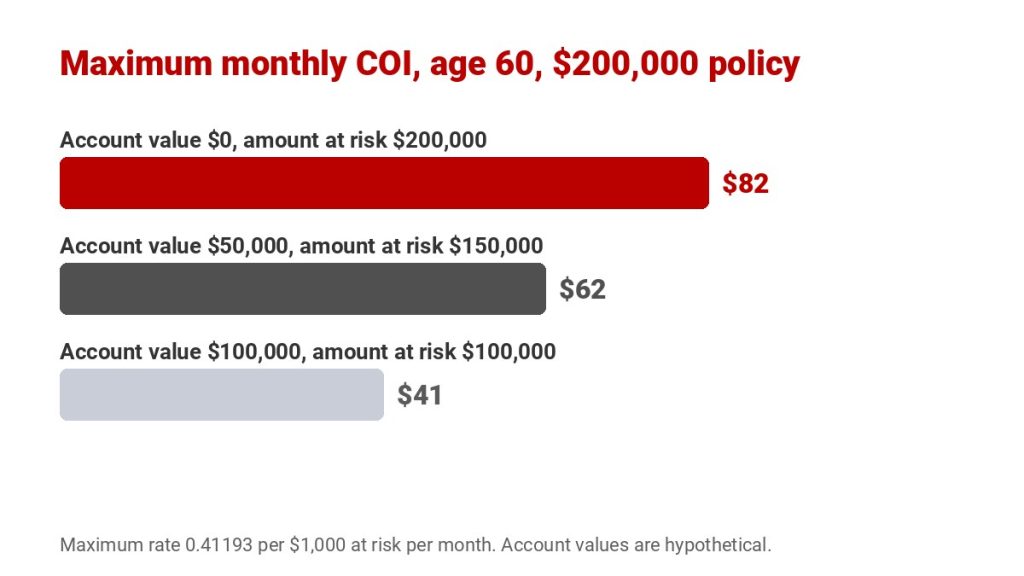
This is why funding the policy well in the early years matters: a larger account means less at risk and lighter COI later in life. With Option B (increasing death benefit), the amount at risk stays roughly the same, so COI is higher.
How does an IUL cost of insurance increase affect your policy?

COI rising with age is normal and already built into your illustration. The real concern is when charges exceed what goes into the account for years in a row: the account value shrinks, and if it reaches zero the policy can lapse.
The guaranteed column is the “worst case” test, using maximum charges and the minimum interest rate. In one sample illustration for a 45-year-old man, the policy lapses in year 31 on the guaranteed column, in year 38 at a lower alternative rate, and stays in force for life at the current rate. See guaranteed vs non-guaranteed values.
How to avoid surprises from an IUL cost of insurance increase
- Save a copy of the maximum table page with your contract.
- Pay the planned premium, especially in the first 10 years, so the account value grows.
- Read your annual statement: check whether the Cost of Insurance line jumped unusually from last year.
- Request an in-force illustration every few years to see how long the policy lasts at current charges.
- Adjust when needed: pay more, switch from Option B to Option A, or reduce the death benefit. Some insurers allow a rate class review if you quit smoking or your health improves, depending on the contract.
- Borrow with a plan: large loans reduce the real account value. See IUL policy loans.
Common misunderstandings
- “My monthly premium is fixed, so COI is fixed”: not true. You can pay the same amount while COI inside the policy rises with age.
- “The insurer can raise COI without limit”: not true. The guaranteed maximum table is the ceiling.
- “If I get sick, they raise COI just for me”: not true. Rate class is set at issue; changes apply by class.
- “I only need the assumed-rate column”: not enough. Check the guaranteed column for the worst case.
Bottom line on an IUL cost of insurance increase
COI is the cost of protection; it rises with age and is charged on the net amount at risk. An IUL cost of insurance increase is allowed for a whole class of policies, but never above the guaranteed maximum table in your contract. You can check it yourself with amount at risk ÷ 1,000 × rate. Keeping the account value healthy and reviewing the policy regularly is the best protection against surprises.
Frequently asked questions
Can an insurer raise the cost of insurance on my IUL?
Yes. It can adjust the current rate for a whole class of policies, but never above the Table of Guaranteed Maximum Cost of Insurance Rates in your contract.
How is IUL cost of insurance calculated?
Divide the net amount at risk by 1,000 and multiply by the monthly rate. For $200,000 at age 60 with a maximum rate of 0.41193: 200 × 0.41193 = $82.39 a month, about $989 a year.
Where is the guaranteed maximum COI table?
In the policy contract, usually in the Policy Data section or near the end, titled something like “Table of Guaranteed Maximum Cost of Insurance Rates”.
Does my COI go up if my health gets worse?
Not individually. Your rate class is set at issue. COI rises with age, and any change to current rates applies to a whole class of policies.
How can I lower my cost of insurance?
Keep the account value strong by funding the policy, use Option A instead of Option B, reduce the death benefit if you need less coverage, and ask about a rate class review if your health has improved.
Want to know the maximum COI in your own contract?
Thinksmart Insurance helps you find the guaranteed maximum table and read your annual statement and in-force illustration in English or Vietnamese, compares several carriers and charges nothing for advice. Contact us →









 Thinksmart Insurance