
Many IUL buyers think more is always better: money inside the policy grows tax-deferred, and loans later are not taxed. That is only true while the policy stays inside the tax law limits. Go past them and the policy becomes a modified endowment contract, or MEC. This guide explains what that means, how the limit is set, and how to fund a policy heavily without crossing the line, with step-by-step examples and a calculator.

What is a modified endowment contract?
A modified endowment contract is not a product you choose to buy. It is a tax label a policy gets when premiums go in too fast compared with the death benefit. The rule dates back to 1988, when Congress wanted to stop people from using life insurance mainly as a tax-sheltered investment account.
A policy with the MEC label is still life insurance. Your family still receives the death benefit, and the cash value still grows tax-deferred. What changes is how money you take out while you are alive is taxed. And once a policy becomes a MEC, it generally stays one for good.
What IRC 7702 says about life insurance limits
IRC 7702 is the section of the federal tax code that defines what counts as life insurance. A policy has to pass one of two tests:
- Guideline Premium Test (GPT): limits the total premium, and the death benefit must stay a certain multiple above the cash value (for example about 2.5 times at age 40 or younger).
- Cash Value Accumulation Test (CVAT): the cash value cannot exceed what it would cost to buy that death benefit outright.
A policy that fails IRC 7702 is no longer taxed as life insurance. Carriers normally block payments that would cause this.
The modified endowment contract rule sits in section 7702A and uses its own test, the 7-pay test. A policy can pass IRC 7702 and still be a MEC if it fails the 7-pay test.
The 7-pay test for a modified endowment contract
The 7-pay test asks a simple question: if this policy were fully paid up with 7 equal yearly payments, how big would each payment be? That number is the yearly 7-pay limit. During the first 7 years, the total you have paid at any point cannot be more than the 7-pay limit times the number of years so far.
On an illustration, this number is often labeled Max Non-MEC premium or 7-pay premium. It depends on age, gender, health and the death benefit. A higher death benefit means a higher limit.

3 examples: when does a policy become a MEC?
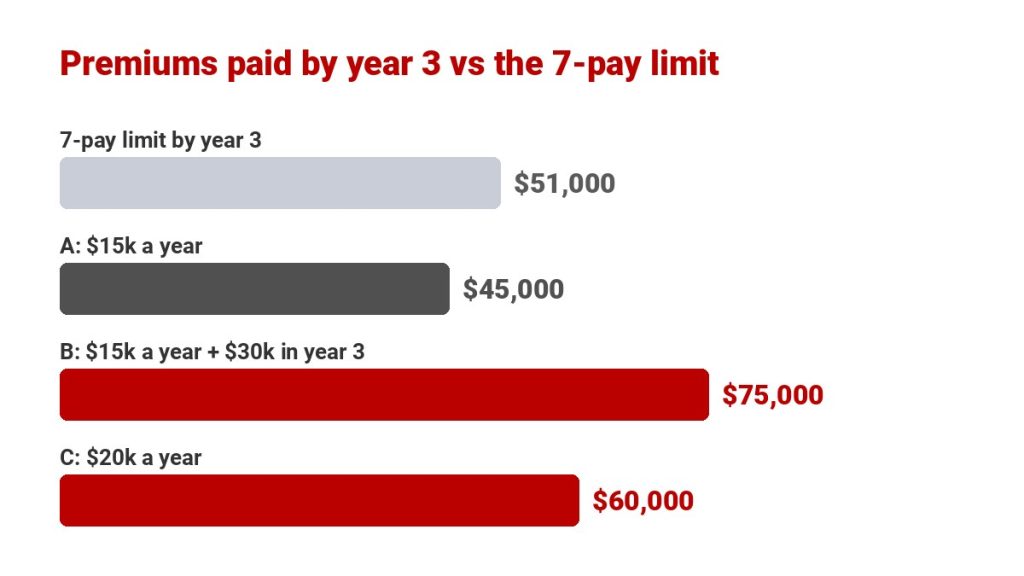
Hypothetical: Tuan is 45 and buys an IUL. His illustration shows a 7-pay limit of $17,000 a year. The running limit is $17,000 in year 1, $34,000 in year 2, $51,000 in year 3 and $119,000 by year 7.
Plan A: pay $15,000 a year for 7 years
- Year 3: paid $15,000 × 3 = $45,000, below $51,000.
- Year 7: paid $15,000 × 7 = $105,000, below $119,000.
- Result: not a MEC.
Plan B: pay $15,000 a year and add a $30,000 bonus in year 3
- Year 3: paid $15,000 × 3 + $30,000 = $75,000.
- Against the $51,000 limit: over by $24,000.
- Result: a MEC in year 3. To stay safe, Tuan could add only about $6,000 in year 3.
Plan C: pay $20,000 a year
- Year 1: paid $20,000, which is $3,000 over the $17,000 limit.
- Result: a MEC from year 1, unless the excess is refunded in time (see below).
| Plan | Paid by year 3 (limit $51,000) | Result |
|---|---|---|
| A: $15,000/year | $45,000 | Not a MEC |
| B: $15,000/year + $30,000 in year 3 | $75,000 | MEC in year 3 |
| C: $20,000/year | $60,000 | MEC from year 1 |
Calculator: would your IUL premium plan turn into a modified endowment contract?
How a modified endowment contract is taxed
With a regular policy (not a MEC), withdrawals come out of your cost basis first, meaning the premiums you paid, and that part is not taxed. Loans from a policy in force are not taxed either. See IUL policy loans.
A modified endowment contract flips that order: gain comes out first. Withdrawals, loans and even pledging the policy as collateral are all treated as taking the gain first, and that gain is taxed as ordinary income. Before age 59½, the taxable part also gets a 10% additional tax, with a few exceptions such as disability.
Hypothetical tax example: the policy has $150,000 of cash value, and $105,000 in total premiums was paid, so the gain is $45,000. Tuan is 50, needs $30,000 and is in the 22% bracket.
- Gain first: the whole $30,000 is gain, since the $45,000 gain is larger.
- Income tax: $30,000 × 22% = $6,600.
- 10% penalty for being under 59½: $30,000 × 10% = $3,000.
- Total cost: $9,600, leaving about $20,400 in hand.
If the policy were not a MEC, the same $30,000 taken as a basis withdrawal or a loan would usually cost nothing in tax. That is why a modified endowment contract matters so much for people who buy IUL for retirement income.

Changes that can restart the 7-pay test
- A material change: such as raising the death benefit or adding benefits. The 7-pay test starts a new 7-year period.
- Lowering the death benefit in the first 7 years: the 7-pay limit is recalculated at the lower amount, going back to the start. A policy that was safe can become a MEC because the new limit is below what you already paid.
- Switching from Option B to Option A or cutting other benefits: can also lower the limit. See Option A vs Option B.
So before changing anything in the first 7 years, ask the carrier whether it affects the 7-pay test.
4 ways to fund an IUL heavily without a modified endowment contract
- Pay at the Max Non-MEC level on your illustration: this is how a max funded IUL is designed, close to the limit but never over it.
- Ask before any large extra payment: the carrier can tell you how much room is left that year, like the $6,000 in Plan B.
- Match the death benefit to what you want to pay in: to pay more, you need a higher death benefit to raise the 7-pay limit.
- If you overpay, ask for a refund right away: the law lets the excess be returned with interest within 60 days after the end of the contract year so the policy does not become a MEC. Many carriers check and refund on their own, but do not count on it.
When a modified endowment contract can make sense
Sometimes it does. If you never plan to take money out while you are alive and only want to leave an income-tax-free death benefit to your children or grandchildren, a single-premium policy that is a MEC can fit. Growth is still tax-deferred and beneficiaries still receive the death benefit as usual. But if you are buying IUL for retirement income, the answer is clear: avoid it. See max funded IUL for retirement and Roth IRA vs IUL.
More on max funded IUL
- Is max funded IUL good?
- Max funded IUL pros and cons
- IUL policy lapse risk from over-borrowing
- How to read an IUL illustration
Bottom line
A modified endowment contract is the price of funding life insurance too fast. The policy still protects your family, but it loses its biggest advantage when you take money out while living. Funding an IUL heavily is fine, as long as you know your 7-pay limit and check before every extra payment.
Frequently asked questions
What is a modified endowment contract?
A life insurance policy that was funded faster than the 7-pay limit in its first 7 years. Withdrawals and loans are then taxed gain-first.
Is a MEC still life insurance?
Yes. The death benefit is still generally income-tax-free and the cash value still grows tax-deferred. Only the tax on money taken out while living changes.
Can a MEC be undone?
Generally no. The main fix is having the excess premium refunded with interest within 60 days after the end of the contract year.
Where do I find my 7-pay limit?
On your illustration, usually labeled Max Non-MEC premium or 7-pay premium. It depends on age, health and the death benefit.
After 7 years, can I pay in as much as I want?
Not exactly. The policy still has to pass IRC 7702, and a material change such as raising the death benefit restarts the 7-pay test.
Want to know how much more you can put in?
Thinksmart Insurance can review your illustration and 7-pay limit and work out a safe funding level, in English or Vietnamese, with no fee. Contact us →









 Thinksmart Insurance