
When people read a max funded IUL illustration, they often see a line like “Death Benefit Option: Increasing” or “Level” that nobody explains. That line is the IUL death benefit Option A vs B choice, and it directly affects your monthly cost of insurance (COI) and how much the policy accumulates over 20-30 years.
This guide explains both options with numbers, why max funded designs often use Option B during the funding years and then switch to Option A, and what to check before you change.

IUL death benefit Option A vs B: the basics
Every IUL has a specified amount. The death benefit option decides how much the insurer pays your family when the insured person dies:
| Option | Death benefit paid | Amount the insurer has at risk |
|---|---|---|
| Option A (Level) | The specified amount | Specified amount minus account value, shrinking over time |
| Option B (Increasing) | Specified amount plus account value | About the specified amount, it does not shrink |
| Option C (some carriers) | Specified amount plus premiums paid | Grows with premiums paid |
The net amount at risk is what the insurer pays on top of your own account value. COI is charged on the net amount at risk, so a bigger amount at risk means higher COI. See IUL cost of insurance for how COI works.
Step-by-step example: how different are Option A and Option B?
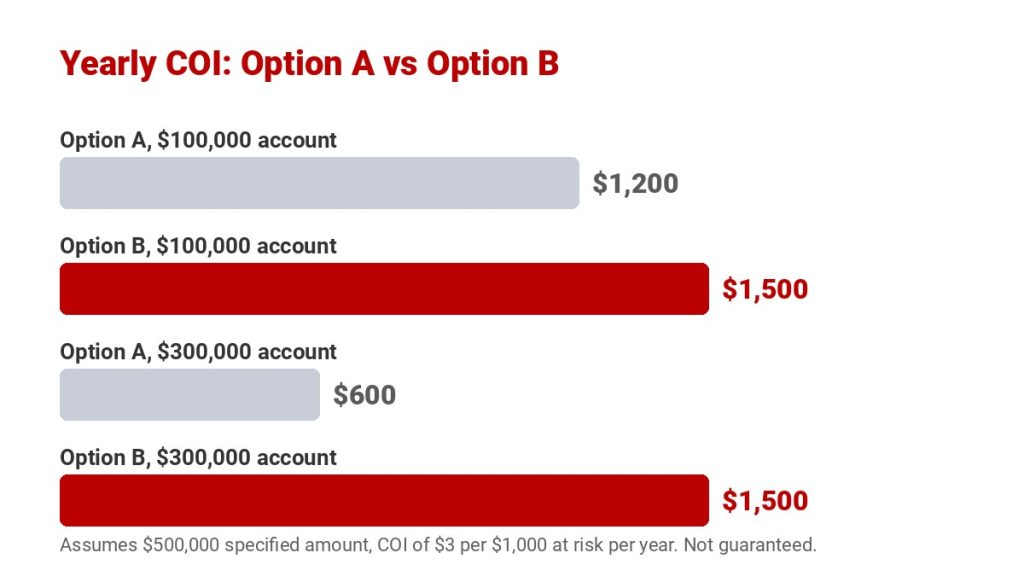
Assumptions: $500,000 specified amount and a sample COI rate of $3 per $1,000 of net amount at risk per year.
With a $100,000 account value
- Option A: death benefit $500,000. Net amount at risk: $500,000 − $100,000 = $400,000. COI: 400 × $3 = $1,200/year.
- Option B: death benefit $500,000 + $100,000 = $600,000. Net amount at risk: $500,000. COI: 500 × $3 = $1,500/year.
With a $300,000 account value
- Option A: death benefit still $500,000. Net amount at risk: $200,000. COI: 200 × $3 = $600/year.
- Option B: death benefit $800,000. Net amount at risk still $500,000. COI: $1,500/year.
At a $300,000 account value, Option B costs $900 more per year. In return, your family receives $800,000 instead of $500,000. In real policies COI rates rise with age, so the gap usually widens as you get older.
Calculator: Option A vs Option B, how different are the death benefit and COI?
Why max funded IUL often uses Option B during the funding years

A max funded IUL is designed with the lowest death benefit allowed for the premium you want to pay, so more money goes to accumulation. See how max funded IUL works. During the funding years, many advisors use Option B because:
- The death benefit grows with the account: your family gets more protection as more money goes in.
- It keeps room under the tax rules: IRC 7702 requires the death benefit to stay above the cash value by a set ratio (the corridor). Option B grows the death benefit automatically with the account.
- The account is still small: in early years the account value is modest, so the extra COI for Option B is limited.
Every carrier has its own rules and design approach, so the specific numbers must come from your own illustration.
When to switch to Option A
Once you stop paying premiums, or get ready to take retirement income through policy loans, staying on Option B means paying COI on a large net amount at risk while your goal is to preserve the account. That is why a common design is to switch to Option A at that stage:
- The death benefit is usually set at the total at the time of the switch (for example $800,000), then stays level.
- From then on, the bigger the account, the smaller the net amount at risk, and COI falls compared with staying on Option B.
- Your illustration should show the planned year to switch to Option A, so you can see the effect on account value.
Can you switch the other way?
Switching from Option B to Option A usually does not require new medical underwriting, because the insurer’s risk goes down. Switching from Option A to Option B usually does, because the risk goes up. Rules differ by carrier, so ask your advisor and check your contract.
Cautions when choosing or changing your IUL death benefit option

- Do not reduce the death benefit in the first 7 years on your own: under IRC 7702A, a reduction in benefits within the first 7 years triggers a recalculation of the premium limit, and the policy could become a MEC and lose its tax-advantaged loans.
- Get illustrations before and after the change: compare account value, death benefit and how long the policy lasts.
- Look at the guaranteed column too: not only the assumed-rate column. See guaranteed vs non-guaranteed values.
- Think about your family goal: if leaving more to your children is the priority, keeping Option B longer can make sense despite the extra COI.
For the full cost picture, read IUL fees explained and how to read an IUL illustration. If you are considering max funded IUL, max funded IUL pros and cons and is max funded IUL good give you the bigger picture.
3 questions to choose your IUL death benefit Option A vs B
There is no single right answer for everyone. Before you sign, answer these 3 questions with your advisor:
- What is your main goal? If your priority is accumulation for retirement income, you need low COI over the long run, so a plan to switch to Option A matters a lot. If your priority is leaving money to your family, keeping Option B longer can make sense.
- How many years will you pay premiums? Your funding period decides when to change options. For example, with 10 years of premiums an illustration often shows the switch around year 11, before policy loans begin.
- Are you sure you can fund the policy fully? If your income is uneven, as it often is for salon owners or 1099 workers, ask for an illustration at a lower premium to see whether Option B still works, because a large net amount at risk lets charges eat into the account faster when you underfund.
Write down your answers and ask your advisor to walk you through every option line in the illustration. A good design clearly shows the switch year, the death benefit before and after the switch, and the account value in both the guaranteed and the assumed-rate columns.
Bottom line on IUL death benefit Option A vs B
Option A keeps the death benefit level and COI falls as the account grows. Option B pays your family the account value on top but costs more COI. In max funded IUL, a common approach is Option B during the funding years and a switch to Option A when premiums stop or before income starts. What matters most is that the design matches your goal and is clearly shown in your illustration.
Frequently asked questions
What is the difference between IUL death benefit Option A and Option B?
Option A keeps the death benefit level with the account value inside it. Option B pays the specified amount plus the account value, so your family gets more but COI is higher.
Which option has lower cost of insurance?
Option A, because the net amount at risk equals the death benefit minus the account value and shrinks as the account grows.
Why do max funded IUL designs often start with Option B?
So the death benefit grows with the account during the funding years and keeps room under IRC 7702, while the account is still small and the extra COI is limited.
Do I need a medical exam to switch from Option B to Option A?
Usually not, because the insurer’s risk goes down. Switching from A to B usually requires underwriting. Rules vary by carrier.
Can reducing the death benefit make my policy a MEC?
It can if the reduction happens in the first 7 years, because the 7-pay premium limit is recalculated. Ask your advisor and get an illustration first.
Not sure whether your policy should use Option A or Option B?
Thinksmart Insurance helps you read your illustration in English or Vietnamese, compares several carriers and charges nothing for advice. Contact us →









 Thinksmart Insurance