
A nail tech gets a chemical burn, a deep cut from nippers, or wrist pain so bad she has to stop working. Who pays the doctor, and who pays her wages for those weeks? The answer is workers comp for nail salons (workers’ compensation). Many salon owners think they do not need it because their techs are paid on a 1099, or because a small salon will never be checked. That mistake can cost an owner the whole business.
This guide explains workers comp for nail salons in 5 states with large Vietnamese communities (California, Texas, Georgia, Washington and Virginia): when it is required, what injured workers get, what happens without it, a step-by-step example and a calculator.

What is workers comp for nail salons and what does it pay?
Workers comp for nail salons is insurance the owner buys for employees. When an employee is injured or gets sick because of the job, it pays for medical treatment and part of the lost wages, no matter who was at fault. In return, in most cases the employee does not sue the owner over that injury.
In California, benefits include:
- Medical care for the work injury.
- Temporary disability payments while the worker is off during treatment.
- Permanent disability payments if the worker does not fully recover.
- Retraining vouchers if the worker cannot return to the old job.
- Death benefits for children or other dependents if the worker dies.
Other states have similar groups of benefits, with different amounts and formulas.

When is workers comp for nail salons required? Rules in 5 states
California: one employee is enough
California law requires every employer with employees to carry workers comp, even with just one employee. A salon without it can get a stop order that bans using employee labor until coverage is in place. The civil penalty is twice the premium that should have been paid or $1,500 per employee, whichever is greater. Going uninsured can also be charged as a misdemeanor.
Georgia: 3 or more workers
In Georgia, any business with three or more workers, including regular part-time workers, must carry workers comp. An injured worker who is out more than 7 days gets two-thirds of the average weekly wage, up to $800 a week for injuries on or after July 1, 2023. The first week is paid only if the worker is out more than 21 days. Workers should report the injury within 30 days or they may lose benefits.
Virginia: more than two employees
In Virginia, as a general rule a business with more than two employees regularly employed in the state must carry workers comp. The count includes part-time, seasonal and temporary workers and family members who work in the business.
Washington: buy from the state fund
Washington does not allow private workers comp coverage. Employers must buy coverage from the Department of Labor & Industries (L&I) or be certified to self-insure, which is not realistic for a small salon.
Texas: optional, with duties
Texas lets private employers choose whether to carry workers comp. A salon that does not (a nonsubscriber) must still post a notice telling workers it has no coverage, give written notice to new hires, and file a notice of no coverage with the state between February 1 and April 30 each year. The key point: with workers comp, the owner’s liability is limited if an employee sues. Without it, the owner can be on the hook for everything if the case is lost.
| State | When workers comp for nail salons is required | Notes |
|---|---|---|
| California | 1 or more employees | Without it: stop order, at least $1,500 per employee |
| Georgia | 3 or more workers | Regular part-time workers count |
| Virginia | More than 2 employees | Seasonal and family workers count |
| Washington | Any employees | State fund (L&I) only |
| Texas | Optional | Must notify workers and file yearly notice |
Do salons with 1099 nail techs need workers comp for nail salons?
This is where many salons get it wrong. Calling a worker a 1099 contractor does not automatically remove the salon’s duty. States look at how the work really happens: does the salon set the hours and prices, supply the tools and pay the tech a commission? If the tech really works like an employee, the state can treat her as one, and the salon is then uninsured for her. A true booth renter who sets her own prices and has her own clients is usually treated differently. See nail tech 1099 vs W-2.

Step-by-step example: 8 weeks out of work in Georgia
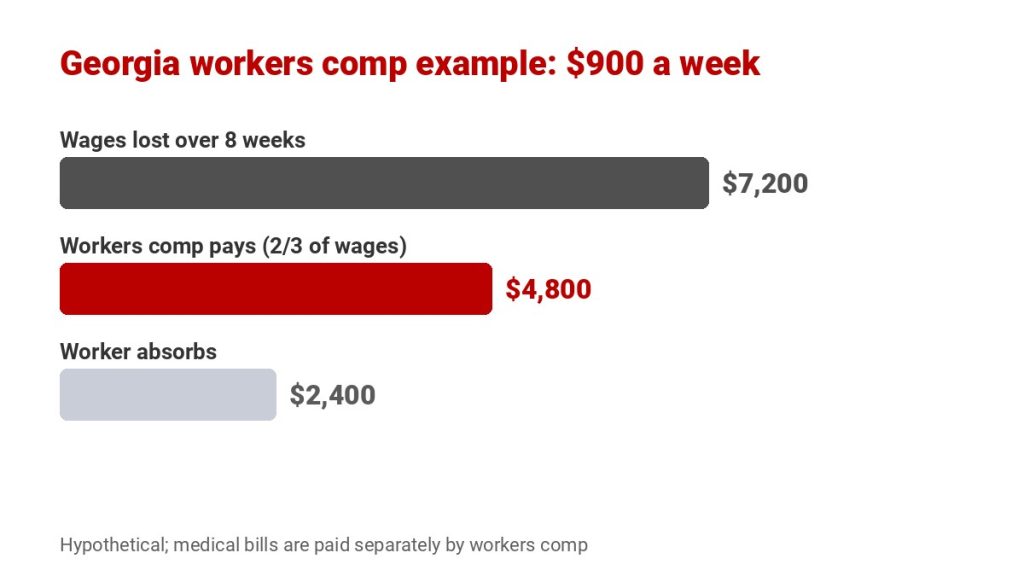
Lan (a hypothetical example) works at a 5-person salon in Georgia and earns an average of $900 a week. She gets a chemical burn on her hand and her doctor says she must stay off work for 8 weeks.
- Weekly benefit: 2/3 × $900 = $600. That is under the $800 maximum, so she gets $600 a week.
- Weeks paid: she is out 8 weeks, more than 21 days, so the first week is paid too, for 8 weeks in total.
- Total benefit: $600 × 8 = $4,800.
- Lost wages: $900 × 8 = $7,200. She absorbs $7,200 − $4,800 = $2,400.
- Medical bills: paid separately by workers comp, not taken out of the amount above.
If she were out only 3 weeks (21 days, not more), the first week would not be paid: $600 × 2 = $1,200. Without workers comp for nail salons, every medical bill and lost paycheck could turn into a dispute between owner and worker.
Calculator: how much does workers comp pay an injured nail tech?
Salon owners: who protects you?
Workers comp for nail salons protects employees. An owner who does nails every day faces the same risks as her techs, but in many cases the owner is not automatically covered. Ask your agent whether your policy covers you as the owner.
Beyond workers comp for nail salons, many owners add life insurance with living benefits, which can pay early for a critical or chronic illness, even one that has nothing to do with work. See also IUL insurance and term life insurance, plus our overview of nail salon insurance and nail technician health risks.
Injured at the salon: what to do right away
- Tell the owner right away, ideally by text or in writing so there is a record.
- See a doctor and say clearly that the injury happened at work.
- Ask for the name of the salon’s workers comp carrier and keep every document.
- Write down the days you miss and your pay before the injury.
Simple ways to lower the risk
Fewer injuries mean fewer claims and a calmer salon. Good ventilation, gloves and masks, labeled chemical bottles, sharp tools kept in their place, adjustable chairs and short stretch breaks all help. Write down who to call and what to do when someone is hurt, and post it near the front desk. When you shop for workers comp for nail salons, ask the agent how your class code and payroll affect the price, and keep payroll records accurate so the yearly audit has no surprises.
Bottom line
Workers comp for nail salons is not just about the law. It lets techs work with peace of mind and keeps one small accident from sinking the salon. Check your state’s rules, count every worker correctly, and do not rely on the word 1099.
Frequently asked questions
Does a Georgia nail salon with 2 techs need workers comp?
Georgia requires coverage with 3 or more workers, including regular part-time workers. Count everyone who works in the salon before deciding.
Can an injured 1099 nail tech get workers comp?
It depends on how the work really happens. If the tech works like an employee, the state may treat her as one even if the paperwork says 1099.
Is there a penalty for not having workers comp in Texas?
Texas lets employers go without it, but they must notify workers and file a yearly notice of no coverage. Without coverage, the salon can be sued when a worker is hurt.
What happens in California without workers comp?
The salon can get a stop order banning employee labor, a penalty of at least $1,500 per employee or twice the premium, and a possible misdemeanor charge.
Does workers comp cover the salon owner?
Workers comp mainly protects employees. Owners should ask their agent whether they are covered and consider insurance with living benefits.
Salon owner looking to protect your own income?
Thinksmart Insurance helps salon owners and nail techs compare life insurance with living benefits, in English or Vietnamese, with no fee for advice. Contact us →









 Thinksmart Insurance