
You just moved to the US, just started working, or simply never bought insurance. Faced with a dozen types of coverage, many people do not know where to start and end up buying nothing. The question of what insurance to get first has a fairly clear answer: start with what protects you from the biggest bill and what the law requires.
This guide ranks 5 types of insurance in order of priority for families in the US: health, auto, home or renters, life and disability, with a sample budget and a calculator.

What insurance to get first: the rule of thumb
Ask yourself: if something bad happens, could I pay for it myself? A minor doctor visit, maybe. A surgery, or a car accident that injures someone else, no. Insurance is for the costs you cannot absorb. So what insurance to get first depends on three things:
- Does the law require it: auto insurance, for example.
- How big is the possible loss: hospital bills, lawsuits, losing your home, losing your income.
- Does anyone depend on you: a spouse, young children, parents.

1. Health insurance: priority number one
Medical care in the US is expensive. Hospitals with emergency departments must examine and stabilize patients who cannot pay, but the bills still come later. That is why, when people ask what insurance to get first, the answer is almost always health insurance.
- Through work: if your employer offers it, this is usually the easiest option.
- Through the Marketplace (Obamacare): open enrollment for 2027 on HealthCare.gov runs November 1, 2026 to January 15, 2027; enroll by December 15 for coverage starting January 1. Some states run their own site with different deadlines. See ACA subsidies 2027.
- Medicaid: for lower incomes, with rules that vary by state.
- Medicare: for eligible people 65 and older.
There has been no federal penalty for going without health insurance since 2019, but California, Massachusetts, New Jersey, Rhode Island and Washington D.C. have their own requirements. Coverage also gives you free preventive care.

2. Auto insurance: required if you drive
Nearly every state requires liability insurance, which pays others when you cause an accident. Minimums vary by state. State minimums are often low compared with the real cost of a serious crash, so many drivers choose higher limits to avoid paying the difference themselves.
If you have a car loan or lease, the lender usually also requires collision and comprehensive coverage.
3. Homeowners or renters insurance
If you have a mortgage, the lender will require homeowners insurance. If you rent, the landlord’s policy covers the building, not your belongings. Renters insurance is usually inexpensive and pays for belongings lost to fire or theft, plus liability if a guest is hurt in your home. Many landlords require tenants to have it.
4. Life insurance: once someone depends on you
If a spouse, young children or parents rely on your income, life insurance is the next step. Term life is usually the cheapest way to get a large amount of coverage while you are young. Many policies also include living benefits that pay early for a serious illness. The younger and healthier you are, the lower the premium. See how much life insurance do I need.
5. Disability insurance: protect your income
Your ability to earn is your biggest asset. If illness or injury keeps you off work for months, who pays the rent? Social Security has disability benefits (SSDI), but you need enough work credits and the rules are strict. A few states, such as California, run state disability insurance. You can also get coverage through work or buy your own.
Sample budget: what insurance to get first on $4,000 a month
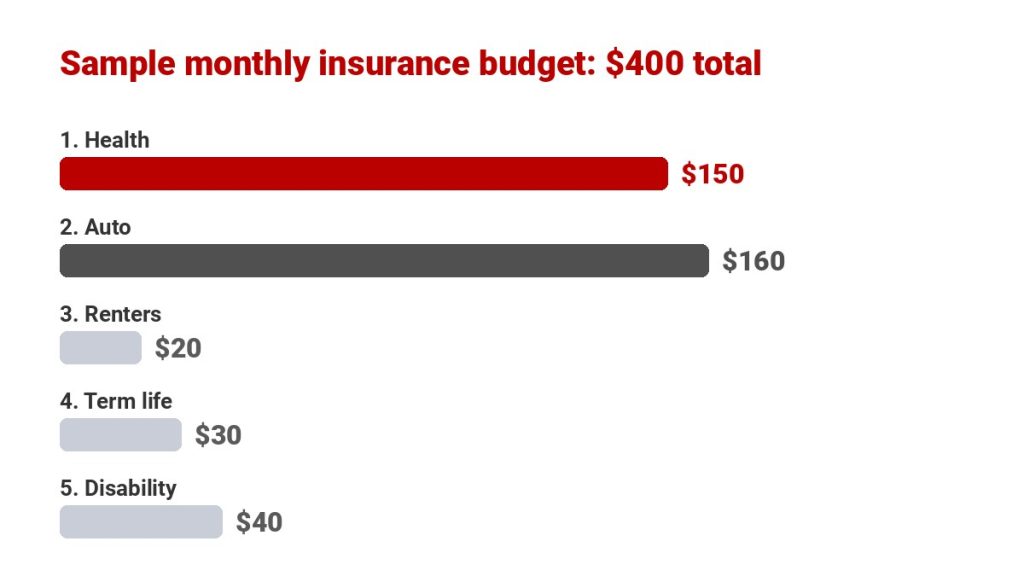
Khoa and Vy (a hypothetical example) take home $4,000 a month, rent an apartment, have one car and a young child. Assumed premiums:
- Health: $150 a month after subsidy (assumed).
- Auto: $160 a month.
- Renters: $20 a month.
- Term life: $30 a month.
- Disability: $40 a month.
Total: $150 + $160 + $20 + $30 + $40 = $400 a month, or $400 ÷ $4,000 = 10% of income, about $4,800 a year. If the budget is tight, buy in order: health and auto first, then renters, then life and disability.
Calculator: your basic insurance budget per month
New to the US: what insurance to get first in your first 30 days?
New arrivals usually focus on paperwork, a job and housing first, and leave insurance for later. But moving to the US from abroad usually counts as a qualifying life event, which lets you enroll in Marketplace health coverage outside open enrollment if you apply within the deadline (usually 60 days). Green card holders and other lawfully present immigrants can generally buy through the Marketplace. For Medicaid, many green card holders must wait a period (often 5 years) before they qualify, and rules vary by state. Worried about public charge? See public charge rule.
- Weeks 1–2: look into health insurance through work or the Marketplace and enroll within your window.
- Before you drive: get auto insurance before you register a car and take it on the road.
- When you sign a lease: ask whether the landlord requires renters insurance and buy it at the same time.
- Once you are settled: look at life and disability insurance, especially if you have young children or send money home to support parents.
Keep every insurance document in one folder and take photos of them on your phone. When something happens, you will need the policy number and the insurer’s phone number right away.
Common mistakes
- Waiting until you are sick: higher premiums or a decline. See waiting until sick to buy life insurance.
- Buying only the state minimum for your car: one serious accident can exceed it by far.
- Assuming the landlord’s policy covers your belongings.
- Missing health enrollment: outside open enrollment you usually need a qualifying event such as losing a job, marriage, a new baby or moving.
5 questions to ask before you buy any policy
- What exactly does it cover, and what does it exclude? Ask for the exclusions in writing, not just the highlights.
- What will I pay out of pocket? For health and auto, look at the deductible, copays and the out-of-pocket maximum, not only the monthly premium.
- Can the price go up? Some premiums are fixed for years, others can change every renewal.
- How do I file a claim? Save the phone number and app, and ask how long claims usually take.
- Can I get help in Vietnamese? Understanding your policy matters more than saving a few dollars.
A cheap policy that does not pay when you need it is not a bargain. Compare coverage first, then price. If you are still unsure what insurance to get first for your family, write down your income, who depends on you and what you own, and go through the five types above one by one. Bundling auto and renters or home insurance with the same company can sometimes lower the total, so ask about it when you get quotes.
Bottom line
What insurance to get first? Start with health, add auto if you drive, then home or renters, then life once someone depends on you, and disability to protect your paycheck. You do not have to buy everything in one day, but do not leave the gaps that could put your whole family in debt.
Frequently asked questions
What insurance should I get first?
Usually health insurance first, then auto if you drive, home or renters insurance, and then life and disability insurance.
Is there a penalty for not having health insurance?
There has been no federal penalty since 2019, but California, Massachusetts, New Jersey, Rhode Island and Washington D.C. have their own rules.
When can I enroll in health insurance for 2027?
On HealthCare.gov from November 1, 2026 to January 15, 2027. Enroll by December 15, 2026 for coverage starting January 1, 2027. Some states have different deadlines.
Do renters need insurance?
The landlord’s policy does not cover your belongings. Renters insurance is usually inexpensive and many landlords require it.
Do young single people need life insurance?
If no one depends on your income, it can wait. But buying while young and healthy costs much less.
Not sure where to start?
Thinksmart Insurance can help you put coverage in the right order for your budget, in English or Vietnamese, with no fee for advice. Contact us →









 Thinksmart Insurance