
Thanksgiving this year falls on Thursday, November 26, 2026. For many families it is one of the few days when everyone comes home and sits at the same table with Mom and Dad. That makes it a good time for a money talk with aging parents: not to ask about inheritance, but to learn what your parents need and how the family can prepare.
Many families, especially immigrant families, find it awkward to talk about money and end-of-life plans with parents. Yet too often children only learn which insurance policies or accounts their parents had when it is too late. This guide offers 5 questions, gentle ways to start, a step-by-step example of splitting costs among siblings, and a calculator to estimate together.

Why have a money talk with aging parents at Thanksgiving?
Thanksgiving is about gratitude. Asking about your parents’ health and plans is one way to show it. The end of the year also has a practical reason: Medicare open enrollment for 2027 ends December 7, 2026, so if your parents are over 65, this is the time to review next year’s coverage. See Medicare open enrollment 2027.
Talking while your parents are healthy is far easier than talking in a crisis. While they are clear-minded, the decisions are theirs. In an emergency, children have to guess and are more likely to disagree.
5 questions for a money talk with aging parents
1. “Where do you keep your important papers?”
You do not need to ask how much money they have. Just learn where things are: a will or trust (if any), life insurance policies, bank statements, property papers in the US and abroad, Medicare and Social Security cards, and a list of current medicines. At least one child should know where these are and how to reach their insurance agent and tax preparer.
2. “Who is the beneficiary on your insurance and accounts?”
Life insurance and many retirement accounts pay directly to the beneficiary named on file, not according to the will. If the beneficiary has died or an old name is still listed, the money may have to go through probate court, which can take months. See how to name them correctly in owner, insured and beneficiary.
3. “If you become seriously ill and cannot decide, who should decide for you?”
In the US, when an adult can no longer make decisions, children do not automatically gain the right to sign for them. Two documents are commonly used: a health care power of attorney or advance directive, and a financial power of attorney. Rules vary by state, so ask a lawyer in the state where your parents live.
4. “What do you live on, and is it enough?”

Many older parents live mostly on Social Security, some with a pension or savings. In 2027, Social Security benefits rise 2.8% (see Social Security COLA 2027). A gentle question: “Do you have enough each month, or should we help more?” Knowing early lets siblings share support fairly instead of one person carrying it all.
Also ask about long-term care. Medicare generally does not pay for long-term care such as a nursing home or daily help with bathing and eating when that is the only care needed. Some life insurance policies include chronic illness benefits that can help; see chronic illness rider.
5. “What are your wishes for a funeral, and how will it be paid for?”
This is the hardest question, but an important one. Do your parents prefer burial or cremation, a service in the US or back in their home country? According to a 2023 survey by the national funeral directors association, the median cost of a funeral with a casket and burial was about $8,300 (not including cemetery plot and headstone), and about $6,280 with cremation. If your parents already have life insurance or a fund for this, it takes a lot of pressure off the children.
How to start a money talk with aging parents without upsetting them
- Start with your own story: “I just bought life insurance and named the kids as beneficiaries. Have you done that?”
- Explain the goal is to honor their wishes: “I want to know what you want, so we do it your way if something happens.”
- Do not ask for amounts: only where papers are and what they need.
- Break it up: you do not need all 5 questions in one dinner. One today, the next at Lunar New Year.
- Include all siblings: it avoids the feeling that “Mom and Dad only told one of us.”
Step-by-step example: the numbers behind a money talk with aging parents

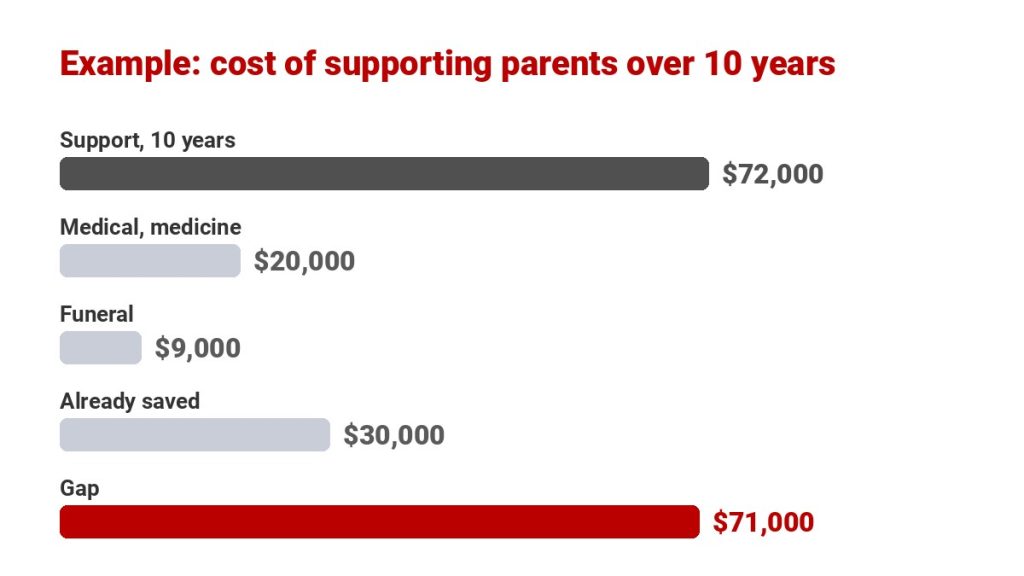
Assume three siblings want to plan for their parents over the next 10 years:
- Monthly support of $600: $600 × 12 × 10 = $72,000.
- Out-of-pocket medical costs of $2,000 a year: $2,000 × 10 = $20,000.
- Funeral budget: $9,000.
- Total: $72,000 + $20,000 + $9,000 = $101,000.
- Minus $30,000 your parents already have: a gap of $71,000.
- Split three ways: about $23,667 each, or about $197 a month for 10 years.
Shared fairly, the number is much easier than one child carrying it all. This example does not include long-term care, which can cost more than all of the above combined.
Calculator: how much should siblings plan to support your parents?
After the money talk with aging parents: next steps
- Write a one-page summary: where papers are, and phone numbers for doctors, insurance agent and bank.
- Check beneficiaries on every insurance policy and retirement account.
- See a lawyer if your parents do not have health care and financial powers of attorney.
- Review Medicare for 2027 before December 7, 2026.
- Look at your own plan: your children will one day need the same information from you.
If your parents have assets in Vietnam, see Form 3520 foreign inheritance to learn when an inheritance must be reported to the IRS.
Keep the money talk with aging parents going after the holiday
One money talk with aging parents rarely covers everything, and that is fine. Many families set a short check-in once or twice a year, for example around Tết and again at Thanksgiving. Each time, look at what changed: a new doctor, a new medicine, a bank account that was closed, or a policy that was paid up. Keep the one-page summary in a folder that at least two siblings can reach, and update the date at the top whenever something changes.
If your parents speak mostly Vietnamese, let the sibling who speaks it best lead the money talk with aging parents, and keep the tone respectful. Ask open questions like “What would make you feel at ease?” rather than “How much do you have?”. Parents who feel listened to usually share more. If a question makes them uncomfortable, stop and come back to it another day. The goal is not to finish a checklist in one night, but to make sure nobody in the family has to guess when it really matters.
Bottom line: one dinner, five questions
A money talk with aging parents is not bad luck or cold talk about money. It is how your parents get to live and leave this world their way, and how siblings avoid guessing or arguing later. This Thanksgiving, start with one small question.
Frequently asked questions
How do I start a money talk with aging parents without upsetting them?
Start with your own situation, explain that the goal is to follow their wishes, avoid asking for amounts, and spread the questions over several visits.
Is life insurance divided according to the will?
Usually not. It is paid directly to the beneficiary named on the policy, so it is important to check and update beneficiaries.
Does Medicare pay for a long-term nursing home stay?
Generally no, when the only care needed is long-term help with daily activities. Families need another plan for this cost.
How much does a funeral cost in the US?
A 2023 survey put the median cost at about $8,300 for a funeral with casket and burial (not including plot and headstone), and about $6,280 with cremation.
Can adult children automatically sign for parents who become seriously ill?
No. They usually need health care and financial powers of attorney, and rules vary by state.
Want to review insurance for your parents or your own family?
Thinksmart Insurance helps you check policies, beneficiaries and age-appropriate options, in English or Vietnamese, with no fee for advice. Contact us →









 Thinksmart Insurance