
A max funded IUL is loaded with cash value, so many people assume it can never lapse. But there is a common way it can: borrowing too much in retirement. That is the real IUL policy lapse risk for a well-funded policy. Loan interest compounds every year, the cost of insurance rises with age, and credited rates are not high every year.
This guide is different from our general article on why IUL policies lapse: here we focus on the retirement income phase of a max funded policy, with 4 step-by-step scenarios and a calculator.

Why IUL policy lapse risk exists even in a max funded policy
In retirement, many people take money from a max funded IUL through policy loans. Loans are not taxable income while the policy stays in force and is not a MEC. But a loan charges interest. If you do not pay the interest, it is added to the loan, and next year interest is charged on the larger balance.
Meanwhile, the cash value has to pay the cost of insurance, which rises with age, and grows only by that year’s credited rate. When the loan plus interest reaches the cash value, the carrier sends a notice asking for more premium. If nothing is paid by the end of the grace period, the policy lapses. See IUL policy loans.

4 IUL policy lapse risk scenarios: step by step
Hypothetical example: Hanh is 65 with $500,000 of cash value and starts borrowing at the start of each year. The loan rate is 5.5% a year and charges are assumed at $6,000 a year (in reality they rise with age).
Year 1 (borrow $35,000, 6% credited):
- Cash value: $500,000 × 1.06 − $6,000 = $524,000.
- Loan: $35,000 × 1.055 = $36,925.
- In year 2 she borrows another $35,000, added to the old balance before interest: ($36,925 + $35,000) × 1.055 = $75,881.
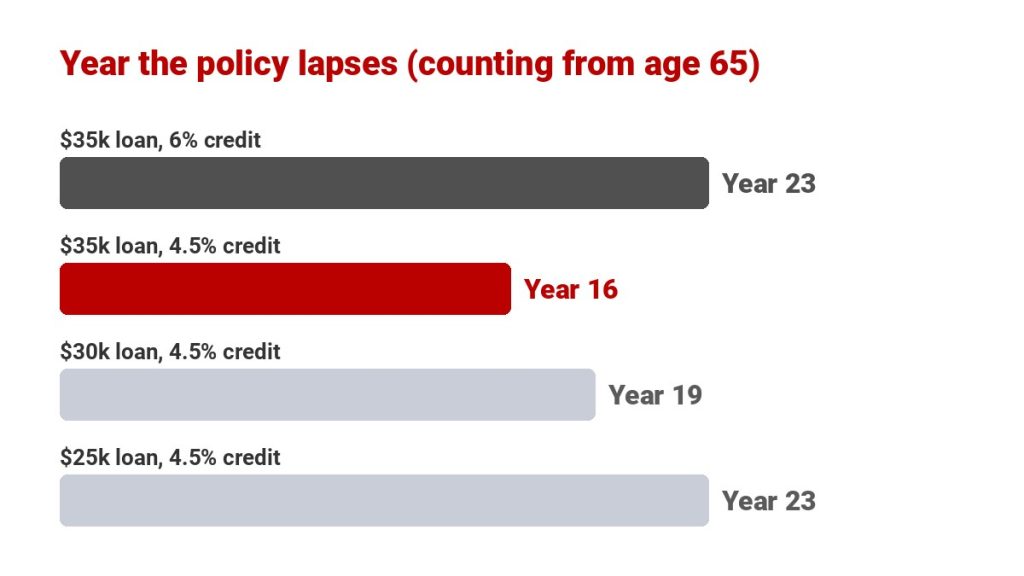
After 10 years the loan is about $475,422 while the cash value is about $816,339. That still looks safe, but the loan is growing faster. Results for 4 scenarios:
| Yearly loan | Assumed credited rate | Loan passes cash value |
|---|---|---|
| $35,000 | 6% | Around year 23 (age 88) |
| $35,000 | 4.5% | Around year 16 (age 81) |
| $30,000 | 4.5% | Around year 19 (age 84) |
| $25,000 | 4.5% | Around year 23 (age 88) |
A credited rate just 1.5% lower moves the lapse point 7 years earlier at the same $35,000 loan. With $25,000 a year at 6%, the loan does not pass the cash value within 40 years under these assumptions. That is why the withdrawal amount matters more than the starting cash value.
Calculator: how much can you borrow each year before IUL policy lapse risk shows up?
The tax side of IUL policy lapse risk
This is the part many people never hear about. When a policy lapses with a loan outstanding, the loan is paid off from the policy value. Any amount you took out above the total premiums you paid (your cost basis) can be treated as taxable income in that year, even though you receive no new money. After many years of loans, that amount can be large. So the goal is not just to take out as much as possible, but to keep the policy in force for life.

5 ways to reduce IUL policy lapse risk
- Borrow moderately: choose a withdrawal level that keeps the policy in force to age 95–100 on an illustration with a conservative credited rate.
- Review an in-force illustration every year: compare the loan with the cash value. See how to read an IUL illustration.
- Borrow less in bad market years: in a 0% year you still owe loan interest. See what happens to IUL in a crash.
- Pick the right loan type: a fixed loan is more predictable than an indexed loan. See fixed vs indexed loans.
- Ask about an overloan protection rider: some carriers offer one to keep the policy from lapsing when the loan gets too high. Conditions usually include a minimum age, a minimum number of policy years and a loan-to-value level, with a charge when it is used. Each carrier differs.
Also remember that withdrawals up to your total premiums paid are usually not taxed, and loans come after that. The right mix depends on each policy and its IUL policy lapse risk.
Warning signs of IUL policy lapse risk
A lapse rarely comes out of nowhere. The warning signs usually show up years earlier, if you read the annual statement:
- The loan-to-cash-value ratio keeps rising: in the example, year 10 shows a $475,422 loan against $816,339 of cash value, about 58%. Once that ratio reaches 80–90%, the safety margin is thin.
- The in-force illustration ends earlier than planned: if a new illustration shows the policy lasting only to age 85 instead of 100, it is time to adjust.
- Several low credited-rate years in a row: 0% or 2–3% credits while the loan rate stays at 5–6% close the gap fast.
- Insurance charges rising with age: after 75–80, the cost of insurance climbs and eats more of the cash value.
If you see any of these, act on your IUL policy lapse risk before a letter from the carrier arrives. Cutting loans a few years early is usually much easier than paying a large sum to save the policy later.
Who faces the highest IUL policy lapse risk?
Three groups run into trouble most often: people who take a high fixed loan from the first year of retirement, people who start borrowing while the policy is still young (under about 10 years), and people who never read the annual statement. If you are in any of these groups, ask your agent to run a new illustration using a lower credited rate than the one you are using now. Seeing the lapse year move earlier on paper is much better than seeing it happen in real life.
IUL policy lapse risk notice: what to do
When the loan plus interest gets close to the cash value, the carrier sends a notice and gives a grace period, usually about 30 to 61 days depending on the carrier and the state. During that time you can:
- Pay the amount requested: this keeps the policy and the death benefit for your family.
- Pay down part of the loan: a smaller loan means less interest in the years ahead.
- Use an overloan protection rider if you have one: check the conditions first, since you usually cannot borrow more after it starts.
- Lower the face amount: a smaller death benefit lowers the cost of insurance and may keep the policy going. Ask about the tax effect first.
Whatever you choose, call the carrier or your agent as soon as the notice arrives. If the grace period runs out, the policy lapses and the tax risk above can kick in.
More on max funded IUL
- Is max funded IUL good?
- How max funded IUL works
- Max funded IUL for retirement
- Max funded IUL pros and cons
- Option A vs Option B
Bottom line
When a max funded IUL lapses, it is usually not because too little went in, but because too much came out. A good policy still needs a careful withdrawal plan reviewed every year. Treat the loan as real debt, because it is.
Frequently asked questions
Can a max funded IUL lapse?
Yes. If the loan plus interest passes the cash value and you do not pay more by the end of the grace period, the policy lapses.
Is there a tax if an IUL lapses with a loan?
There can be. Any amount taken out above the premiums you paid can be treated as taxable income in the year the policy lapses.
What is an overloan protection rider?
A feature at some carriers that keeps the policy from lapsing when the loan gets too high, with conditions on age and policy years and a charge when it is used.
How much can I safely borrow from a max funded IUL each year?
There is no single number. Use an illustration with a conservative credited rate to pick a level that keeps the policy in force to age 95–100.
Can I pay back part of the loan?
Yes. You can pay some interest or principal at any time to reduce IUL policy lapse risk.
Want to check your IUL withdrawal plan?
Thinksmart Insurance can review your in-force illustration and estimate a safer loan level, in English or Vietnamese, with no fee. Contact us →









 Thinksmart Insurance