
“I paid into my IUL for 12 years and suddenly got a letter saying it may lapse. How?” This is more common than many people think. An IUL lapse does not happen overnight. It is the result of years of underfunding, heavy loans, lower credits than illustrated, or rising charges that nobody reviewed.
This guide explains how an IUL policy lapses, the 5 most common causes, a step-by-step example, the tax trap when there is a loan, and 5 ways to prevent it. A calculator at the end lets you check your own numbers.

What is an IUL lapse?
Every month the insurer deducts charges from your IUL account: cost of insurance (COI), administrative fees and rider charges. See where your IUL premium goes. When you pay premiums, money goes into the account. When you stop, the charges keep coming out of what is already there.
If in any month the cash surrender value (account value minus surrender charges and loans) is not enough to pay that month’s charges, the insurer sends a notice and gives you a grace period, usually about 30 to 61 days depending on the policy and the state. If you do not pay the required amount by the end of it, the policy lapses and coverage ends.
Key point: IUL is a “flexible premium” policy. Flexible means you may pay less or pause for a while. It does not mean the policy runs forever on its own. The account must be large enough to carry the monthly charges.
5 reasons an IUL lapse happens
1. Underpaying or stopping premiums too early
Many people think “10 years of payments and I’m done” because they misread the illustration. If the illustration assumed a high rate, a short funding period may not be enough when real credits are lower. Stopping while the account is still small is the most common cause.
2. Borrowing too much
Policy loans charge interest every year. If you do not pay the interest, it is added to the loan. The loan grows while charges reduce the account, and the gap shrinks until the policy runs out of money. See IUL policy loans.
3. Credits lower than the illustration
In years the index falls, the credit is 0%, but charges are still deducted, so the account value still drops. The insurer may also lower caps within contract limits. Several low years in a row mean slower growth than expected. See what happens to IUL in a market crash.
4. Cost of insurance rises with age
COI is charged on the amount at risk and increases as you age. At 70 or 80, the monthly charge can be far higher than when you bought the policy. The insurer can adjust COI but not above the maximum in your contract. Details in IUL cost of insurance.
5. Large withdrawals
Withdrawals reduce the account value immediately. Withdrawing heavily while charges continue drains the account faster.
Step-by-step example: how long until an IUL lapse?
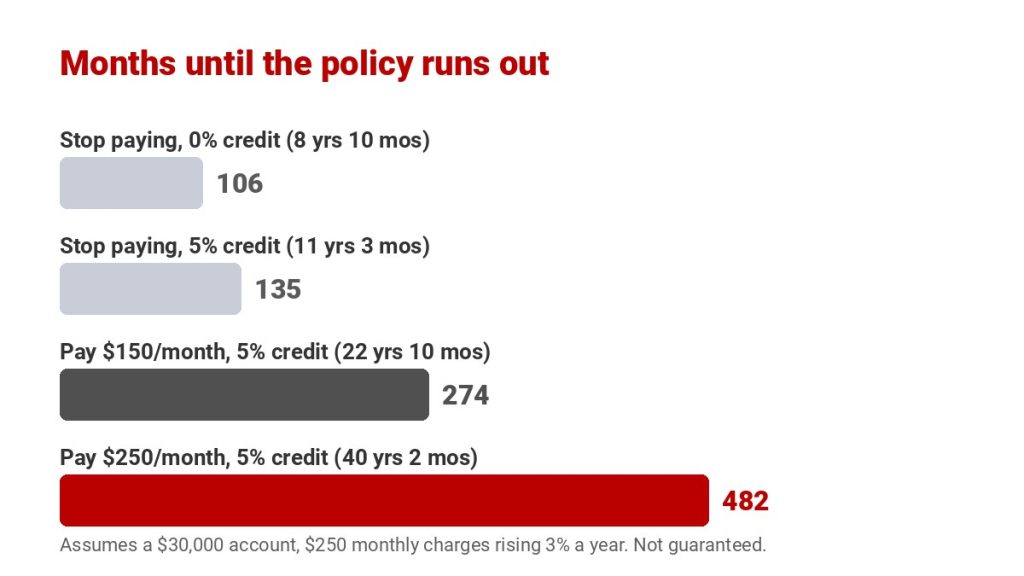
Simple assumptions: $30,000 account value, no loan, total charges of $250 a month rising 3% each year.
- Stop paying, 0% credit each year: year one deducts $250 × 12 = $3,000, leaving $27,000. Next year the charge is $257.50 a month, or $3,090 a year. Continuing this way, the policy runs out of money in about 8 years 10 months.
- Stop paying, 5% credit: interest stretches it to about 11 years 3 months.
- Pay $150 a month, 5% credit: about 22 years 10 months.
- Pay $250 a month, 5% credit: about 40 years 2 months.
The same policy can last 4 to 5 times longer depending on funding and credits. In real life COI usually rises faster than 3% a year at older ages, so the actual time may be shorter.
When there is a loan
A $100,000 account with a $70,000 loan at 5% interest that is not paid, and $250 monthly charges:
- What is really yours: $100,000 − $70,000 = $30,000.
- At a 0% credit, charges reduce the account while the loan grows 5% a year. The policy could lapse in about 4 years 4 months.
- At a 5% credit, it lasts about 11 years 3 months, the same as a $30,000 account with no loan.
In other words, a large account is not safe if the loan is large too.
Calculator: at your current funding, how long could your IUL last?
The tax trap: an IUL lapse with a loan outstanding

IUL loans are generally not taxed while the policy stays in force and is not a MEC. But when a policy lapses with a loan, the loan is paid off from the policy value, and the IRS treats it as money you received.
Example: you paid $60,000 in total premiums. At lapse, the loan balance is $90,000. The $90,000 − $60,000 = $30,000 difference can be taxable income, reported on Form 1099-R, even though you receive no cash. In the 22% bracket, that is about $6,600 in federal tax, plus any state tax.
That is why people who use IUL loans for retirement income need to monitor their policy most closely.
5 ways to prevent an IUL lapse
1. Fund the policy as planned, not just the minimum
The minimum premium often keeps the policy going only for a limited time. To last and accumulate, pay the planned premium. If your income is uneven, as it often is for salon owners or 1099 workers, ask for a lower-premium scenario up front so you know your limits.
2. Review an in-force illustration every year
An in-force illustration is an updated projection based on your policy’s real history: premiums paid, credits received and loans. You can request one from the insurer or your advisor each year. It shows how long the policy lasts at your current funding. See how to read an IUL illustration.
3. Look at the guaranteed column, not only the assumed rate
The guaranteed column uses maximum charges and minimum interest. In one sample illustration, a policy lasted for life at the current rate but lapsed much earlier on the guaranteed column. See guaranteed vs non-guaranteed values.
4. Manage loans and use the right riders
Pay loan interest when you can, and do not borrow to the limit. Some policies offer an Overloan Protection Rider that helps prevent a lapse when the loan becomes very large (conditions apply and there may be a charge when used). Some policies have a no-lapse guarantee rider for a number of years if you pay the required premium. Ask which riders your policy has.
5. Act early when you see warning signs

If your in-force illustration shows the policy running out of money in a few years, you still have options: pay more premium, repay part of the loan, lower the death benefit to reduce COI, or switch from Option B to Option A (see IUL death benefit Option A vs B). Lowering the death benefit in the first 7 years can turn the policy into a MEC, so always get an illustration before you change anything.
What if your IUL already lapsed?
Many policies allow reinstatement for a limited time after a lapse, often a few years depending on the insurer. You usually need to apply, show that you are still insurable, and pay the missed charges plus interest. If your health has changed, reinstatement may be difficult or denied. Fixing the problem during the grace period is always much easier than reinstating later.
Warning signs to check right away
- Your account value dropped two years in a row even though you kept paying.
- Your loan is above roughly 70% to 80% of the account value.
- A letter from the insurer says the policy is "projected to lapse" or asks for more premium.
- You stopped paying years ago and never reviewed an illustration.
If any of these apply, request an in-force illustration and ask an advisor to walk you through it.
Bottom line: an IUL lapse is preventable
An IUL lapse almost always shows warning signs years in advance. Funding the policy, reviewing an updated illustration every year, controlling loans and checking the guaranteed column keep your policy running until your family needs it. Catch it early and you have many options. Catch it late and you could lose coverage and still owe tax.
Frequently asked questions
What does IUL lapse mean?
It means the cash surrender value cannot pay the monthly deductions and you did not pay more during the grace period, so coverage ends.
Can my IUL lapse if I paid for 10 years and stopped?
Yes. If the account is not large enough or real credits are lower than illustrated, charges keep coming out and the policy can run out of money. Review an in-force illustration before you stop.
Do I owe tax if my IUL lapses with a loan?
You may. The part of the loan above the total premiums you paid can be taxable income, even though you receive no cash.
How long is the IUL grace period?
Usually about 30 to 61 days depending on the policy and the state. The insurer’s notice shows the amount due and the deadline.
Can a lapsed IUL be reinstated?
Many policies allow reinstatement for a limited time, usually with proof of insurability and payment of missed charges. Rules vary by insurer.
Want to check whether your IUL is at risk of lapsing?
Thinksmart Insurance helps you read your in-force illustration in English or Vietnamese and review your loans and funding, with no fee for advice. Contact us →








 Thinksmart Insurance