
Many people buy life insurance with a critical illness benefit and feel protected. But what if you were diagnosed with cancer in the second month after buying? Or had a mild stroke: would it pay? A critical illness rider has conditions few people read closely: the waiting period, the list of conditions and how the money is figured.
This guide explains the critical illness rider in plain words: what a 30 to 90 day waiting period means, 9 conditions often covered, common reasons for denial, a step-by-step payout example, and a calculator.

What is a critical illness rider?
In the US, critical illness coverage usually comes in two forms. The first is a benefit built into a life insurance policy (a critical illness rider, one type of living benefit): if you are diagnosed with a listed condition, you can receive part of the death benefit early. The second is a separate policy that pays a fixed lump sum, often bought through work.
This guide focuses on the first type, because it is common in IUL and term life policies. The key point: the early payout is not extra money. It is the policy’s own money, paid early when you need it.
What is the critical illness rider waiting period?
The waiting period is the time right after the policy takes effect during which a condition diagnosed may not qualify for the critical illness rider. It exists so people do not buy coverage after they already know they are sick.
- About 30 days: for conditions like heart attack and stroke with some carriers.
- About 90 days: for cancer with some carriers, because cancer often shows signs earlier.
- Not every carrier is the same: some have no waiting period, some count it differently. Always read the rider in your own policy.
The waiting period applies only to the critical illness benefit. The death benefit follows its own terms. It is also why you should not wait until you are sick to buy life insurance: buy while healthy and the waiting period passes before you ever need it.

Which conditions does a critical illness rider cover?
The list is in the policy, and it differs by carrier. A common list includes 9 groups:
| Condition | What is usually required |
|---|---|
| Severe heart attack | A heart attack diagnosed under the policy’s standards |
| Stroke | Usually lasting nerve damage, not just a brief warning stroke |
| Coronary bypass | Surgery performed as the policy defines it |
| End-stage kidney failure | Regular dialysis or a kidney transplant |
| Invasive cancer | Cancer that has invaded tissue; many policies exclude in-situ or very early cancer |
| Major organ transplant | Transplant done or on a transplant waiting list |
| Coma | Lasting the number of days the policy sets |
| Paralysis | Permanent loss of use of limbs as defined |
| Severe burns | Third-degree burns over a large part of the body |
Some carriers also include critical injuries such as a traumatic brain injury. The policy wording is what counts, not the condition names in a brochure.
When is a critical illness rider claim denied?
- Diagnosed during the waiting period.
- Does not meet the definition: for example very early cancer, or a brief warning stroke with no lasting damage.
- Excluded at purchase: people with health conditions may be approved for life insurance but have certain conditions excluded from the critical illness rider.
- Health history not disclosed correctly: the carrier may review the application.
- Benefit cap reached: each carrier limits this benefit, for example $1 million or $2 million depending on the carrier.
How much does a critical illness rider pay? Step-by-step example
There are two common methods. In the first, you choose to accelerate part of the death benefit and the carrier subtracts a discount. In the second, the carrier pays based on how much the illness shortens life expectancy, so the same illness pays a younger and an older person differently, and in some cases a qualifying claim pays very little.
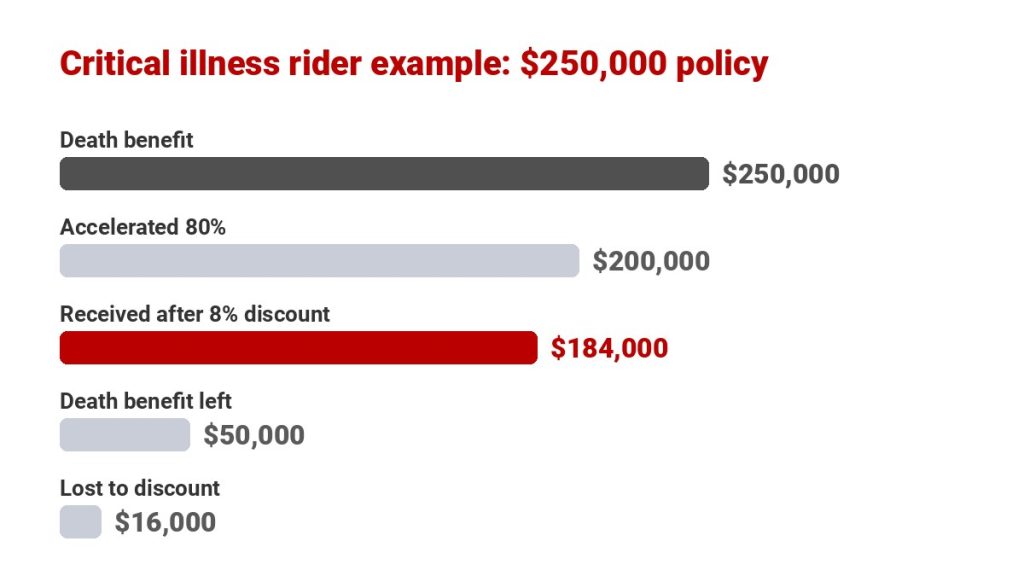
Hypothetical example of the first method: Minh has a $250,000 policy, has a stroke that meets the definition, accelerates 80%, and the assumed discount is 8%.
- Amount accelerated: $250,000 × 80% = $200,000.
- Discount: $200,000 × 8% = $16,000.
- Amount received: $200,000 − $16,000 = $184,000.
- Death benefit left: $250,000 − $200,000 = $50,000 for his family.
Minh can use the money for anything: hospital bills, lost wages, the mortgage. That is different from health insurance, which pays only the hospital and doctors.
Calculator: how much could a critical illness rider pay early?
Critical illness rider vs chronic illness rider
A critical illness rider pays when you are diagnosed with a listed condition. A chronic illness rider pays when you cannot do 2 of 6 activities of daily living for a long time, or have severe cognitive impairment, whatever the cause. See chronic illness rider. Using one benefit may reduce or end the other, so ask before you file.

How to choose a policy with a good critical illness rider
- Read the list and each definition, especially for cancer and stroke.
- Ask about the waiting period for each group of conditions.
- Ask how the payout is figured: a percentage discount or life expectancy.
- Ask about the cap and whether the rider costs extra.
- Buy early while healthy: lower premiums and fewer exclusions. See when to file a life insurance claim to learn how to claim.
Diagnosed with a serious illness: how to use the rider
- Call your agent or the carrier early. Ask whether your diagnosis fits the definition in your policy and what forms are needed.
- Collect medical records: the diagnosis, test results such as a pathology report for cancer, and a statement from your doctor.
- Ask for an estimate before you accept. The carrier can tell you how much you would receive and how much death benefit would remain.
- Decide how much to take. You often do not have to take the maximum. Taking less leaves more for your family later.
- Ask about taxes and benefits. How an early payout is taxed depends on the rider and the type of illness, so ask a tax professional before you file. A large payment can also affect means-tested programs such as Medicaid or SSI, which look at your income and savings.
Many families only remember the rider months after the diagnosis, when bills have already piled up. Keep a copy of your policy where your spouse or children can find it, and tell them it includes living benefits. If you are the one who is sick, a family member can usually help gather documents and talk to the carrier with your permission.
Critical illness rider vs health insurance
Health insurance pays doctors and hospitals, minus your deductible and copays. It does not replace your paycheck, pay your rent or cover a relative who stops working to care for you. A critical illness rider fills that gap with cash you control. The two work together: one pays for treatment, the other helps your household keep going while you recover.
Bottom line
A critical illness rider is a safety net that gives your family money during a serious illness, not only after a death. It works best when you understand the waiting period, the list of conditions and the payout formula. Read the rider closely, and buy while you are healthy.
Frequently asked questions
How long is the critical illness rider waiting period?
It depends on the carrier. With some carriers it is about 30 days for conditions like heart attack and stroke and about 90 days for cancer, counted from the policy effective date.
Does a critical illness rider pay for early-stage cancer?
Many policies pay only for invasive cancer and exclude in-situ or very early cancer. Check the definition in your policy.
Does an early payout reduce the death benefit for my family?
Yes. The accelerated amount is subtracted from the death benefit, and the payout is usually discounted.
Do I have to use the money for medical bills?
No. You can use it for anything: hospital bills, lost income, the mortgage or family care.
Can I get a critical illness rider with a health condition?
Often you can still buy life insurance, but the carrier may exclude certain conditions from the critical illness benefit.
Want to check whether your policy has a critical illness benefit?
Thinksmart Insurance can review your policy and explain the list of conditions and the waiting period, in English or Vietnamese, with no fee. Contact us →









 Thinksmart Insurance