
Most people think there is only one answer to when to file a life insurance claim: when the insured dies. In fact, many policies today also pay while the insured is still alive, for example after a serious illness or when someone can no longer care for themselves. This guide explains 5 situations to contact the insurer right away, the documents you need, and why waiting costs you.

5 situations when to file a life insurance claim
1. The insured has died
This is a death claim. The beneficiary contacts the insurer or agent, completes the claim form and sends a death certificate. There is no single nationwide deadline, but policies usually require notice “as soon as reasonably possible.” Filing early gets the money to the family sooner, and in many states the insurer must add interest if payment is delayed after the date of death.
2. Terminal illness
When a doctor certifies a life expectancy of about 24 months or less (12 months with some insurers), many policies let you receive a large part of the death benefit early. This money can help pay for treatment, care and important plans while there is still time.
3. Critical illness
Commonly listed conditions include a major heart attack, stroke, invasive cancer, end-stage kidney failure, organ transplant, paralysis, coma and severe burns. The list and conditions vary by insurer, and there may be a waiting period after diagnosis. File as soon as the diagnosis is confirmed.
4. Chronic illness
This usually applies when someone cannot perform 2 of 6 activities of daily living (bathing, eating, dressing, toileting, transferring, continence) for at least 90 days, or has a severe cognitive impairment such as Alzheimer’s. Payments are usually monthly with limits. See living benefits explained.
5. Disability (if you have a waiver of premium rider)
If the policy includes a waiver of premium rider, someone who cannot work for a long time because of illness or injury can ask the insurer to waive premiums during the disability. These riders usually have a waiting period of several months, so file early so you do not miss out.
Living benefits: how much can you receive?
Accelerated money is not extra money. The insurer advances part of the death benefit, minus a discount for paying early and sometimes a processing fee. The amount received is subtracted from what is paid at death.
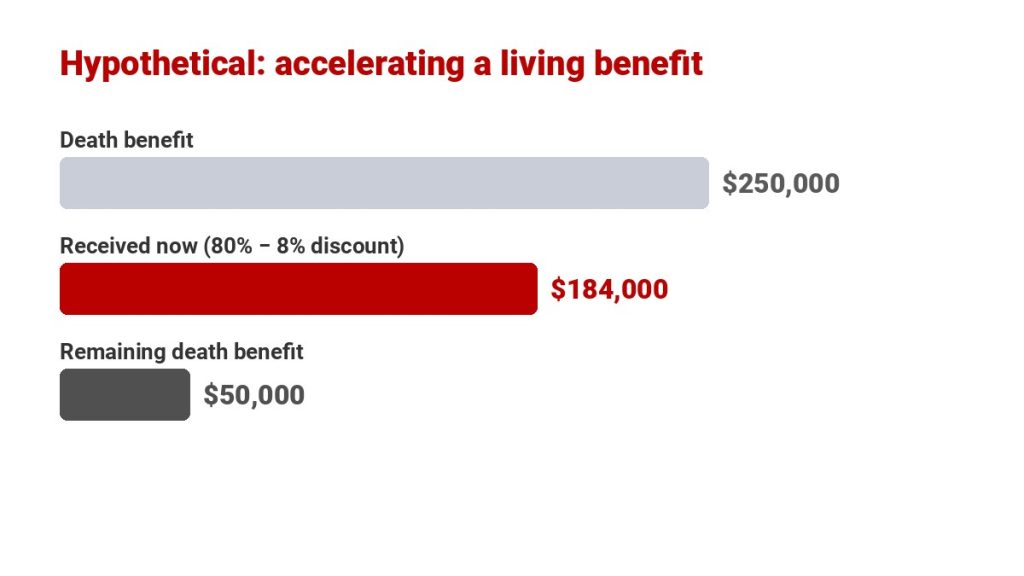
Hypothetical example: Hai has a $250,000 policy, is diagnosed with a critical illness, and asks to accelerate 80%, with an assumed 8% discount.
- Amount accelerated: $250,000 × 80% = $200,000.
- After the discount: $200,000 × (1 − 8%) = $184,000 paid to Hai.
- Remaining death benefit for the family: $250,000 − $200,000 = $50,000.
Using living benefits may reduce or end some other policy benefits. Ask the insurer or your agent for real numbers before deciding.
Calculator: estimate an accelerated benefit
Enter the death benefit, the portion to accelerate and an assumed discount:
Calculator: how much could you receive from a living benefit?

Documents to prepare

| Claim type | Documents usually needed |
|---|---|
| Death claim | The insurer’s claimant statement, a certified death certificate, the policy number, the beneficiary’s ID. If death occurs in the first 2 years, the insurer may also request medical records. |
| Living benefits | Claim form, a doctor’s statement of the diagnosis or life expectancy, related medical records, sometimes a review by the insurer’s own doctor. |
| Waiver of premium | Claim form, a doctor’s statement of the disability, periodic updates. |
Death certificates usually come from the vital records office of the county or state where the death occurred, and funeral homes often help families order copies. Get several certified copies, because banks, Social Security and insurers may all need one.
Step by step: how to file a claim
- Notify the insurer: call the customer service number on the policy or use the insurer’s website. Give the policy number, the insured’s name and the reason for the claim.
- Get the claim packet: the insurer sends a claimant statement and a list of required documents. Each beneficiary usually fills out a separate form.
- Collect documents: a certified death certificate or a doctor’s statement, a photo ID, and sometimes medical records.
- Submit and keep copies: send everything through the online portal, by email or by tracked mail. Take a photo of every page first.
- Follow up: ask for the claim number and the name of the examiner, and call back if you hear nothing after a few weeks.
If the insurer asks for more paperwork, send it quickly, because the processing clock usually starts only when the file is complete. Most beneficiaries do not need a lawyer for a routine claim. The agent who sold the policy can often help fill out the forms at no cost.
A quick tip on timing: there is no rule that says you must file within a set number of days after a death, but most policies ask you to notify the insurer “as soon as reasonably possible.” For living benefits, the timing matters even more, because the money is meant to help while the insured is still alive. Knowing when to file a life insurance claim is often the difference between money that arrives in time for treatment and money that arrives too late to help.
What happens after you file
The claims examiner checks that the policy was in force, confirms the cause of death or the diagnosis, and verifies who the beneficiaries are. For a straightforward death claim with complete papers, payment of the death benefit commonly arrives within a few weeks. For living benefits, the insurer may ask its own doctor to review the records before approving. If the claim is approved, you choose how to be paid. If it is denied, the insurer must explain why in writing, and you can ask for a review or contact your state’s insurance department.
Why you should not wait
- Slower payment: the insurer only starts once it has complete documents. Complete claims are often paid within a few weeks.
- Harder paperwork: the longer you wait, the harder it is to collect medical records and the deceased’s documents.
- Missed benefits: with living benefits and premium waivers, waiting can cost months of benefits.
- Forgotten policies: if no one claims, the money may eventually go to the state’s unclaimed property program, which takes extra steps to recover.
Not sure whether a loved one had a policy? You can use the free Life Insurance Policy Locator from the NAIC, or look through bank statements for regular premium payments.
Special situations

- A policy about to lapse: if the insured dies during the grace period (usually about 30 to 31 days after a missed due date), the insurer still pays, minus the premium owed.
- Death in the first 2 years: the insurer may review the original application, so processing takes longer; see why life insurance claims are denied.
- A minor beneficiary or one living in Vietnam: extra guardianship or translated ID documents may be needed; see owner, insured and beneficiary.
- How to receive the money: a lump sum or installments. The death benefit is generally not subject to income tax, but interest earned on installments can be taxable.
Read real claim stories from Thinksmart clients, and see our Term Life and Thinksmart IUL pages.
Frequently asked questions
When is the right time to file a life insurance claim?
As soon as possible after the event: when the insured has died and a death certificate is available, or when a terminal, critical or chronic illness is diagnosed if the policy has living benefits.
Is there a deadline to file a life insurance claim?
There is no single nationwide deadline. Policies usually ask for notice within a reasonable time. Waiting does not usually cancel the right to the death benefit, but it delays payment and the money may end up with the state’s unclaimed property program.
How long does it take to get paid?
With complete documents, many insurers pay within a few weeks. If the insured died in the first 2 years or paperwork is missing, it can take longer.
Do living benefits reduce what my family receives?
Yes. The amount accelerated is subtracted from the death benefit, and the insurer usually also applies a discount for paying early.
Is a life insurance death benefit taxable?
The death benefit is generally not subject to federal income tax. Interest earned when you take installments can be taxable.
Need help filing a claim?
The Thinksmart Insurance team helps families prepare documents and work with the insurer in plain English or Vietnamese, even for policies bought elsewhere. Contact us for free help →









 Thinksmart Insurance