
Living benefits life insurance lets you receive part of your death benefit while you are still alive if you become seriously ill as defined in the policy. Many people think life insurance only pays when someone dies. In fact, many policies today can help pay medical bills, replace lost income or cover care while the insured person is still in treatment. This guide explains the three types of living benefits, the rules, how the payout is calculated and how to file a claim.

What is living benefits life insurance?
In the policy, living benefits usually appear as an accelerated death benefit or an accelerated benefit rider. Instead of waiting until death, the insured person can ask the insurer to pay part of the death benefit early when they meet the medical conditions in the rider.
The money is usually paid directly to the insured person and can be used for anything: hospital bills, medication, rent or mortgage, a caregiver, or income while they cannot work. That is a big difference from health insurance, which pays doctors and hospitals for covered bills.
The 3 types of living benefits
1. Terminal illness
This applies when a doctor certifies that the insured’s life expectancy is no more than a set period, usually 12 or 24 months depending on the insurer. It is usually not limited to a list of diseases: any illness that leads to that prognosis can qualify. The amount you can accelerate can be a large share of the death benefit, up to the insurer’s limit.
2. Chronic illness
This applies when the insured cannot perform at least 2 of the 6 activities of daily living (ADLs) for a long period, usually at least 90 days, or has a severe cognitive impairment such as Alzheimer’s that requires supervision. Payments are often made monthly or yearly, up to a maximum.
| Activity of daily living | What it means |
|---|---|
| Bathing | Washing yourself and getting in and out of the tub or shower |
| Eating | Feeding yourself |
| Dressing | Putting on and taking off clothes |
| Toileting | Using the toilet and cleaning yourself |
| Transferring | Getting in and out of a bed or chair |
| Continence | Controlling bladder and bowel function |
3. Critical illness
This applies when you are diagnosed with one of the conditions listed in the rider. The list commonly includes a major heart attack, stroke, invasive cancer, end-stage kidney failure, major organ transplant, paralysis, coma and severe burns. Some insurers also cover critical injuries. Each condition has its own medical definition, so a diagnosis alone is not enough: it must meet the severity the policy describes.
Read real client stories: Ms. Tien received $323,195 after breast cancer and Mr. Son received $54,000 after liver cancer.
How much can you receive, and how is it reduced?
This is the part people most often misunderstand. When you use an accelerated death benefit, two things happen at once:
- Your death benefit goes down by the amount you accelerate.
- The cash you actually receive is usually less than that amount, because the insurer pays early, applies a discount and may charge an administrative fee.
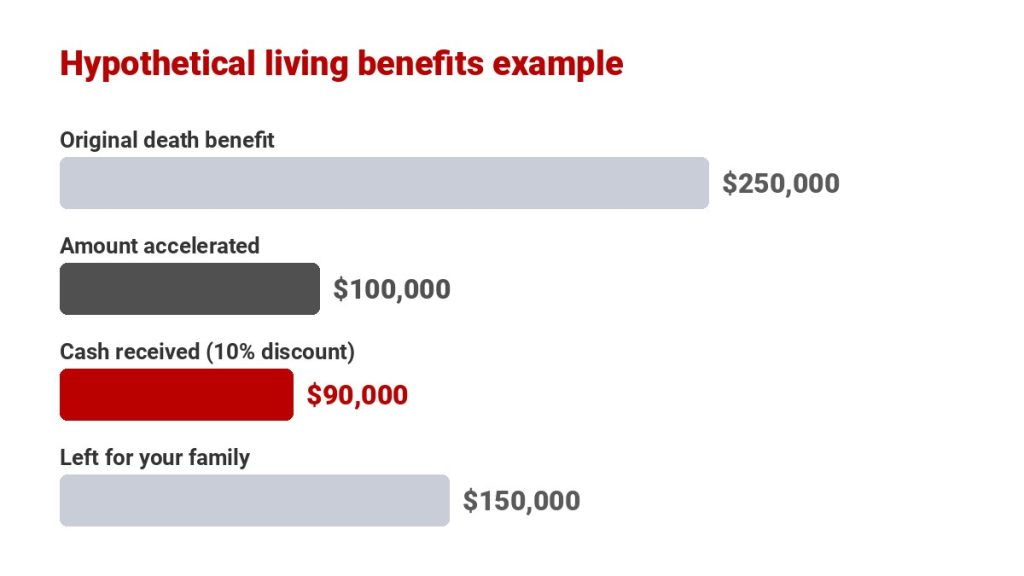
Hypothetical example: Minh has a $250,000 policy, is diagnosed with a critical illness and accelerates $100,000. Assume the insurer applies a 10% discount:
- Cash received: $100,000 × (1 − 10%) = $90,000.
- Death benefit left: $250,000 − $100,000 = $150,000 for his family later.
The real discount depends on age, the illness, life expectancy and interest rates. A shorter life expectancy usually means a smaller discount. Use the calculator below to estimate with your own numbers:
Living benefits estimate calculator
Estimated cash you receive:
Waiting periods, limits and other rules
- Waiting periods: for critical illness, many policies have a waiting period from the policy date, often about 30 days and up to 90 days for cancer. A condition found during this time may not be covered.
- Maximums: each insurer caps how much you can accelerate, both as a percentage of the death benefit and as a dollar amount.
- Using one benefit affects the others: once you accelerate for one condition, less is left for any other living benefit.
- The policy must be in force, and the health answers on the application must have been truthful. See why life insurance claims get denied.
Are living benefits taxable?
Under US federal tax law, accelerated death benefits paid to someone who is terminally ill (a doctor certifies a life expectancy of 24 months or less) are generally not taxable income. Benefits paid for chronic illness are also generally tax-free, but within limits and rules on how the money is used. Every situation is different, so talk to a tax professional before you take a large payment.
One thing many people miss: living benefits can affect eligibility for means-tested programs such as Medicaid or SSI. If your family receives, or may soon apply for, these benefits, ask before you file.
Which policies include living benefits life insurance riders?
Living benefits can be found on many types of life insurance: term life, whole life and IUL. What matters is the specific policy:
- Does it include all three (terminal, chronic and critical), or only terminal?
- Is the rider built in with no upfront cost, or an add-on with a monthly charge?
- With term life, living benefits only work while the term is active. When the term ends, so do the riders. See what happens when term life expires.
Living benefits vs health insurance vs long-term care
| Living benefits | Health insurance | Long-term care | |
|---|---|---|---|
| Paid to | The insured | Doctors and hospitals | Usually based on care costs |
| How money is used | Any purpose | Medical bills | Long-term care |
| Reduces death benefit | Yes | No | No (except hybrid policies) |
Living benefits do not replace health insurance. They add a layer of protection that gives your family cash when a serious illness stops your income.
How to file a living benefits claim

- Tell your agent or the insurer as soon as you have a diagnosis, so you know which benefits your policy offers.
- Complete the insurer’s claim form.
- Send medical records and a doctor’s statement that clearly show the diagnosis, the severity or the life expectancy.
- Review the insurer’s offer: the cash amount, the discount and the remaining death benefit, before you sign.
When medical records do not describe the severity clearly, a claim can be delayed or denied, as in Ms. Nga’s story. Thinksmart clients get help through the whole process on our insurance claims support page.
5 questions to ask about living benefits before you buy

- Does the policy include terminal, chronic and critical illness benefits?
- Do the riders cost extra, and is the cost charged up front or only when used?
- Which critical illnesses are covered, and how are they defined?
- How long is the waiting period, and what is the maximum I can accelerate?
- If I use a living benefit, how do my death benefit and monthly charges change?
It also helps to read about conditions life insurance may not cover so you know the common limits.
Living benefits life insurance is most useful when you understand it before you need it. A few minutes with your policy now can save your family stress and money later, at a time when they will already have a lot to handle.
Frequently asked questions
What are living benefits in life insurance?
Living benefits, also called an accelerated death benefit, let the insured receive part of the life insurance death benefit early if they have a terminal, chronic or critical illness as defined in the policy.
Does my family still get money if I use living benefits?
Yes, but less. The death benefit is reduced by the amount you accelerated. The rest is still paid to your beneficiaries when you die, as long as the policy stays in force.
When does a chronic illness benefit pay?
Usually when you cannot perform at least 2 of the 6 activities of daily living (bathing, eating, dressing, toileting, transferring and continence) for at least 90 days, or have a severe cognitive impairment such as Alzheimer’s.
Are living benefits taxable?
For terminal illness, accelerated benefits are generally not taxable federal income. For chronic illness they are generally tax-free within limits. Ask a tax professional about your situation.
Does term life insurance have living benefits?
Many term life policies include living benefits, sometimes at no extra premium. They can only be used while the term is still active.
Want to know if your policy has living benefits?
The Thinksmart Insurance team can review your policy with you and explain each benefit in plain English or Vietnamese, free of charge. Book a free consultation →









 Thinksmart Insurance