
Waiting until sick to buy life insurance is a mindset many families share: “I am young and healthy, I do not need it yet. I will buy it when something comes up.” It sounds reasonable, since everyone wants their money to go toward things they need right now. But life insurance does not work that way, and the cost of waiting is often much higher than people expect.
This article is not meant to scare you. It explains why people wait, how life insurance evaluates applicants, and how to buy something affordable without waiting.

Why do so many people end up waiting until sick to buy life insurance?
The reasons are easy to understand:
- Feeling healthy: no illness yet, so risk feels far away.
- Other priorities: rent or mortgage, car payments, sending money to family abroad, raising kids.
- Confusing it with health insurance: ACA health plans cannot deny you for pre-existing conditions, so many assume life insurance is the same. It is not (see how the US healthcare system works).
- Not wanting to talk about it: many families avoid discussing illness and death.
- Past bad stories about insurance that make people hesitant.
All of these are real. But knowing how life insurance underwriting works will help you make a better decision.
How life insurance evaluates your health
When you apply, the insurer underwrites you: it asks about your medical history and medications, may take blood and urine samples, and may review doctor records and prescription databases. It then assigns a rate class such as Preferred Plus, Preferred, Standard, a Table rating (higher cost), or a decline. See how rate class affects your premium.
The key point: your rate class is locked in when you buy. Buy while healthy and you get a good class; if you develop a condition later, an existing policy’s premium stays as stated in the contract. Buy after a diagnosis and you are rated based on that condition.
5 real costs of waiting until sick to buy life insurance
1. Much higher premiums, or a decline

Conditions such as diabetes, high blood pressure, heart disease or cancer often push your rate class down. Serious or recent diagnoses can lead to a postponement or decline (see why applications get declined and life insurance after cancer).
2. Age raises premiums even if you stay healthy
Life insurance is priced by age. Every year you wait, the price goes up, even with no health issues at all.
3. Only small policies with waiting periods are left
People who are declined are often left with guaranteed issue coverage, which asks no health questions. These policies usually offer small amounts, cost a lot relative to the benefit, and have a waiting period of about 2 to 3 years: if you die from an illness during that time, the insurer typically refunds the premiums plus some interest rather than paying the full benefit.
4. Losing access to living benefits
Many policies include living benefits that let you access part of the death benefit early for a terminal, chronic or critical illness. But they generally apply to conditions that arise after the policy is in force. A condition you already had usually does not qualify.
5. Years with no protection for your family
While you wait, if something happens, your family has nothing. This is the hardest cost to put a number on: the mortgage, your children’s education, debts and final expenses.
Step-by-step hypothetical example
Tuan (a hypothetical person) is 35, healthy, and considering a 20-year, $500,000 term policy.
- Buy at 35, Preferred: assume $25/month. Over 20 years: $25 × 12 × 20 = $6,000.
- Wait until 45, still healthy: assume $45/month. Over 20 years: $45 × 12 × 20 = $10,800.
- At 45 with diabetes, Standard: assume $75/month. Over 20 years: $75 × 12 × 20 = $18,000.
- Difference between buying at 35 and buying at 45 with diabetes: $18,000 − $6,000 = $12,000, plus 10 years without coverage.
- If instead of diabetes Tuan has a heart attack, he may be postponed or declined, leaving no number to compare.
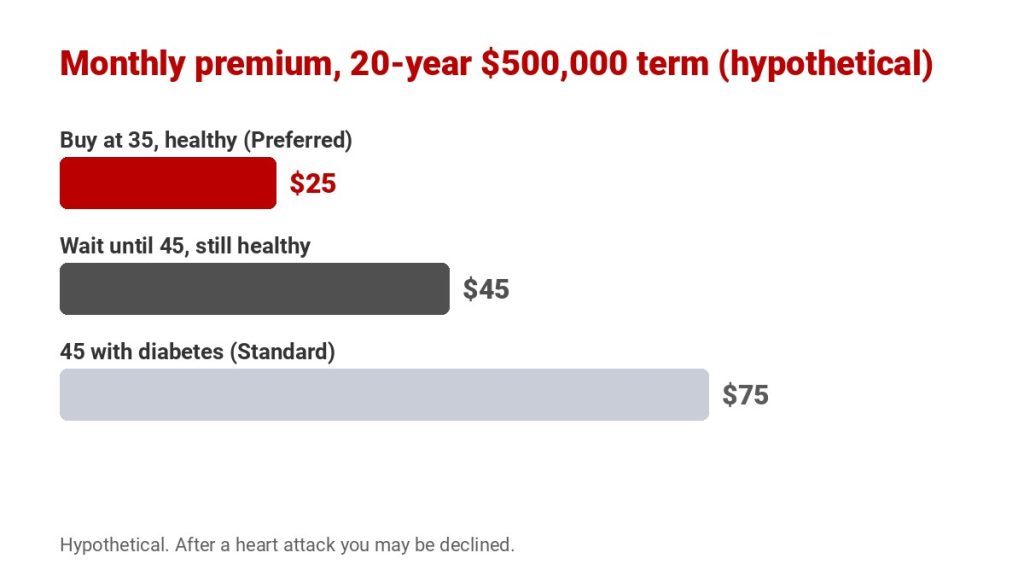
All numbers are hypothetical, not any insurer’s rates. Real premiums depend on age, sex, health, tobacco use, insurer and product.
Calculator: the cost of waiting (hypothetical)
Can you hide a condition to get approved?
You should not. Most policies have a contestability period, usually the first 2 years. If the insured dies during that time, the insurer can review the application again. If it finds a material misstatement or a hidden condition, it may deny the claim or rescind the policy. The worst outcome is a family that paid premiums for years and receives nothing when it matters. Being truthful from the start is always safer.
How to avoid it: buy at the right time and within budget

- Start small: an affordable term policy while healthy beats waiting until you can afford a big one.
- Choose convertible term: if your health changes, you can switch to permanent coverage without a new exam (see term life conversion).
- Choose a policy with living benefits for support during a serious illness while you are alive.
- Add coverage as income grows: you can buy another policy while still healthy.
- Compare insurers: each one views conditions differently. The same condition might be Standard at one company and a Table rating at another.
If you already have a condition, do not give up. Well-controlled conditions, such as blood pressure or stable type 2 diabetes, are often still insurable, just at a higher price. An agent can ask several insurers informally before you submit a formal application.
Is it ever too late?
It is rarely completely too late, but options narrow with age and health. Many insurers stop issuing new term policies at older ages, and longer terms are not available as you get older. Guaranteed issue coverage is often available to older applicants, but with small amounts and a waiting period. The earlier you look, the more choices you have, so even if you decide not to buy today, it is worth knowing where you stand. A short conversation with a licensed agent, or a quick informal quote from a few insurers, can show you what is realistic for your age and health today, without any obligation to buy.
How to talk to a family member who keeps putting it off
Many people read about this because they worry about a parent, spouse or sibling who keeps delaying. A few gentle approaches help: talk about plans rather than death (“if you could not work for a few months, how would we manage?”), focus on the kids and the house, and suggest just getting a quote first with no commitment. Do not push. A calm conversation usually works better than scary stories, and it gives the other person room to decide for themselves.
Frequently asked questions
Can I buy life insurance if I already have a health condition?
Often yes, if the condition is well controlled, but at a higher premium. Serious or recent diagnoses may be postponed or declined, leaving mainly small guaranteed issue policies.
If I buy while healthy and get sick later, will my premium go up?
For term and many other policies, your rate class is locked in at purchase. A later diagnosis does not change the class of a policy you already own. Term premiums are usually level for the chosen period.
Why can health insurance not deny me, but life insurance can?
ACA health plans are governed by a law that bans denials for pre-existing conditions. Life insurance is not covered by that rule, so insurers can consider health and age when deciding whether to accept you and what to charge.
What happens if I hide a condition on my application?
Your claim could be denied. During the contestability period, usually the first 2 years, an insurer that finds a material misstatement can deny payment or rescind the policy.
What is the best age to buy life insurance?
There is no fixed age. A good time is when someone depends on your income, such as after marriage, having children or buying a home, and while you are healthy. The earlier you buy, the lower the premium.
Want to know your likely rate class and premium?
Thinksmart Insurance compares several insurers at once and explains everything clearly, in English or Vietnamese, at no cost. Even with a health condition, it is worth asking. Contact us →





 Thinksmart Insurance