
“If the stock market crashes 30-40%, does the money in my IUL disappear?” Every time the news turns red, this is the question we hear most. The IUL stock market crash question deserves an answer with both sides, because hearing only half of it leads to wrong decisions.
The short answer: you do not lose money with the market, because IUL has a floor (usually 0%) on index credits. But your account value can still go down, because cost of insurance and policy charges come out every month, even in a down year. This article walks through real numbers from actual crash years.

IUL stock market crash basics: how the floor works
In an IUL, your money is not used to buy stocks directly. An index like the S&P 500 is only a measuring stick for the interest credit. Every index strategy has three key numbers:
| Term | Plain meaning |
|---|---|
| Floor | The lowest credit in a crediting period, usually 0%, some strategies 1% |
| Cap | The highest credit for the period, for example 9-11% |
| Participation rate | The percentage of the index gain that counts toward your credit |
Because of the 0% floor, an IUL credits 0% in a crash year instead of -38%. That is the biggest difference between IUL and a brokerage account or a VUL (Variable Universal Life). Learn more about caps in IUL cap rate and participation rate, and how the insurer manages your money in where your IUL premium goes.
Crediting periods: what if the market crashes mid-year?
Most strategies use an annual point-to-point method. The insurer only compares the index value on the first day and the last day of the segment. If the market crashes mid-year and recovers before the end date, you can still earn a credit. On the other hand, if the market drops right at the end of the segment, that year credits 0% even if it was up earlier. Some carriers offer an index lock feature to lock in a gain during the segment.
Real numbers: crash years and what an IUL would credit
Here are calendar-year S&P 500 price returns (without dividends) for some of the worst recent years, and what a sample IUL (10% cap, 0% floor) would credit:
| Year | S&P 500 | Sample IUL credit |
|---|---|---|
| 2001 | -13.04% | 0% |
| 2002 | -23.37% | 0% |
| 2008 | -38.49% | 0% |
| 2009 | +23.45% | 10% (capped) |
| 2022 | -19.44% | 0% |
| 2023 | +24.23% | 10% (capped) |
The pattern is clear: in every IUL stock market crash year above, the 0% floor held and the IUL sat at 0%, and in a strong rebound it only earns up to the cap. That is the price of the protection.
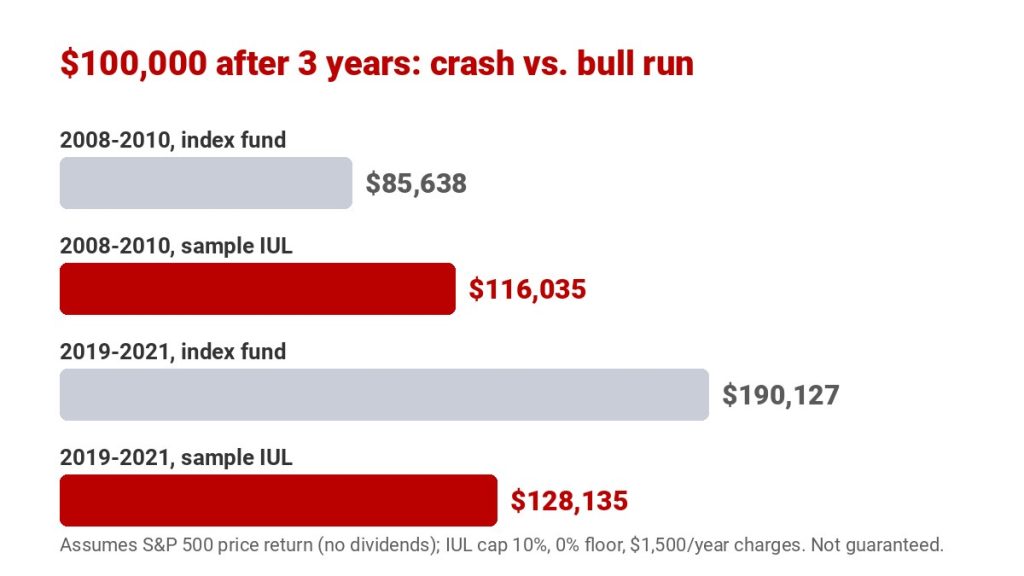
IUL stock market crash example: $100,000 through 2008-2010
Assumptions: $100,000 account value, 10% cap, 0% floor, $1,500 in policy charges per year. Compared with putting $100,000 directly into an S&P 500 index fund (no dividends or fund fees).
Index fund:
- 2008: $100,000 × (1 − 38.49%) = $61,510.
- 2009: $61,510 × (1 + 23.45%) = $75,934.
- 2010: $75,934 × (1 + 12.78%) = $85,638.
Sample IUL:
- 2008: 0% credit, minus charges: $100,000 − $1,500 = $98,500.
- 2009: 10% credit (capped): $98,500 × 1.10 − $1,500 = $106,850.
- 2010: 10% credit (capped): $106,850 × 1.10 − $1,500 = $116,035.
After 3 years the sample IUL is about $30,000 ahead. The main reason is the annual reset combined with the 0% floor: the IUL did not lose in 2008, so 2009 started from almost $100,000. The index fund needed a gain of about 63% just to get back to $100,000.
And when the market soars? Example 2019-2021
To be fair, an IUL stock market crash example is only half the story, so look at the other side too. Same assumptions, but in 2019-2021 the index rose 28.88%, 16.26% and 26.89%:
- Index fund: $100,000 → $128,880 → $149,836 → $190,127.
- Sample IUL: 10% capped credit each year minus $1,500: $108,500 → $117,850 → $128,135.
This time the index fund is about $62,000 ahead, before dividends. So IUL is not built to “beat the market”. It fits people who need life insurance, want steady accumulation and cannot afford to watch their account fall 30-40% right before retirement.
Calculator: after one up or down year, what is left in an IUL vs an index fund?
An IUL can still lose value in a stock market crash: 3 situations

1. Charges still come out in down years
In an IUL stock market crash, the 0% floor only protects the index credit. Cost of insurance (COI), policy fees and rider charges are still deducted monthly. In a run of losses like 2000-2002 (down 10.14%, 13.04% and 23.37%), the sample IUL credits 0% three years in a row and the account drifts from $100,000 to $95,500 because of charges. The index fund would be near $59,880, so the IUL dip is far smaller, but it is not zero. See every charge in IUL fees explained.
2. An underfunded policy
A policy funded at the minimum that runs into a few 0% years may not have enough to cover charges later in life, when COI rises with age. If the account value cannot pay the charges, the policy can lapse unless you add money. That is a real risk, not because the market took your money, but because the account did not grow as planned.
3. You have a policy loan
With an indexed (participating) loan, the borrowed amount earns 0% in a down year while loan interest keeps accruing. A few years like that can grow the loan faster than expected. Read IUL policy loans before taking retirement income.
What to do with your IUL when the market crashes

- Do not surrender in a panic: the 0% floor is doing its job, and the annual reset lets you catch the rebound. Early surrender usually costs surrender charges.
- Keep paying the planned premium: this is the best way to keep the account from running short in 0% years.
- Read your annual statement: check the account value, charges deducted and any loan balance.
- Request an in-force illustration: it shows how long the policy lasts on current assumptions. See how to read an IUL illustration and guaranteed vs non-guaranteed values.
- Review your allocation: some carriers offer 1% floor strategies or a fixed account to spread the risk of several flat years.
Common misunderstandings during a crash
- "An IUL never goes down": not true, even with a 0% floor. Index credits never go negative, but charges can still reduce the value.
- "If the market gains 25%, I get 25%": not true. Credits are limited by the cap and participation rate, and there are no dividends.
- "The insurer bought stocks with my money, so a crash wipes it out": not true. The money sits in the insurer’s general account, mostly high-quality bonds.
- "After a bad year, next year’s cap is guaranteed to stay the same": not necessarily. Current caps can change, but not below the contract minimum.
Bottom line on an IUL stock market crash
No, a crash does not wipe out your IUL. Thanks to the 0% floor, the index credit stays at 0% instead of following the market down 20-40%. But charges still come out in down years, and in strong up years the IUL only earns up to the cap. Understand both sides, fund the policy as planned and review it every year.
Frequently asked questions
Does an IUL lose money when the stock market crashes?
The index credit cannot go negative because of the floor (usually 0%), so you do not lose with the market. Policy charges still come out monthly, so the account value can dip slightly.
What did an IUL credit in 2008 when the S&P 500 fell 38%?
With an S&P 500 strategy and a 0% floor, the index credit for that year was 0%. The account only went down by the charges deducted.
Does an IUL need to wait for the market to recover after a loss?
No. Most strategies reset each year, so the next credit is measured from the new index level, not from the old high.
Why does an IUL earn less in strong market years?
Credits are limited by the cap and participation rate, and IUL does not receive dividends. That is the trade-off for the floor.
Should I cancel my IUL when the market crashes?
Usually not. The floor already protects your credits, and surrendering early can trigger surrender charges. Keep funding the policy and request an in-force illustration instead.
Want to see how your IUL holds up in a down year?
Thinksmart Insurance helps you read your annual statement and illustration in English or Vietnamese, compares several carriers and charges nothing for advice. Contact us →







 Thinksmart Insurance