
Life insurance for single parents is something many people know they need but keep putting off. That is understandable: one person working, driving kids around, paying rent and groceries, with little time or money left over. But precisely because there is only one income, if that parent dies, the children lose both a parent and their means of support at the same time.
This guide answers the 3 questions single parents ask most: how much to buy, which type to choose and, most importantly, who will manage the money while the kids are young.

Why single parents need life insurance even more
In a two-parent home, if one parent dies, the other still has an income. A single mom or single dad has no second safety net. Child support from the other parent, if any, is not guaranteed either. If the single parent dies, the children are often raised by grandparents, aunts or uncles who may be older or have their own families to support.
A large enough life insurance policy gives whoever raises your children money to replace your income: housing, food, school and medical costs, until the kids are on their own.
Life insurance for single parents: how much is enough?
A simple calculation has 4 parts:
- Raising the kids: what your children need per year × years until your youngest turns 18.
- College: a fund for each child (community college, trade school or a 4-year degree).
- Debts and funeral: credit cards, car loan and funeral costs.
- Subtract any life insurance you already have, such as coverage through work.
In addition, unmarried children under 18 (or 19 if still in high school full time) of a worker who paid enough into Social Security may receive survivor benefits. That reduces the need, but it rarely replaces a parent’s full income. For more detail, see how much life insurance you need.
Hypothetical example, step by step
Hanh (a hypothetical person) is 34, works as a 1099 nail technician earning about $42,000 a year, and raises two children aged 5 and 9 on her own. She has no life insurance yet.
- What the kids need per year: she estimates $30,000 (housing, food, school, transportation).
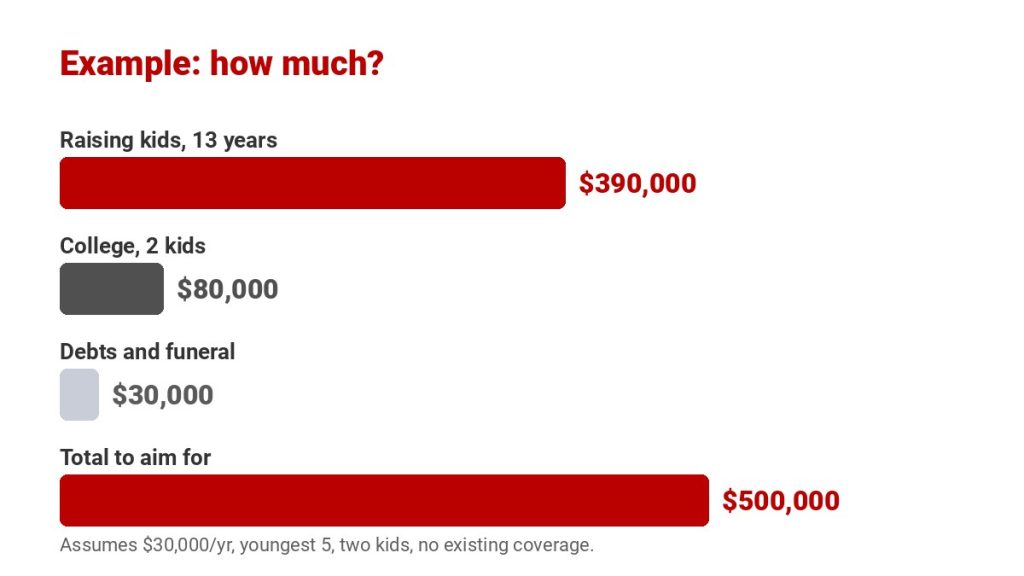
- Years until the youngest turns 18: 18 − 5 = 13 years. Raising the kids: $30,000 × 13 = $390,000.
- College: $40,000 × 2 children = $80,000.
- Debts and funeral: car and card debt $18,000 + funeral $12,000 = $30,000.
- Total: $390,000 + $80,000 + $30,000 = $500,000.
- Minus existing coverage: $0. Coverage to aim for: about $500,000.
With this amount, a 20-year term policy would protect her until her youngest is 25. The actual premium depends on age, health and insurer, so she needs real quotes.
Calculator: how much life insurance does a single parent need?
Which type of life insurance?
- Term life: the lowest cost for a large amount. Choose a term that lasts until your youngest is independent, often 20 to 25 years. Look for a conversion option so you can switch to permanent coverage later.
- Living benefits: many policies let you access part of the death benefit early for a serious illness such as cancer or stroke. For a single parent, a serious illness that stops you from working is just as dangerous. See what living benefits are.
- Permanent insurance (whole life, IUL): builds cash value but costs more. It fits once you have enough term coverage and extra money you can pay steadily for many years. Many parents combine a large term policy with a small permanent one.
- Coverage through work: convenient, but often only 1 to 2 times salary and lost when you leave the job. Do not rely on it alone.
Who manages the money for children under 18?

This is the step many parents skip. Insurers usually will not pay a large sum directly to a child under the age of majority. If you name your child as beneficiary with no other arrangement, a court may have to appoint someone to manage the money, which takes time and costs money. The person the court picks may not be who you would choose, and when your child reaches the age of majority, they get full control of the entire amount.
| Arrangement | Pros | Watch out |
|---|---|---|
| 1. Name the child directly | Easy | May need court involvement; child gets everything at the age of majority |
| 2. UTMA custodian | Simple, often set up right on the beneficiary form | Child gets full control at the age set by state law, often 18 or 21, up to 25 in some states |
| 3. Trust | Most control: pay out in stages, or only for school, housing and so on | Needs an attorney and has an upfront cost |
| 4. Name a trusted adult | Fast, no extra paperwork | Legally the money is theirs; they are not required to spend it on your child |
For many single parents, the safest option is to set up a trust and name the trust as beneficiary. If that is not possible yet, naming a UTMA custodian is still better than naming the child directly. Learn the role of each person on a policy in our guide to owner, insured and beneficiary.
The guardian and the money manager can be different people
Many single parents assume these must be the same person. They do not have to be.
The guardian raises your child day to day. The trustee or custodian manages the money. You might choose grandma to raise your child and your organized sister to manage the funds. Name your child’s guardian in your will. Without a will, a court decides, and in many cases the other living parent has priority.
Common mistakes single parents make
- Not updating the beneficiary after divorce: an ex-spouse’s name stays on the policy. Do not count on the law to fix it; update it yourself.
- Relying only on work coverage: it ends when the job ends, and the amount is small.
- Buying too little to save money: an affordable term policy beats nothing, but calculate your real need first.
- Not telling family: whoever raises your kids needs to know the policy exists, which insurer, and where the papers are.
- No will: without a named guardian, a court decides for you.
Where to start when time and money are tight

- Use the calculator above to get a target number.
- Get term quotes from several insurers. Buying while young and healthy gives the lowest price.
- Decide who will raise your kids and who will manage the money, and talk with them first.
- Set up the beneficiary correctly (trust or UTMA) and keep the papers where family can find them.
- Review after any big change: a new job, a home purchase, kids growing up, remarriage.
Frequently asked questions
How much life insurance does a single parent need?
Multiply what your kids need per year by the years until your youngest turns 18, add college, debts and funeral costs, then subtract existing coverage. Many families land between $300,000 and $750,000.
Should I name my minor child as beneficiary?
Not directly. Insurers usually will not pay a large sum straight to a minor, and a court may need to appoint someone to manage the money. Use a trust or a UTMA custodian instead.
What is the difference between a guardian and a trustee?
The guardian raises your child day to day and is usually named in your will. The trustee or custodian manages the insurance money for your child. They can be the same person or two different people.
Can a self-employed single parent on a 1099 get life insurance?
Yes. Insurers look at age, health and income. People paid on a 1099 usually show income with their tax returns.
Will Social Security pay my children if I die?
Unmarried children under 18 (or 19 if still in high school full time) of a worker who paid enough into Social Security may receive survivor benefits. These rarely replace a parent’s full income.
Want help sizing your coverage and setting up who holds the money?
Thinksmart Insurance compares several insurers at once and explains everything clearly, in English or Vietnamese, at no cost. It only takes a few minutes to start. Contact us →









 Thinksmart Insurance