
A life insurance beneficiary is the person who receives the money when the insured dies. But every policy has two other roles as well: the policy owner and the insured. Many families fill in these three boxes quickly and only find a problem when it is time to collect: delayed payment, a court process, or a death benefit treated as a “gift” that must be reported. This guide explains each role, the Goodman triangle and safe ways to set things up.

Who is the policy owner?
The policy owner signs the application, usually pays the premiums and has full control: changing the beneficiary, borrowing or withdrawing cash value, lowering the face amount or cancelling the policy. The insurer only acts on the owner’s instructions. Choosing the owner means choosing who holds the keys to the policy.
At purchase, the owner must have an insurable interest in the insured, meaning they would suffer a financial or emotional loss if that person died. Spouses, parents and children, and business partners usually qualify. Strangers do not.
Who is the insured?
The insured is the person whose life is covered. The insurer underwrites this person’s health, age and occupation to set the premium. If the insured dies while the policy is in force, the insurer pays the beneficiary. The insured must sign consent to the application, except for young children, where a parent signs. See what is the insured for more.
Who is the life insurance beneficiary?
The beneficiary is the person or organization that receives the death benefit. There are two kinds:
- Primary beneficiary: paid first. You can name several and split by percentage, for example two children at 50% each.
- Contingent beneficiary: paid only if all primary beneficiaries have died first. Many policies leave this blank.
A beneficiary can live outside the US and does not need a green card or SSN; see life insurance without a green card. Normally the owner can change the beneficiary at any time. If you choose an irrevocable beneficiary, any change needs that beneficiary’s written consent.
3 common setups
| Setup | Example | Comment |
|---|---|---|
| Owner = insured | Husband owns a policy on his own life, wife is the beneficiary | Most common and simple. The proceeds count in the husband’s estate, but most families are far below the estate tax threshold. |
| Owner = beneficiary | Wife owns the policy and is the beneficiary, husband is the insured | No gift tax issue; the wife keeps control. |
| Three different people | Wife owns, husband is insured, child is the beneficiary | Goodman triangle: avoid it or ask a tax professional. |
The Goodman triangle: when the beneficiary receives a “gift”
A life insurance death benefit is generally free of federal income tax. But when the owner, the insured and the beneficiary are three different people, US tax law treats the owner as having given that money to the beneficiary. Tax professionals call this the “Goodman triangle”, after a 1946 court case.
In 2026, each person can give up to $19,000 per recipient per year without filing. Anything above that must be reported on Form 709 and counts against the lifetime gift and estate tax exemption, about $15 million per person in 2026. Most families owe no tax right away, but they must file, and part of the lifetime exemption is used up.
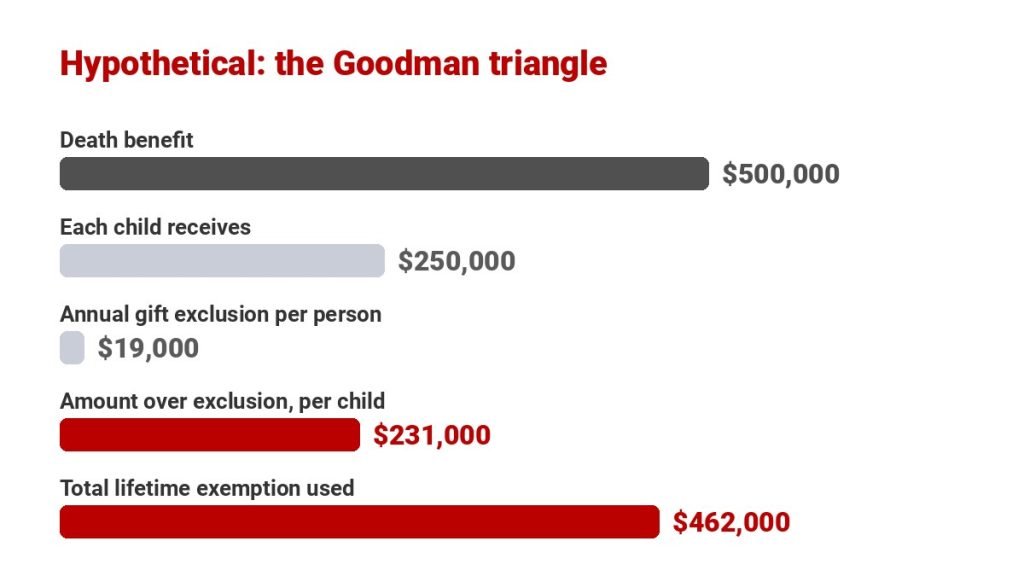
Hypothetical example: $500,000 to two children
Mai owns a $500,000 policy on her husband Hung, and their two children are equal beneficiaries. Hung dies in 2026.
- Death benefit: $500,000, treated as a gift from Mai to the children.
- Each child receives: $500,000 ÷ 2 = $250,000.
- Amount over the annual exclusion per child: $250,000 − $19,000 = $231,000.
- Total to report: $231,000 × 2 = $462,000, counted against Mai’s lifetime exemption.
If Mai had been both owner and beneficiary, or Hung had owned the policy, there would be no gift at all. One box on the form makes a big difference.
Calculator: check your family’s setup
Choose who is the policy owner, who is the insured and who is the beneficiary, then see the result:
Check your owner, insured and life insurance beneficiary setup
Naming a minor child as life insurance beneficiary

This mistake is very common. Insurers generally do not pay a minor directly. Without planning, the family may need a court-appointed guardian of the property, which takes time and money, and the court then supervises how the money is used. How to prepare:
- Name a custodian under your state’s UTMA law directly on the beneficiary designation, if the insurer allows it.
- Or set up a trust for the children and name the trust as beneficiary; do this with an attorney.
- Avoid naming a relative to “hold it for the kids” with no paperwork, because legally the money belongs to that relative.
5 beneficiary mistakes to avoid
- Leaving it blank or naming “my estate”: the money goes through probate, which is slow and costly.
- No contingent beneficiary: if the primary dies first, the money may end up in the estate.
- Not updating after divorce, remarriage or a new baby: the insurer pays whoever is on file, not what you intended.
- Incomplete details: list the full legal name, date of birth, relationship and percentage.
- Ignoring community property rules: in community property states such as California, Texas, Arizona and Washington, if premiums are paid with marital funds and the beneficiary is not the spouse, the insurer may require the spouse’s consent.
A simple habit helps: keep a copy of the latest beneficiary confirmation letter from the insurer with your important papers, and tell the people you named where to find it. Many families never learn a policy exists, or cannot find the policy number, which slows everything down at a hard time. Writing down the insurer’s name, policy number and agent contact on one page solves most of this.
Beneficiary paperwork problems are also a common reason claims are delayed; see why life insurance claims are denied.
When should you change the policy owner?

The owner can transfer ownership using the insurer’s form. But a transfer can itself be a gift for tax purposes, and transferring a policy for value (selling it) can cost the death benefit its income tax exclusion. Families with large estates who want the proceeds outside the estate usually use an irrevocable life insurance trust (ILIT) drafted by an attorney. For most families, the simplest setup is still owner = insured or owner = beneficiary.
Read more about US estate tax, or work out how much life insurance you need.
Checklist before you sign

- Who is the policy owner, and is that person paying premiums with their own money?
- Do the three roles form a Goodman triangle?
- Have you named primary and contingent beneficiaries, with percentages?
- Is any beneficiary a minor? Is there a custodian or trust?
- Plan to review beneficiaries after every major family change.
Learn more on the Term Life and Thinksmart IUL pages.
Frequently asked questions
Can the policy owner and the beneficiary be the same person?
Yes. For example, the wife owns the policy and is the beneficiary, and the husband is the insured. This is a common setup that avoids the gift problem.
What is the Goodman triangle?
It is when the owner, the insured and the beneficiary are three different people. When the insured dies, the death benefit is treated as a gift from the owner to the beneficiary, and amounts above $19,000 per recipient (2026) must be reported on Form 709.
Does a life insurance beneficiary pay income tax on the death benefit?
Generally no. Life insurance death benefits are generally not subject to federal income tax. Interest earned if you take installments, or a policy that was sold, can be taxable.
Can I name a minor child as beneficiary?
Yes, but insurers usually will not pay a minor directly. Name a UTMA custodian or use a trust to avoid a court guardianship.
How often should I review my beneficiaries?
After any major change: marriage, divorce, a new child, a beneficiary passing away, or moving to another state. It is also wise to check every few years.
Not sure your policy is set up correctly?
Send the first page of your policy to the Thinksmart Insurance team and we will review the owner, insured and beneficiary with you in plain English or Vietnamese, free. Book a free consultation →









 Thinksmart Insurance