
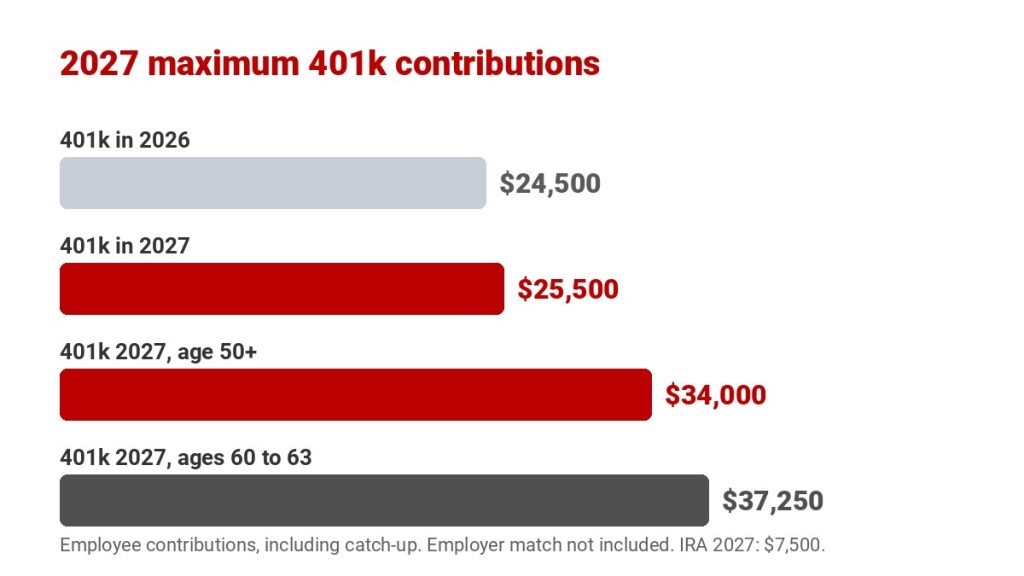
The 401k contribution limit 2027 was announced by the IRS in mid-November 2026. Workers can put up to $25,500 into a 401k in 2027, $1,000 more than in 2026. People 50 and older can save more, while the IRA limit stays the same.
For many families, a 401k is the easiest way to save for retirement: the money comes straight out of each paycheck, it lowers your taxes, and many employers add a match. This guide explains the new numbers in plain English, with a step-by-step example and a calculator to see how much room you have left.

401k contribution limit 2027 vs 2026
The table below collects the most important numbers. The last column applies to pay you receive from January through December 2027.
| Limit | 2026 | 2027 |
|---|---|---|
| 401k, 403(b), 457, TSP (employee deferral) | $24,500 | $25,500 |
| Catch-up, age 50+ | $8,000 | $8,500 |
| Catch-up, ages 60 to 63 | $11,250 | $11,750 |
| Total from all sources | $72,000 | $75,000 |
| IRA (traditional and Roth) | $7,500 | $7,500 |
| IRA catch-up, age 50+ | $1,100 | $1,100 |
Note: your employer match does not count toward your $25,500. The match only counts toward the $75,000 total limit.
What is a catch-up contribution and who gets it?
A catch-up contribution is extra room for older workers, so people who started saving late can catch up.
- Age 50 or older by the end of 2027: you can add $8,500 to your 401k.
- Ages 60 to 63: a higher catch-up of $11,750 replaces the $8,500. At 64 it goes back to the regular amount.
- Higher earners: if your 2026 FICA wages from that employer were above $155,000, your 2027 catch-up must go in as Roth (after-tax), not pre-tax.
Not every plan offers the age 60 to 63 catch-up or a Roth option. Ask HR or check your 401k provider website.
IRA in 2027: still $7,500, but income limits rise
The IRA limit for 2027 stays at $7,500, plus $1,100 for people 50 and older, for $8,600 in total. What changes are the income ranges that decide who can contribute to a Roth IRA and who can deduct a traditional IRA contribution.
Roth IRA income limits
- Single or head of household: full contribution with income (MAGI) under $158,000; partial from $158,000 to $173,000; none at $173,000 or more.
- Married filing jointly: full under $250,000; partial from $250,000 to $260,000.
- Married filing separately (lived together during the year): phase-out from $0 to $10,000.
Traditional IRA deduction limits
If you have no retirement plan at work, a traditional IRA contribution is usually fully deductible. If you have a 401k at work, the deduction phases out with income:
- Single and covered by a workplace plan: $83,000 to $93,000.
- Married filing jointly, the contributing spouse is covered: $133,000 to $153,000.
- Not covered yourself, but your spouse is: $250,000 to $260,000.
Hypothetical example: the 401k contribution limit 2027 step by step
Minh (a hypothetical person) is 45 and earns $60,000 a year. His employer matches 50% of what he contributes, up to 6% of pay. He saves 10% of pay in a traditional 401k, and his top federal tax rate is 12%.
- His contribution: $60,000 × 10% = $6,000 a year, about $500 a month.
- Pay eligible for the match: up to 6% of pay = $60,000 × 6% = $3,600.
- Employer match: $3,600 × 50% = $1,800. This is free money; contributing less than 6% would leave some of it on the table.
- Total into the 401k this year: $6,000 + $1,800 = $7,800.
- Federal tax savings: $6,000 × 12% = $720. His real cost is $6,000 − $720 = $5,280.
- Room left: $25,500 − $6,000 = $19,500 if he wants and can afford it.
If Minh were 52, his maximum would be $25,500 + $8,500 = $34,000. At 61, it would be $25,500 + $11,750 = $37,250.
Calculator: how much can you put in your 401k in 2027?
How to make the most of the new limits

Nobody has to contribute the maximum. What matters is saving steadily, in the right order, and never missing the match. A common order many financial professionals suggest:
- Contribute enough to get the full match. It is an instant return you should not skip.
- Build an emergency fund of about 3 to 6 months of expenses, so you never need to raid your 401k.
- Consider a Roth IRA if your income is within the limits. Growth and qualified withdrawals in retirement are tax-free.
- Raise your 401k percentage a little each year, for example 1% with every raise. The higher 2027 limit gives you more room to grow.
- Protect your family at the same time. A 401k is money for your old age, not money for your family to live on if you die early. See how much life insurance you need.
Self-employed: nail techs, rideshare drivers, small business owners
If you are paid on a 1099 or own a small business, you have no employer 401k, but you can open a Solo 401k or a SEP IRA. With a Solo 401k you contribute as the “employee” up to $25,500 and as the “employer” based on your profit, with a combined total of up to $75,000 (before catch-up). The employer part is tricky to calculate, so ask your tax preparer. See also nail tech 1099 vs W-2.
Maxed out your 401k and IRA: where else can you save?

Some higher earners, or people who already max out their 401k and IRA, still want more tax-advantaged retirement savings. One option is a max funded indexed universal life (IUL) policy: you pay premiums with after-tax money, the cash value grows based on an index, and you can access it through withdrawals of basis and policy loans without income tax as long as the policy stays in force. In exchange, IUL has insurance charges and surrender charges in the early years, and there is no employer match. Our guide on max funded IUL vs 401k compares the two in detail.
For most families, the 401k, especially the matched part, should come first. IUL fits better when you need both family protection and extra money you can commit for many years.
When should you change your 401k contribution?
The new limits apply to paychecks dated in 2027. If you want to save more, log in to your 401k account or ask HR in December and set your new percentage before your first January paycheck. Many plans let you choose a percentage of pay, so divide your yearly goal by your salary. For example, to reach $25,500 on a $90,000 salary, you would need about $25,500 ÷ $90,000 = 28% of pay. If that is too much, start with what you can afford and raise it later in the year.
Common 401k mistakes
- Contributing less than the match: you lose money your employer would give you.
- Withdrawing before age 59½: usually income tax plus a 10% penalty, with some exceptions.
- Cashing out when you change jobs: consider a rollover to your new 401k or an IRA to avoid taxes and penalties.
- Forgetting to update your beneficiary after marriage, divorce or a new child.
- Over-contributing with two employers in one year: the $25,500 limit is per person, not per employer. Excess deferrals must be reported and withdrawn by April 15 of the next year.
Frequently asked questions
What is the 401k contribution limit for 2027?
Employees can contribute up to $25,500 to a 401k in 2027. Workers 50 and older can add $8,500, and those aged 60 to 63 can add $11,750 instead of $8,500.
Did the IRA limit go up for 2027?
No. The traditional and Roth IRA limit stays at $7,500, plus $1,100 for people 50 and older. Only the income ranges for Roth IRA eligibility and traditional IRA deductions went up.
Does my employer match count toward the $25,500 limit?
No. The $25,500 limit only counts your own contributions. The employer match counts toward the $75,000 total limit from all sources.
Can I contribute to both a 401k and an IRA?
Yes. The two limits are separate. You can contribute to an IRA even with a 401k at work, although the traditional IRA deduction may be reduced if your income is high.
If I work for two employers, do I get two 401k limits?
No. The $25,500 limit is per person per year, across all employers. If you contribute too much, ask your 401k provider to return the excess by April 15 of the following year.
Want a clear plan for retirement and family protection?
Thinksmart Insurance explains everything clearly, in English or Vietnamese, compares several insurers and helps you choose an option that fits your budget, at no cost. Contact us →









 Thinksmart Insurance