
A max funded IUL for retirement is often sold as “tax-free retirement income”. That is partly true, but it leaves out an important detail: most of the money you take out in retirement is a loan from the insurance company, with interest, and it must be managed carefully.
This guide walks through each step: how the money comes out, why it is not taxed, how loan interest compounds, and the risks to watch. If you are new to the idea, start with how a max funded IUL works.

Max funded IUL for retirement: in what order does the money come out?
During your working years, you pay premiums close to the legal maximum so the cash value grows quickly. In retirement, there are 3 ways to take money out:
- Withdrawals: for a non-MEC policy, withdrawals come out as a return of basis first. Up to the total premiums you paid, they are not taxed. Withdrawals reduce the cash value and usually the death benefit.
- Policy loans: the insurer lends you money using your cash value as collateral. Loan proceeds are not income, so they are not taxed as long as the policy stays in force.
- Surrender: you take all remaining cash value, and any gain above your basis is taxed as ordinary income. Rarely a good choice for retirement income.
A common approach in illustrations is to withdraw up to basis first, then switch to loans. Each insurer and policy may illustrate this differently, so review your own illustration closely.
Why are policy loans not taxed?

A loan, from a bank or an insurer, is not income because you owe it back. With an IUL, the loan is repaid one of two ways: you repay it yourself, or the insurer subtracts it from the death benefit when the insured dies. The beneficiary receives the rest, generally free of income tax.
Because loan proceeds are not income, they generally do not count toward the income used to figure taxes on Social Security benefits or income-based Medicare premiums. Many people see this as an advantage over traditional 401(k) withdrawals, which are taxable income.
The key conditions: the policy must not be a MEC (overfunded beyond the 7702A limit) and must stay in force for life.
Hypothetical example: how loan interest compounds
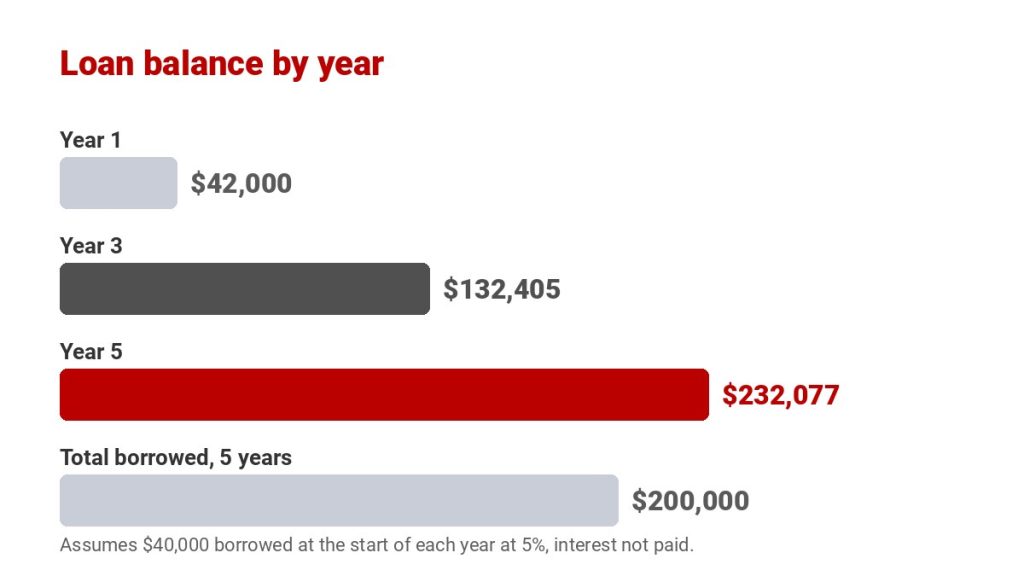
Mr. Long (a hypothetical person) is 65 and borrows $40,000 at the start of each year from his IUL. The loan rate is assumed to be 5% a year. He does not pay the interest; it is added to the loan.
- Year 1: $40,000 × 1.05 = $42,000.
- Year 2: ($42,000 + $40,000) × 1.05 = $86,100.
- Year 3: ($86,100 + $40,000) × 1.05 = $132,405.
- Year 4: ($132,405 + $40,000) × 1.05 = $181,025.
- Year 5: ($181,025 + $40,000) × 1.05 = $232,077.
- Result: he borrowed $200,000 but owes $232,077. Interest added: $232,077 − $200,000 = $32,077.
Meanwhile, the cash value used as collateral still receives index or fixed credits, depending on the loan type. If credits beat the loan rate, the policy holds up. If they fall short, such as in a 0% index year, the loan grows faster than the account. That is why the same loan plan can be safe in one scenario and dangerous in another.
Calculator: how does a policy loan balance grow? (hypothetical)
5 risks of using a max funded IUL for retirement
1. The loan balance outgrows the cash value
When the loan plus monthly charges exceed the cash value, the insurer sends a notice asking for more premium. If you do not pay, the policy lapses.
2. Taxes when the policy lapses
If the policy lapses or is surrendered with a loan outstanding, the forgiven loan is treated as money you received. The amount above your basis can be taxed as income, even though you receive no new cash. This is the biggest risk, and many people do not know about it.
3. Credits below the illustrated rate
Illustrations usually assume one fixed rate every year. Real life has 0% years and strong years. The order of good and bad years, especially early in the loan phase, matters a lot. Learn more about cap rates and participation rates.
4. Insurance charges rise with age
Monthly cost of insurance charges increase as you get older. The cash value must cover those charges and also serve as collateral for the loan. See IUL fees explained.
5. Borrowing too much, too soon
Illustrations often show the maximum loan that keeps the policy alive “just enough” to a target age. Borrowing at that maximum leaves no safety margin. Many people borrow less, for example 70% to 80% of the illustrated amount, to leave room for bad markets.
How to manage policy loans more safely

- Request an in-force illustration every year and compare the loan balance with the cash value and the age the policy is projected to last.
- Look at several rate scenarios: the illustrated rate, 1% to 2% lower, and a scenario with a few 0% years. See how to read an IUL illustration.
- Ask about an overloan protection rider: many policies have one, but the trigger conditions (age, loan ratio, years in force) vary by insurer.
- Consider paying some interest in years when you have other income, such as Social Security, so the loan does not grow too fast.
- Reduce or pause loans when the loan-to-value ratio climbs, and talk with your agent before increasing loans.
What a typical retirement year looks like
Here is a typical year once loans have started. At the start of the year, you request a loan (many insurers also allow monthly payments). The insurer deposits the money into your bank account. At the policy anniversary, you receive a statement showing the cash value, the loan balance, the interest added and the charges deducted. Compare it with last year: if the loan-to-value ratio is rising faster than planned, request a new illustration and consider borrowing less next year. This review takes about an afternoon each year, but it can prevent the most expensive mistake: a lapse with a large loan outstanding.
Is a max funded IUL for retirement right for you?
It tends to fit people with steady income who can fund the policy for many years (often 7 to 15 years or more), who already capture any 401(k) match, and who want an extra tax-flexible retirement source along with family protection. It fits less well for people who may need the money within a few years or are unsure they can keep paying. Compare options in max funded IUL vs 401k, is a max funded IUL good and how much a max funded IUL costs. Product details are on our Max Funded IUL page.
Frequently asked questions
Is retirement income from a max funded IUL taxable?
Withdrawals up to your total premiums paid are not taxed. After that, policy loans are not income as long as the policy stays in force and is not a MEC. If the policy lapses with a loan outstanding, taxes can be due.
Do I pay interest on an IUL policy loan?
Yes. The insurer charges loan interest every year. You can pay it or let it be added to the loan. If it is added, the balance grows and must be watched so it does not exceed the cash value.
Do I have to repay the loan?
Not during your lifetime. Any outstanding loan is subtracted from the death benefit when the insured dies, and the beneficiary receives the rest.
When should I start taking money from a max funded IUL?
Usually after many years of funding, once surrender charges are gone and the cash value is large enough. Taking money too early reduces compounding and raises the risk of a lapse.
Do IUL policy loans affect taxes on Social Security?
Loan proceeds are not income, so they generally do not count toward the income used to tax Social Security benefits. Traditional 401(k) withdrawals do count as income.
Want to see a retirement illustration under several rate scenarios?
Thinksmart Insurance compares several insurers and explains every number clearly, in English or Vietnamese, at no cost. Already taking loans? Bring your policy for a review. Contact us →









 Thinksmart Insurance