
When you buy an IUL (Indexed Universal Life), the carrier asks where you want your money allocated. The list often has confusing names: cap focus, par focus, 1% floor, uncapped. Your IUL index strategy decides how much interest your policy is credited each year. This guide compares each option with real math so you can see which kind of year each one wins.
If you are not sure what cap, floor and participation rate mean, start with IUL cap rate, floor and participation rate.

What is an IUL index strategy?
Money in an IUL is not invested in stocks. The carrier credits interest based on the movement of an index, usually the S&P 500, using a formula. Each formula is an IUL index strategy, built from 3 numbers:
- Cap: the most interest you can be credited in one period.
- Participation rate (par): what percentage of the index gain you get.
- Floor: the minimum, usually 0% or 1%, so a falling index does not reduce your value.
The general formula: credit = index gain × par, but no more than the cap and no less than the floor. Policy charges are still deducted monthly, so in a 0% year your account value can still go down.
4 common IUL index strategy options
1. Cap focus: 100% par, a relatively high cap (for example 11%), 0% floor. You get the index gain up to the cap.
2. Par focus: par above 100% (for example 140%), a lower cap (for example 8.25%), 0% floor. A 5% index gain becomes 7%.
3. 1% floor: 100% par, a slightly lower cap (for example 8.5%), but you still get 1% when the index falls.
4. Uncapped: uses a volatility-controlled index designed by a large bank, with par that can be above 200% and no cap. In exchange, the index is built to move less than the S&P 500, and some of these indexes have a fee built in. A high par does not mean double the interest.

Comparing each IUL index strategy year by year
Hypothetical example using the 3 strategies above. Formula: credit = gain × par, limited by cap and floor.
Index up 15%:
- Cap focus: 15% × 100% = 15%, above the 11% cap → credited 11%.
- Par focus: 15% × 140% = 21%, above the 8.25% cap → credited 8.25%.
- 1% floor: 15% × 100% = 15%, above the 8.5% cap → credited 8.5%.
Index up 5%:
- Cap focus: 5% × 100% = 5%.
- Par focus: 5% × 140% = 7%.
- 1% floor: 5% × 100% = 5%.
Index down 20%: cap focus 0%, par focus 0%, 1% floor 1%.
| Index that year | Cap focus | Par focus | 1% floor |
|---|---|---|---|
| +15% | 11% | 8.25% | 8.5% |
| +5% | 5% | 7% | 5% |
| +2% | 2% | 2.8% | 2% |
| −20% | 0% | 0% | 1% |
Each IUL index strategy wins a different kind of year: cap focus in strong years, par focus in moderate years, 1% floor in down years.
Calculator: in the same index year, how much does each IUL index strategy credit?
A 25-year look back: which IUL index strategy credited more?
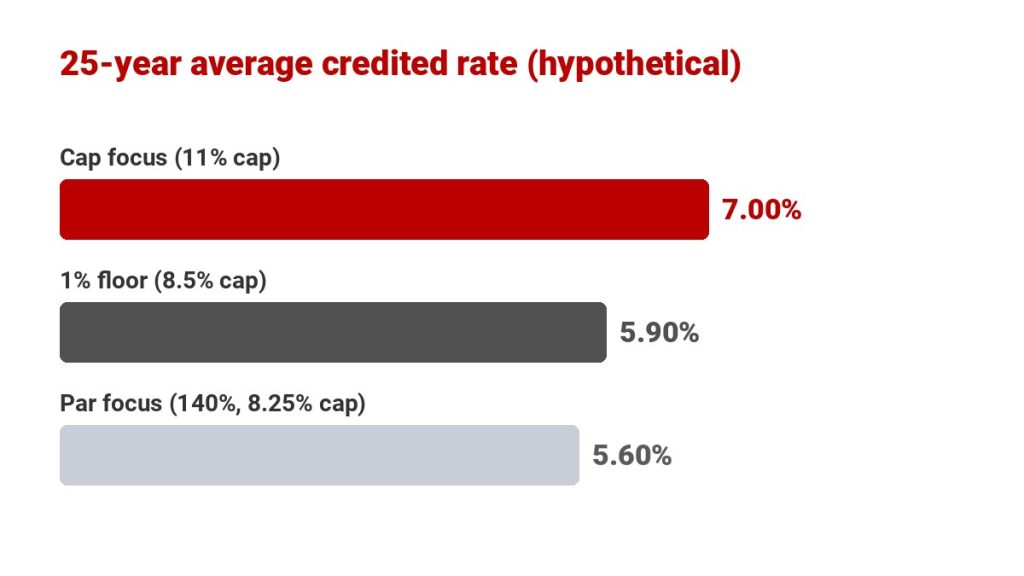
In one carrier’s hypothetical illustration, run against the S&P 500 from 2001 to 2025 (before charges):
- Cap focus (11% cap, 100% par): about 7.00% a year on average.
- 1% floor (8.5% cap): about 5.90% a year.
- Par focus (8.25% cap, 140% par): about 5.60% a year.
That period had 4 years when the index fell between 13% and 38% (2001, 2002, 2008 and 2022). Cap focus credited 0% in those years and lost nothing to the index. Thanks to strong years credited up to 11%, it still had the highest 25-year average.
Results depend on each carrier’s caps and pars, and a different period could give a different answer. Past results do not guarantee the future.
Caps and pars are not fixed
This is something many buyers are not told clearly. The cap and par in an IUL index strategy are current rates. The carrier can change them based on interest rates and the cost of options, as long as they stay at or above the guaranteed minimum in the contract. A current cap of 11% might have a guaranteed minimum of only 2–3%.
So when comparing carriers, ask for both numbers: the current cap and the guaranteed minimum. Also ask how the carrier has treated caps on older policies. See how to read an IUL illustration.
Illustrations are capped by regulation
Even if a strategy has a high historical average, illustration rules (AG 49-A) limit the rate a carrier can use in an illustration. If you see an illustration running around 5–6.5%, that is usually the maximum allowed, not a forecast. Choose an IUL index strategy for how it credits, not for the illustrated number.

How to choose your IUL index strategy
- Long-term accumulation, comfortable with some 0% years: cap focus is often a reasonable core.
- Close to taking income or already borrowing: loan interest is still due in a 0% year, so a 1% floor or a partial allocation to a floor strategy can ease the pressure. See IUL policy loans.
- Want balance: split across 2–3 strategies, for example 50% cap focus, 25% par focus, 25% 1% floor.
- Curious about uncapped indexes: ask whether the index has a built-in fee, how long its history is, and do not put everything into one new index.
Most policies let you change allocations on each index segment anniversary (usually yearly). Review alongside your annual statement.
Common mistakes when picking an IUL index strategy
- Chasing last year’s winner. A strategy that credited the most last year can credit the least next year. One strong year says little about the next 20.
- Putting everything in one new index. Some newer indexes have only a few years of real history; the rest is back-tested. A small share is fine, but do not bet the whole account on it.
- Ignoring the guaranteed minimums. Two strategies can show the same current cap today, yet one may have a much lower guaranteed floor for the cap. That matters over 20 or 30 years.
- Forgetting about loans. If you plan to borrow for income later, a run of 0% years hurts more because loan interest keeps adding up. Plan your IUL index strategy around when you expect to take money out.
- Never reviewing. Caps and pars change. Set a reminder to check your allocation each policy anniversary, the same day you read your annual statement.
None of these mistakes is fatal on its own, but together they can turn a solid policy into a disappointing one. A short yearly review with your agent avoids most of them.
Questions to ask before you choose
- What are the current cap and par of each strategy? What are the guaranteed minimums?
- How long is the index period (1 year, 2 years)? When is interest credited?
- When can I switch strategies? Do I lose anything by switching mid-period?
- Which strategies earn a bonus, and is there a charge attached?
See also what happens to IUL in a market crash and IUL fees explained.
Bottom line
No IUL index strategy wins every year. Cap focus wins strong years, par focus wins moderate years, and a 1% floor keeps a little interest when markets fall. Understand the formula, ask about guaranteed caps, split sensibly and review every year.
Frequently asked questions
Which IUL index strategy is best?
None wins every year. Cap focus wins strong years, par focus wins moderate years and a 1% floor wins down years. Many people split across several.
What is the difference between cap focus and par focus?
Cap focus credits 100% of the gain with a higher cap. Par focus credits more than 100% of the gain (for example 140%) with a lower cap.
Can I change my index strategy?
Usually yes, on the index segment anniversary, typically once a year. Rules vary by carrier.
Is an uncapped index better?
Not necessarily. It has no cap, but the index is designed to move less and some have a built-in fee. A high par does not mean double the interest.
Can the carrier lower my cap after I buy?
Yes, but not below the guaranteed minimum in your contract. Ask for both the current and the guaranteed cap.
Want help splitting your IUL allocation?
Thinksmart Insurance can review your illustration and annual statement, compare caps and pars across strategies and suggest an allocation, in English or Vietnamese, with no fee. Contact us →









 Thinksmart Insurance