
Starting January 1, 2026, the United States began collecting a new tax on money sent abroad, usually called the remittance tax. Many families who support parents and relatives overseas are asking whether every transfer is now taxed. The remittance tax 2026 rule is 1%, but it applies only when you hand cash or a similar paper instrument to a money transfer company. Send from a bank account or a US-issued card and the tax does not apply.

What is the remittance tax 2026?
It is a new federal excise tax on remittance transfers, created by the tax law Congress passed in 2025. It is not specific to any country. Sending money to Vietnam, Mexico, the Philippines or anywhere else through a transfer company follows the same rule.
The tax is based on the amount you send, not on your income. It does not replace the income tax you file each year. It is a separate charge collected at the time of the transfer.
When do you pay the 1% tax?
The law says the tax applies only when the sender gives the transfer company one of these:
- Cash.
- A money order.
- A cashier’s check.
- Any similar physical instrument, as defined by the IRS.
A common example: you bring $1,000 in cash to a transfer counter in a grocery store to send to your mother. You pay $10 in remittance tax on top of the company’s fee.
When you do not pay the remittance tax 2026
The law has two clear exceptions:
- Funds withdrawn from an account at a US financial institution: such as a bank or credit union account, sent directly through your bank app or a transfer app linked to that account.
- Payment with a debit or credit card issued in the United States.
So for the same $1,000 transfer: cash costs $10 in tax, while a bank account transfer costs $0. For other methods such as prepaid cards or digital wallets, the IRS issued proposed regulations in 2026 and details may still change. The safest step is to ask the transfer company whether your transaction will be taxed before you send.
Note: paying with a credit card is often treated as a cash advance, with high fees and interest. Avoiding a 1% tax by paying a 5% fee is not a good trade.

Remittance tax 2026 examples, step by step
Example 1: Lan sends $500 in cash to her parents every month
- Tax per transfer: $500 × 1% = $5.
- 12 transfers a year: $5 × 12 = $60.
- Over 5 years: $60 × 5 = $300.
- If Lan sends from her bank account instead of cash: $0 tax.
Example 2: Hung sends $2,000 in cash as a Lunar New Year gift
- Tax: $2,000 × 1% = $20.
- The family still receives $2,000 (before the provider’s fee and exchange rate). Hung pays the $20 on top.
| Cash sent each month | Tax per year (12 transfers) | Tax over 5 years |
|---|---|---|
| $200 | $24 | $120 |
| $500 | $60 | $300 |
| $1,000 | $120 | $600 |
| $2,000 | $240 | $1,200 |
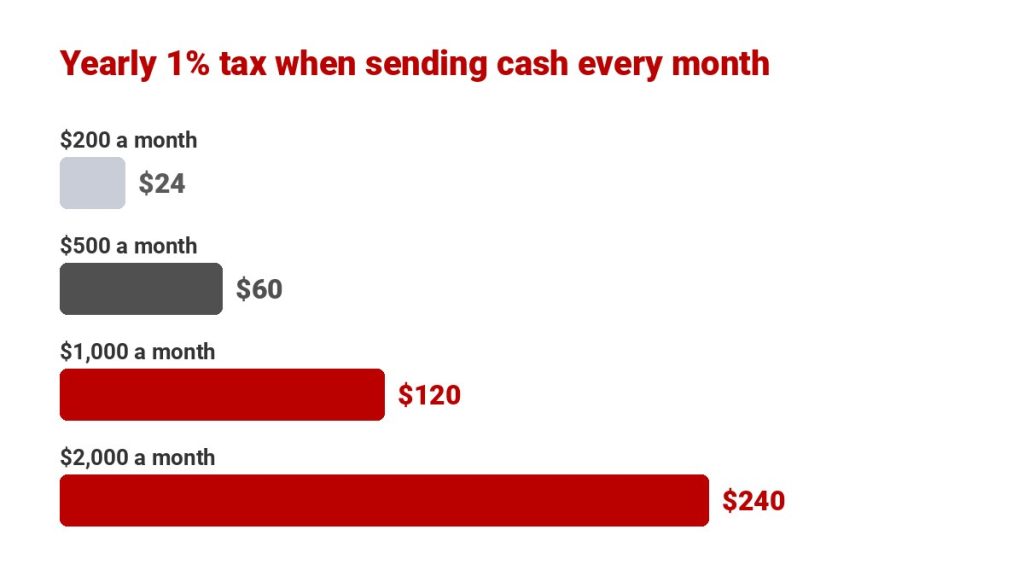
Calculator: how much remittance tax do you pay when sending cash abroad?
Who collects the remittance tax, and do you report it?
The sender owes the tax, but the transfer company collects it when you send and pays it to the IRS every quarter. You do not fill out any form for it at tax time. If the company fails to collect it, the law makes the company pay it.
Keep your receipt for every transfer. It usually shows the amount, the fee, the exchange rate and any tax charged. It is also useful if you ever need to show where money came from.
Does citizenship or your state matter?
No. The law does not distinguish between US citizens, green card holders and visa holders. It is a federal tax, so it applies the same way in Texas, California, Georgia, Washington, Virginia and every other state. There is no minimum and no cap: $50 or $5,000 in cash is taxed at 1%.
5 common remittance tax 2026 situations
- Handing cash to a transfer counter at a grocery store: the 1% remittance tax applies.
- Buying a money order with cash and giving it to a transfer company: the 1% applies, because a money order is named in the law.
- Sending through your bank app straight from a checking account: no remittance tax.
- Paying with a debit card from a US bank at the transfer counter: no remittance tax.
- Asking a friend to carry cash home: this does not go through a transfer company, so it is not this tax. But carrying more than $10,000 in cash when leaving the US must be declared to US customs, and carrying someone else’s money has its own risks.
If you are not sure about your case, ask the clerk before handing over money. The receipt will show whether the remittance tax was charged.
What this means for families who send money every month
For most families the remittance tax 2026 rule is small but easy to avoid. Someone sending $300 in cash twice a month pays $72 a year. That is money that could go to parents instead. The fix is simple: open a checking account at a bank or credit union, link it to a transfer app or use the bank’s own international transfer, and send from there. Many banks and credit unions offer basic checking accounts with low minimum balances, so ask about fees before you open one.
If you still prefer cash because it feels safer or because the receiving family wants a specific service, compare the full cost: fee, exchange rate and the 1% tax together. Sometimes a different provider with a better rate covers the tax and more.
Is the money taxed when it arrives in Vietnam?
Under Vietnam’s personal income tax law, remittances received from abroad are exempt income. Parents and relatives who receive money you send usually do not owe income tax on it there. Other countries have their own rules.
In the other direction, if you live in the US and receive a large inheritance or gift from abroad, you may need to report it to the IRS. See Form 3520 for a foreign inheritance.
3 ways to cut the cost of sending money home
- Send from a bank account instead of cash: this avoids the remittance tax entirely. If you do not have a bank account yet, opening one is the best first step.
- Compare the total cost, not just the fee: a weaker exchange rate can cost more than the 1% tax.
- Combine small transfers: the 1% does not change with the number of transfers, but flat fees do.
Supporting parents abroad: think long term
Many families send money home for decades. If the person sending it gets sick or dies, that support stops right away. Life insurance can help the family in the US and parents abroad keep that support. See how much life insurance you need and money questions to ask your parents. For the bigger tax picture, see 2027 tax brackets.
Bottom line
The remittance tax 2026 rule charges 1% only on cash and similar paper instruments handed to a transfer company. Send from a bank account or a US-issued card and you skip it. For someone sending $500 a month, that is $60 a year kept for the family.
Frequently asked questions
What is the remittance tax rate in 2026?
1% of the amount transferred, for transfers made on or after January 1, 2026, when you pay with cash, a money order, a cashier’s check or a similar physical instrument.
Is a transfer from my bank account taxed?
No. Funds from an account at a US financial institution, or paid with a US-issued debit or credit card, are exempt.
Do I report the remittance tax on my tax return?
No. The transfer company collects it when you send and pays it to the IRS each quarter.
Do US citizens pay the remittance tax?
Yes, if they send cash or a similar instrument. The law applies regardless of citizenship and in every state.
Is there a minimum or maximum?
No. The 1% applies to any cash transfer amount, with no minimum and no cap.
Planning for family in two countries?
Thinksmart Insurance can help you figure out the right protection so your family and parents keep their support if something unexpected happens, in English or Vietnamese, with no fee. Contact us →









 Thinksmart Insurance