
“I heard a Roth IRA is tax-free too, so why buy an IUL?” It is a great question. A Roth IRA vs IUL comparison matters because both can give you retirement income without income tax, but they work very differently and have very different limits and risks.
This guide compares 8 points using 2027 IRS numbers, with a step-by-step example and a calculator that shows how much you can put into a Roth IRA.

What are a Roth IRA and an IUL?
A Roth IRA is an individual retirement account. You contribute after-tax money and invest it in stocks, funds or bonds you choose. Qualified withdrawals are completely tax-free. The original owner never has to take required minimum distributions, so the money can keep growing as long as you like.
An IUL (Indexed Universal Life) is life insurance with an account value credited based on an index like the S&P 500, with a floor and a cap. Premiums are also paid with after-tax money. In retirement you can borrow from the policy, and loans are generally not taxed if the policy is not a MEC and stays in force. See how max funded IUL works.
Roth IRA vs IUL: 8 key differences
| Point | Roth IRA | IUL |
|---|---|---|
| 1. Contribution | Up to $7,500/year (2027), $8,600 at 50+ | No fixed dollar cap; limited by IRC 7702 and the death benefit |
| 2. Income limit | Yes: phases out from $158,000 (single), $250,000 (married) | None |
| 3. Eligibility | Need earned income (yours or your spouse’s) | Medical and financial underwriting |
| 4. Market risk | Can lose money if invested in stocks | 0% floor, but gains limited by the cap |
| 5. Cost | Usually low (fund fees) | Higher, especially in the first 10 years (COI, policy charges) |
| 6. Access before retirement | Contributions any time; earnings before 59½ may be taxed and penalized | Policy loans at any age, no age penalty |
| 7. At death | Beneficiaries inherit the account balance | Family receives the death benefit, usually much larger, income-tax-free |
| 8. Serious illness | No protection | Many policies include living benefits |
2027 Roth IRA contribution and income limits
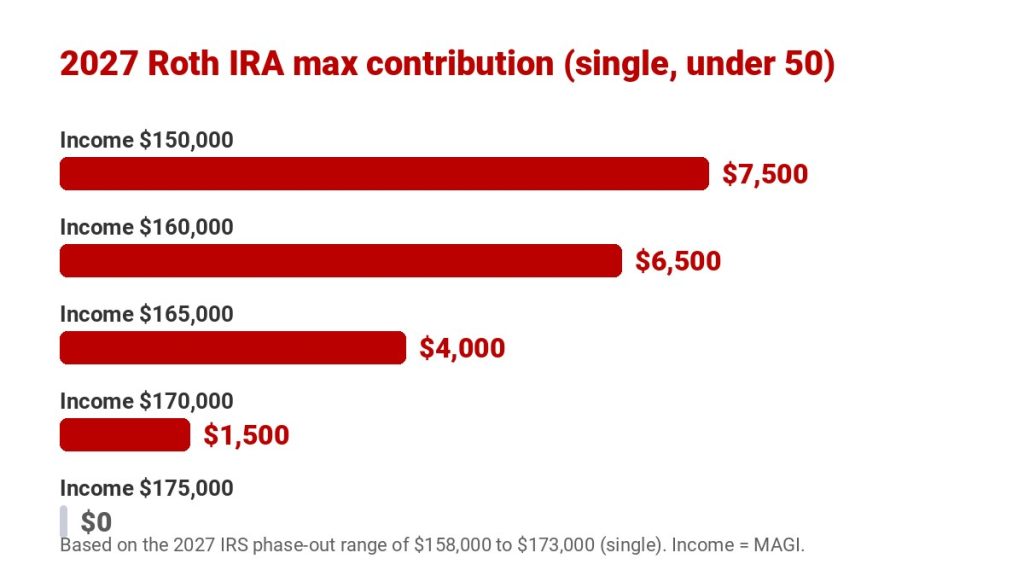
According to the IRS, the 2027 IRA limit stays at $7,500, and people 50 and older can add $1,100. A Roth IRA has an income limit based on modified AGI:
- Single and head of household: phases out from $158,000 to $173,000. Above $173,000, no direct contribution.
- Married filing jointly: phases out from $250,000 to $260,000.
- Married filing separately: phases out from $0 to $10,000, so almost no contribution.
Step-by-step example: single, $165,000 income
- Phase-out range: $173,000 − $158,000 = $15,000.
- Room left to the top: $173,000 − $165,000 = $8,000.
- Contribution: $7,500 × $8,000 ÷ $15,000 = $4,000 (rounded up to the next $10).
Many salon owners, restaurant owners and dual-income couples earn above these levels, so they cannot contribute to a Roth IRA directly. See all 2027 retirement limits in 401k contribution limit 2027.
Calculator: how much can you put in a Roth IRA for 2027?
Example: what do 25 years of Roth IRA contributions grow to?

Assume $7,500 per year for 25 years at an assumed 6% average return (not guaranteed):
- Total contributed: $7,500 × 25 = $187,500.
- Future value: $7,500 × [(1.0625 − 1) ÷ 0.06] ≈ $411,484.
- If you are 59½ and the account has been open 5 years, all of it comes out tax-free.
That is an excellent result at low cost. But if your family wants to save $20,000 to $30,000 a year for retirement, a Roth IRA only takes part of it. The rest needs another home, such as a 401k or an IUL. See max funded IUL vs 401k.
When a Roth IRA fits better, and when an IUL does
A Roth IRA fits you when
- Your income is under the limit and you have earned income.
- You want low costs, choose your own investments and accept market swings.
- You do not need more life insurance, or already have enough.
An IUL fits you when
- Your income is above the Roth limit, or you want to save more than $7,500 a year.
- Your family needs life insurance, with young children or a mortgage.
- You do not want your retirement savings to drop 30-40% in a crash. See IUL and a stock market crash.
- You can pay premiums steadily for at least 10 years, since early surrender usually loses money.
Using both a Roth IRA and an IUL

The Roth IRA vs IUL choice is not either-or. A common order is:
- Contribute to your 401k enough to get any employer match.
- Fund a Roth IRA if your income is within the limit.
- Use an IUL for family protection and extra tax-free savings, designed correctly so it does not become a MEC.
The right order depends on your income, taxes and goals. Before buying an IUL, read IUL fees explained and max funded IUL pros and cons to understand both sides.
Common misunderstandings
- “IUL is better than a Roth IRA”: not for everyone. A Roth IRA costs much less and needs no medical underwriting.
- “A Roth IRA can never lose money”: false. The money is invested in the market and can lose value.
- “IUL loans are always tax-free”: only if the policy is not a MEC and stays in force. If a policy lapses with a large loan, taxes can be due.
- “High earners have no tax-free retirement option”: not true. Besides IUL there is the Roth 401k at work and other routes; ask a tax professional.
5 questions to answer before you choose
- What is your modified AGI this year? If you are under the limit, a Roth IRA deserves priority because of its low cost.
- Does your family need life insurance? With young children, a mortgage or other dependents, an IUL covers both protection and accumulation.
- How much do you want to save each year? If it is more than $7,500, you need a place beyond the Roth IRA.
- How much market swing can you handle? If a 30% drop in one year would keep you up at night, the IUL floor has real value for you.
- Can you fund steadily for 10 years or more? An IUL needs time; a Roth IRA is more flexible, and you can skip a year when money is tight.
Once you answer these 5 questions, it becomes clear whether you need a Roth IRA, an IUL or both, and which one to fund first. Bring your answers to an advisor and a tax professional so the plan fits your real numbers.
Bottom line: Roth IRA vs IUL, which one?
If you qualify, a Roth IRA is a low-cost, tax-free place to save that is well worth using, but it is capped at $7,500 a year for 2027. An IUL has no income limit, offers a floor and protects your family, in exchange for higher costs and a long-term commitment. For many Vietnamese-American families, the answer is not Roth IRA vs IUL, but using both in the right roles.
Frequently asked questions
What is the 2027 Roth IRA contribution limit?
Up to $7,500, plus a $1,100 catch-up at age 50 or older, for $8,600 total. The limit phases down if your income falls in the IRS range.
What are the 2027 Roth IRA income limits?
Single and head of household phase out from $158,000 to $173,000; married filing jointly from $250,000 to $260,000; married filing separately from $0 to $10,000.
Does an IUL have an income limit like a Roth IRA?
No. An IUL has no income limit, but premiums are limited by IRC 7702 relative to the death benefit so the policy does not become a MEC.
Which gives tax-free retirement income, a Roth IRA or an IUL?
Both can. Roth IRA withdrawals are tax-free once you are 59½ and the account is 5 years old. IUL income comes from policy loans, generally tax-free if the policy is not a MEC and stays in force.
Should I use both a Roth IRA and an IUL?
Many families do: fund a Roth IRA if eligible, and use an IUL for family protection and extra savings. Make sure you can afford IUL premiums for the long term.
Not sure whether to use a Roth IRA, an IUL or both?
Thinksmart Insurance reviews your income and goals and compares several carriers in English or Vietnamese, with no fee for advice. Contact us →









 Thinksmart Insurance