
Term life conversion is the right to exchange part or all of a term policy for permanent coverage, such as whole life or universal life, without a new medical exam. It is one of the most overlooked features of term insurance, and it can matter a great deal if your health changes years later.
Example: you buy a 20-year term policy at 40 in great health. At 52 you are diagnosed with diabetes and high blood pressure. A new application might now get a lower rate class, a much higher premium, or a decline. But if your term policy is convertible, you can still switch to permanent coverage at your original rate class.

What is term life conversion and how does it work?
When you buy term, the insurer underwrites you once and assigns a rate class such as Preferred or Standard (see how rate class affects your premium). The conversion privilege is a clause in the contract that lets you switch to a permanent product from the same insurer without new underwriting.
The usual steps:
- You or your agent contact the insurer to confirm which products are eligible and the deadline.
- Choose how much to convert: all of it, or part of it if partial conversion is allowed.
- Complete a conversion form, with no exam and no new health questions.
- The insurer issues a new permanent policy priced at your current age and original rate class. The converted portion of the term policy ends.

1. The conversion deadline
This is the most important detail and the easiest to miss. Each policy states its conversion period, often as “within X years or before age Y, whichever comes first.” A common example: within the first 15 years or before age 70. Step by step:
| Term bought at | 15 years ends at | Conversion deadline |
|---|---|---|
| Age 35 | Age 50 | Age 50 (15 years comes first) |
| Age 45 | Age 60 | Age 60 (15 years comes first) |
| Age 58 | Age 73 | Age 70 (age limit comes first) |
Some insurers allow conversion for the whole term period, others only for the first few years, and some products limit you to one specific conversion product after a certain point. Read the “Conversion” section of your policy or call the insurer, and put the deadline on your calendar. Once it passes, the right is gone.
2. Same rate class, no exam

This is the real value of term life conversion. Even if you now have heart disease, cancer, diabetes or any other condition, the insurer uses the rate class from your original term policy. For someone with a serious diagnosis, it may be the only way to get permanent coverage. People who are declined on a new application often do not realize this right still exists in their old term policy.
3. Premiums are based on your age at conversion
Conversion keeps your rate class, but not your age. Permanent premiums are based on your age when you convert, and permanent coverage costs several times more than term for the same death benefit because it lasts for life and builds cash value. That is why many people convert only part of the coverage, enough for lasting needs such as final expenses, a legacy for children or protecting a spouse.
Step-by-step hypothetical example
Lan (a hypothetical person) buys a 20-year, $500,000 term policy at 40, rated Preferred. At 55 she develops heart disease. Her term ends at 60, and she wants to keep $250,000 of coverage for life.
- Deadline: bought at 40, plus 15 years is 55, earlier than age 70. She must convert before the end of year 15.
- Convert $250,000: assume a permanent rate at 55, Preferred, of $16.80 per $1,000 per year. Premium: 250 × $16.80 = $4,200/year.
- If she applies new and gets Standard: assume 30% more: $4,200 × 1.3 = $5,460/year.
- If she applies new and gets Table 4: assume double: $4,200 × 2 = $8,400/year.
- 20-year difference between converting and Table 4: ($8,400 − $4,200) × 20 = $84,000.
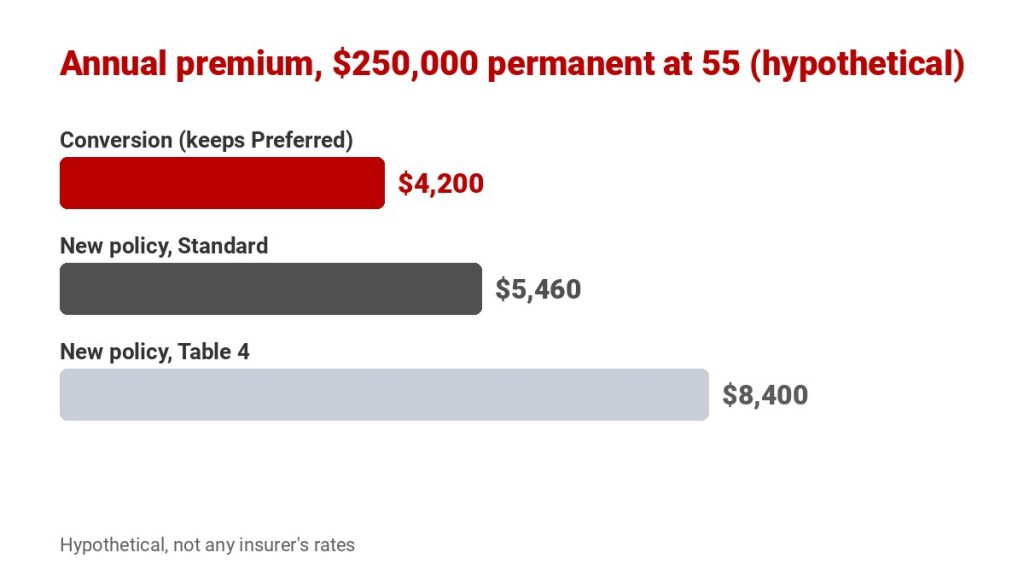
With serious heart disease, Lan could also be declined outright on a new application, making conversion her only option. If partial conversion is allowed, the remaining $250,000 of term continues to the end of its period. All numbers are hypothetical, not any insurer’s rates.
Calculator: premium if you convert vs buy new (hypothetical)
4. Which product can you convert to?
Insurers only allow conversion to the permanent products they designate, typically whole life, universal life (UL) and sometimes IUL. Compare before choosing:
- Whole life: fixed premium, guaranteed cash value, usually the highest premium.
- Guaranteed UL: focused on a guaranteed death benefit to a stated age, usually cheaper than whole life, with little cash value.
- IUL: flexible premiums, cash value credited based on an index with a cap and floor, no guaranteed returns. See IUL vs whole life.
Some insurers offer a “conversion credit” that reduces the first-year premium if you convert within a certain window. Term riders, such as waiver of premium or a child rider, may not carry over or may carry over only under their own rules. Living benefits on the new policy also depend on the product.
5. When should you consider term life conversion?
- Your health has declined since you bought term. This is when conversion is worth the most.
- Your term is ending and your family still needs coverage. After the level period, renewal premiums usually rise sharply every year (see what happens when term life expires).
- Lasting needs: leaving a legacy, covering final expenses, or protecting a lifelong dependent such as a child with special needs.
- Your income is more stable and you can afford a higher premium.
On the other hand, if you are still healthy, compare a new policy too: with a good rate class and a better-suited product, buying new can sometimes cost less. Never cancel your old term until the new policy is approved and in force.
6 questions to ask the insurer before converting
- What is my exact conversion deadline, by date?
- Which permanent products can I convert to today, and does that list change later in the term?
- Is there a minimum amount for a partial conversion, and what happens to the remaining term coverage?
- Is there a conversion credit, and how long does it last?
- Which riders carry over to the new policy, and which end?
- Could you send an illustration of the new policy at my current age and original rate class?
Get the answers in writing and compare at least two product options before you sign. A licensed agent can request these illustrations for you at no cost.
Common term life conversion mistakes
- Not knowing the policy is convertible, or not knowing the deadline.
- Waiting until the last year of the term to ask, after the conversion window has closed.
- Converting the full amount and then being unable to afford the premium, so the policy lapses.
- Not comparing the eligible conversion products.
- Letting the term policy lapse for late payment: a lapsed policy no longer has a conversion right.
When buying new term coverage, ask up front: is it convertible, until what year or age, and into which products? See Thinksmart’s term life options.
Frequently asked questions
Does term life conversion require a medical exam?
No. If you convert within the window your policy allows, the insurer does not underwrite you again and uses the rate class from your original term policy.
When is the term life conversion deadline?
It depends on the insurer and product. A common example is within the first 15 years or before age 70, whichever comes first. Check the Conversion section of your policy or ask the insurer.
Will my premium stay the same after conversion?
No. Permanent coverage costs much more than term and is priced at your age when you convert. Only your rate class carries over.
Can I convert only part of my term policy?
Many insurers allow partial conversion, usually with a minimum amount. The remaining term coverage continues until it ends.
Can I convert a term policy that lapsed for nonpayment?
Usually not. The conversion right only applies while the term policy is in force. If it just lapsed, ask the insurer about reinstatement as soon as possible.
Want to know if your term policy can still be converted?
Send Thinksmart Insurance your policy details and we will help check the deadline, the eligible products and compare premiums, in English or Vietnamese, at no cost. Contact us →






 Thinksmart Insurance