
Term life insurance expires at the end of its level period, and that is often the first time in 20 years that a family opens the policy again. Some people assume the coverage simply stops. Others receive a renewal notice and are shocked by a premium several times higher. This guide explains what actually happens when the term ends, walks through a year-by-year example, lays out five options, and shows how to find your deadline for converting to permanent coverage without a new medical exam.

What it means when term life insurance expires
Term life insurance covers you for a fixed period, usually 10, 15, 20 or 30 years. During that period the premium stays level, and if the insured person dies, the family receives the death benefit. A standard term policy builds no cash value, which is why it costs far less than whole life or other permanent coverage.
When the level period ends, one of two things usually happens. Either the policy terminates, or, more commonly, it becomes annually renewable up to an age such as 90 or 95, with a new premium calculated each year based on your current age. That annual repricing is where the big jump comes from.
Example: the year-21 premium is almost 10 times higher
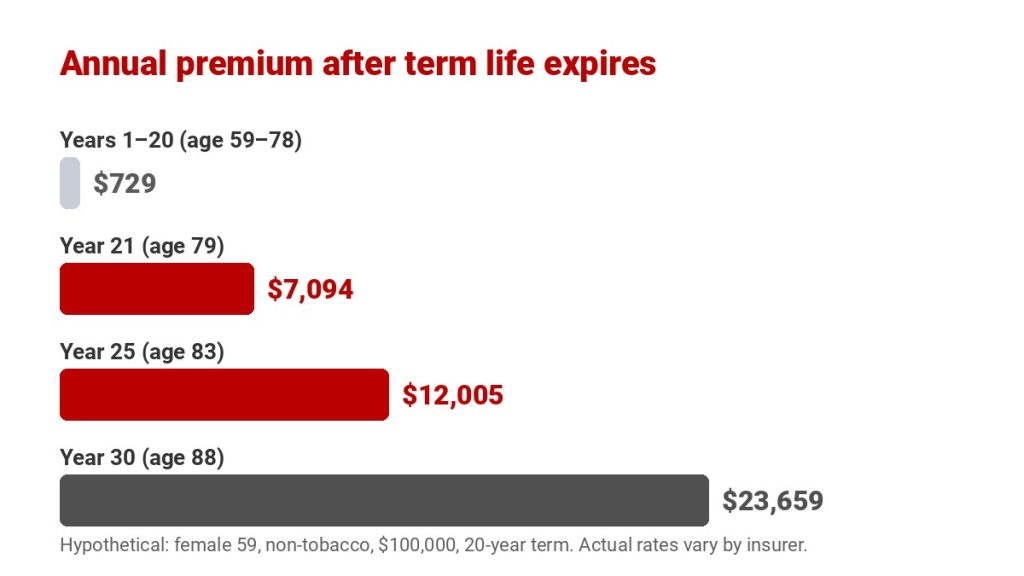
Here is a hypothetical example based on a sample illustration from one insurer. Lan is 59, a non-smoker in good health (Preferred class), and buys a 20-year term policy with a $100,000 death benefit. Her level premium is $60.72 a month, or $728.64 a year, for the first 20 years.
| Policy year | Age | Annual premium |
|---|---|---|
| Years 1 to 20 | 59 to 78 | $728.64 |
| Year 21 | 79 | $7,094.16 |
| Year 22 | 80 | $8,176.56 |
| Year 23 | 81 | $9,425.88 |
| Year 25 | 83 | $12,004.56 |
| Year 30 | 88 | $23,658.60 |
Step by step:
- First 20 years: $728.64 × 20 = $14,572.80 in total premiums.
- Year 21: $7,094.16 ÷ $728.64 ≈ 9.7 times the old premium, roughly $591 a month.
- Years 21 through 30 combined: $139,816.32, more than the $100,000 death benefit itself.
In other words, if Lan kept renewing year after year, within about eight years she would have paid more than her family would ever receive. That is why almost nobody should keep a term policy on annual renewal for long. Exact figures depend on the insurer, your age and your health, but every term policy follows the same steep curve after the level period.
Why premiums jump when the term ends
During the level period, the premium is averaged out. In the early years you pay a little more than your actual risk, and in the later years a little less. Once the term ends, the insurer prices each year at the real risk for your current age, and mortality risk at 79 is far higher than at 59. Healthy people also tend to drop renewing policies and buy new ones, while people in poorer health tend to stay, so insurers price renewals conservatively.
5 options when your term life ends
1. Let the policy expire
If your children are independent, the mortgage is paid off and you have enough savings, you may not need much coverage anymore. Letting the policy lapse can be a sound decision. Re-check your needs first with the method in how much life insurance do I need. Many people still want a smaller amount for final expenses or a legacy for their children.
2. Keep renewing for a short time
Annual renewal makes sense when you need only one or two more years of protection, for example while a new policy is being underwritten, or if a health condition makes new coverage hard to get. Treat it as a bridge, not a plan.
3. Convert to permanent coverage
Many term policies include a conversion privilege that lets you switch to whole life or indexed universal life without a new medical exam, usually keeping your original health class. This is the most valuable option if your health has changed, such as a new diagnosis of diabetes, heart disease or cancer. The new premium is based on your age at conversion, so it is higher than the term premium, but it stays level and the policy builds cash value.
4. Buy a new policy
If you are still healthy, a new 10- or 15-year term policy or a permanent policy can cost much less than the renewal rate. The trade-off is that you must answer health questions and may need an exam. Never cancel the old policy until the new one is approved and in force.
5. Convert part of the coverage
Some insurers let you convert only part of the death benefit, for example $50,000 of a $100,000 policy. You keep some lifelong protection at a premium you can afford and let the rest expire.
The biggest trap: conversion ends before term life insurance expires

What many people miss is that the conversion privilege rarely lasts the whole term. In the sample illustration above, the policy can be converted only during the first 15 years or before age 70, whichever comes first. Lan bought at 59, so her deadline is age 70, around policy year 11. By the time her term ends at 79, the conversion option has been gone for nine years.
So do not wait for the final year to read your contract. Find the “Conversion Privilege” section, write down the deadline and set a reminder one to two years before it. You can estimate your own deadline with the calculator below.
Term life conversion deadline calculator
Last chance to convert without a medical exam:
A timeline to follow before the term ends
- Five years before the term ends: recalculate your coverage need, confirm the conversion deadline and request a conversion quote.
- Two years before the conversion deadline: if your health has changed, lean toward converting. If you are healthy, compare against new-policy quotes.
- One year before the term ends: apply for any new policy so it can be approved in time.
- When the renewal notice arrives: read it carefully so the policy does not quietly renew at a much higher price.
Do you get money back when term life ends?

With standard term life, no. The premiums paid for protection during the term, much like car or home insurance. The exception is return-of-premium term, which costs considerably more and refunds premiums if you outlive the term, subject to the policy’s conditions. Many term policies today also include accelerated benefit riders at no extra premium, which can pay part of the death benefit early if you become seriously ill during the term.
If you are comparing term with other types, read term life vs whole life insurance and what term life insurance is and how much it costs. Common buying errors are covered in 7 life insurance mistakes.
Choosing a term length so you are not surprised later
When you buy term life insurance, pick a term that covers the years your family depends on you most: until the kids finish school, the mortgage is paid off, or you reach retirement. Someone buying at 35 with young children often needs 25 to 30 years, while someone buying at 50 may need only 15. If you want some protection for life, you can pair a large term policy with a smaller permanent one. See Thinksmart’s term life insurance options.
Frequently asked questions
Do I lose my money when term life insurance expires?
A standard term policy has no cash value, so you do not get premiums back when the term ends. Those premiums paid for protection during the term. Return-of-premium term is the exception and may refund premiums under the policy’s conditions.
Can I keep my policy after the 20-year term ends?
Many policies are annually renewable to age 90 or 95, but the premium is recalculated every year by age. In the hypothetical example in this article, the year-21 premium rises from $728.64 to $7,094.16 a year, about 9.7 times higher.
Do I need a medical exam to convert term to permanent life insurance?
Usually not. A conversion privilege lets you switch to permanent coverage without proving your health again, but only within the window stated in the policy, such as the first 15 years or before age 70.
How do I find my conversion deadline?
Look for the Conversion Privilege section of your policy or call your insurer. The deadline is usually a number of years from the issue date or a maximum age, whichever comes first.
Should I convert or buy a new policy?
If your health has declined, converting is usually better because no exam is required. If you are still healthy, a new policy may cost less. Compare both quotes before the conversion deadline and keep the old policy until the new one is in force.
Is your term policy about to end?
Send your policy to Thinksmart Insurance. Our Vietnamese-speaking team will check your conversion deadline, renewal premiums and the options that fit your current health, free of charge. Book a free consultation →








 Thinksmart Insurance