
Many people hear “max funded IUL” and imagine a special product. It is actually a design of a regular IUL policy: paying close to the maximum premium tax law allows, with the lowest death benefit possible, so as much money as possible goes into cash value. The easiest way to answer how does max funded IUL work is to follow each premium dollar: what gets deducted, where it sits and how it grows.
If you want to know whether to buy one, first read is max funded IUL good. This guide focuses on the mechanics inside.

How does max funded IUL work: the money in 5 steps
Step 1: You pay a premium and a premium charge comes off
Each time you pay, the insurer first deducts a premium expense charge, for example 8% (it varies by insurer and by year). Pay $1,000 and about $920 goes into the account. This charge applies only while you are paying premiums, so on a policy funded for 10 or 20 years it stops afterward.
Step 2: The money enters the account
What remains after step 1 sits in the policy account. This is the cash value people talk about. You can place it in a fixed account, in index strategies, or split it among several.
Step 3: Monthly cost of insurance and policy charges
Every month the insurer deducts these from the account (names vary by insurer):
- Cost of insurance (COI): the cost of the insurance itself. It is charged on the net amount at risk, roughly the death benefit minus the account value. COI rises with age.
- Policy fee: a small fixed monthly amount.
- Expense charge: often higher in roughly the first 10 years, then reduced or gone.
- Account value charge and rider charges, if any.
Each one is explained in IUL fees explained.
Step 4: Interest credited by an index
An IUL does not buy stocks. The insurer takes the index gain (usually the S&P 500, excluding dividends) over a period, typically one year, and applies three settings: a cap (the most you can be credited), a floor (the minimum, often 0%) and a participation rate. In a down year the interest credit is 0%, but the charges in step 3 are still deducted, so the account value can still fall. See IUL cap rate and participation rate.
Step 5: Surrender value and how money comes out
Surrender value is the account value minus any surrender charge, which usually applies for about the first 10 years. So in the early years, what you can actually take out is much lower than the premiums paid. Later, owners usually take money by withdrawing up to their cost basis (the premiums paid), then using policy loans secured by the cash value. Loans are not taxed if the policy stays in force and is not a MEC.

Why max funding grows cash value faster
The key is step 3. COI is charged on the amount the insurer has at risk. For the same premium, a lower death benefit means lower COI, and charges based on each $1,000 of death benefit are lower too. Those savings stay in the account and earn interest.
Hypothetical example, step by step (year 1)
Someone pays $12,000 a year. Assumptions: an 8% premium charge, COI of $0.10 per $1,000 per month, an $8 monthly policy fee, and no index credit yet. Two designs:
- Premium charge: $12,000 × 8% = $960. Money into the account: $12,000 − $960 = $11,040 (the same for both designs).
- Max funded design, $300,000 death benefit: amount at risk ≈ $300,000 − $11,040 = $288,960. COI = 288.96 × $0.10 × 12 ≈ $347.
- Regular design, $1,000,000 death benefit: amount at risk ≈ $988,960. COI = 988.96 × $0.10 × 12 ≈ $1,187.
- Policy fee: $8 × 12 = $96 for both.
- Account value at the end of year 1: max funded $11,040 − $347 − $96 = $10,597; regular $11,040 − $1,187 − $96 = $9,757.
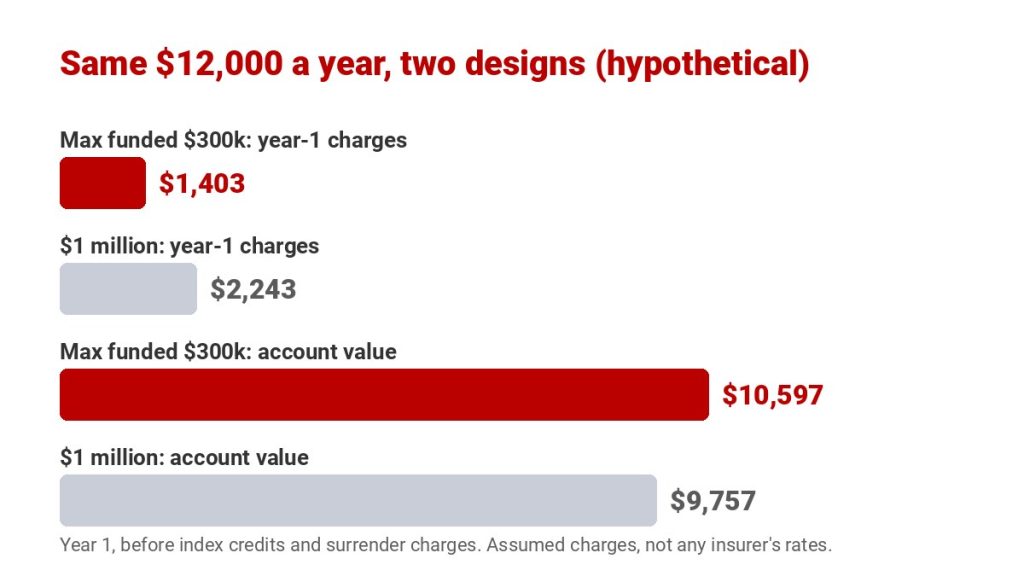
That is an $840 difference in the first year alone, and it keeps earning interest in later years. In exchange, the max funded design has a much smaller death benefit: $300,000 instead of $1 million. If protecting your family is your main goal, it may not be enough. This example is simplified: real policies deduct charges monthly, COI rises with age, and there are expense charges and surrender charges in early years.
Calculator: follow the money in year 1 (hypothetical, simplified)
The limit on max funding: section 7702 and the MEC rules
If more is better, why not pay a huge premium with a tiny death benefit? Because tax law does not allow it. To be taxed as life insurance, a policy must pass a section 7702 test (the Guideline Premium Test or the Cash Value Accumulation Test), which requires enough death benefit for the money going in.
There is also the 7-pay test (section 7702A). If premiums paid in the first 7 years exceed the allowed amount, the policy becomes a MEC (Modified Endowment Contract). Then:
- Withdrawals and loans are taxed gain-first, as ordinary income.
- A 10% additional tax usually applies before age 59½ (with some exceptions).
- The death benefit to beneficiaries generally remains income tax free.
A material change, such as reducing the death benefit in the first 7 years, can make the insurer re-run the 7-pay test. A max funded design pays close to, but not over, the maximum non-MEC premium. Illustrations usually show that maximum so you and your agent can track it. See how to read an IUL illustration.
Risks to understand

- It takes time: charges are high in the early years and surrender charges last about 10 years, so surrendering early usually means a loss.
- No guaranteed return: caps, participation rates and current charges can change within contract limits. An illustration is only an assumption.
- Over-borrowing: loan interest compounds, and you still owe it in a 0% index year. If the loan grows past the account value, the policy can lapse and trigger a large tax bill.
- Consistent funding: max funding only works if you can pay a high premium for many years. With uneven income, a lower premium may fit better.
How does max funded IUL work in practice also depends on how each insurer charges and credits, so compare several illustrations at the same premium. See real costs in how much a max funded IUL costs, compare with IUL vs whole life, or visit Thinksmart Max Funded IUL.
Frequently asked questions
How does max funded IUL work compared with a regular IUL?
It is the same type of policy with a different design: premiums close to the maximum non-MEC amount and the lowest death benefit allowed, so insurance charges take a smaller share and more money goes into cash value.
Can a max funded IUL lose money?
Yes. The 0% floor only protects the interest credit; monthly charges are still deducted. Surrendering early usually means a loss because of surrender charges and high early charges. Heavy loans can cause the policy to lapse.
What is a MEC?
A MEC (Modified Endowment Contract) is a life insurance policy whose premiums in the first 7 years exceed the 7-pay test limit. Withdrawals and loans from a MEC are taxed gain-first and usually face a 10% additional tax before age 59½.
How is interest credited in a max funded IUL?
Based on the gain of an index such as the S&P 500 over each period, limited by the cap and participation rate, with a floor that is often 0%. The policy does not buy stocks directly and does not include dividends.
How long before a max funded IUL becomes efficient?
Usually many years. Charges are high in roughly the first 10 years and surrender charges apply, so it is a long-term plan. Check the surrender value column of the illustration to see what you could take out each year.
Want to see a max funded IUL designed for you?
Thinksmart Insurance compares illustrations from several insurers at the same premium and explains what is and is not guaranteed, in English or Vietnamese, at no cost. Contact us →









 Thinksmart Insurance