
Many newcomers to the US get a high fever at midnight and have no idea whether to wait and call a doctor in the morning, go to urgent care or rush to the hospital. Going to the wrong place can mean hours of waiting or a bill of several thousand dollars for a minor illness. Understanding how the US healthcare system works starts with one idea: there is no single neighborhood clinic for everything. Instead there are several levels of care, each with its own role and its own price.
This guide explains how the US healthcare system works in plain language: the 5 places you can get care, when to use each one, how health insurance splits a bill, and a few legal protections many people never hear about.

How the US healthcare system works, in 4 steps
In many countries people walk straight into a big hospital or buy medicine over the counter at a pharmacy. In the US the usual path looks like this:
- Have health insurance (through work, from the ACA Marketplace, Medicaid or Medicare).
- Choose a primary care doctor in your insurance network.
- Your primary care doctor treats you, follows your health over time, and refers you to specialists, imaging or lab tests when needed.
- Pharmacies only sell many medicines with a prescription, including antibiotics.
Most medical spending in the US flows through insurance. Without insurance you can still be seen, but the price is often far higher than the rate insurers have negotiated with hospitals. That is why understanding the system starts with understanding your own health plan. If you buy your own coverage, see ACA health insurance and subsidies.
The 5 places to get care
1. Primary care doctor (PCP)
Your primary care doctor is your front door. This is an internal medicine doctor, a family doctor, or a pediatrician for children. They handle common illnesses (colds, sore throats, mild urinary infections), manage chronic conditions like high blood pressure, diabetes and cholesterol, give vaccines, and do your yearly checkup.
The downside: you usually need an appointment, sometimes days or weeks out for new patients. A good tip is to register and do a first checkup as soon as you have insurance, so the office already has your records when you get sick and can fit you in faster.
2. Specialist
Cardiology, gastroenterology, dermatology, orthopedics, oncology and OB-GYN are specialists. With an HMO plan you usually need a referral from your primary care doctor for insurance to pay. With a PPO plan you can usually book a specialist directly, but monthly premiums tend to be higher. Before booking, call the number on the back of your card to confirm the doctor is in network.
3. Urgent care
Urgent care clinics take walk-ins and are open evenings and weekends. They fit problems that need care today but are not life-threatening: fever, cough, ear pain, sprains, small cuts that need stitches, urinary infections, a possible small fracture. Many have X-ray and rapid tests.
For the same minor problem, urgent care usually costs much less than the emergency room, and the wait is usually shorter. If your condition is more serious than they can handle, they will send you to a hospital.
4. Hospital emergency room (ER)
The emergency room is for conditions that threaten your life or could cause lasting harm. Call 911 or go to the emergency room right away for:
- Chest pain or pressure, trouble breathing, blue lips.
- Stroke signs: a drooping face, weakness or numbness on one side, sudden trouble speaking.
- Heavy bleeding that will not stop, a head injury, a serious car accident.
- Seizures, fainting, sudden confusion, a severe allergic reaction.
- Severe abdominal pain, or a high fever in a newborn.
The emergency room sees patients by severity, not by arrival time, so people with minor problems may wait for hours. Using the emergency room for something minor is usually the most expensive of the 5 options. But in a real emergency, do not let cost stop you: arriving late can cost far more in health.
5. Telehealth
Many plans and clinics offer video or phone visits. They fit minor illnesses, follow-ups, medication questions and mental health care. The doctor can send a prescription straight to a pharmacy near you. Many plans also have a 24/7 nurse line on the back of the insurance card: calling it before deciding where to go is free and very useful at midnight.

Quick chooser table
| Situation | Where to go |
|---|---|
| Yearly checkup, vaccines, blood pressure follow-up | Primary care doctor (book ahead) |
| Cold, sore throat, medication question | Telehealth or primary care doctor (cheap and fast) |
| Fever, sprain, small cut, evening or weekend | Urgent care (no appointment) |
| Chest pain, trouble breathing, stroke signs, serious accident | Call 911 or emergency room (go now) |
| Condition that needs deep expertise | Specialist (HMO usually needs a referral) |
Besides 911, save two more numbers: 988 is the mental health crisis line (call or text), and 1-800-222-1222 is Poison Control if a child swallows medicine or chemicals.
How health insurance splits the bill

Know these 5 terms and you will understand most US medical bills:
- Premium: what you pay every month for the plan, whether or not you use care.
- Deductible: what you pay each year before the plan starts sharing the cost of many services.
- Copay: a flat amount for a visit or a prescription, for example $30 to see your primary care doctor.
- Coinsurance: the percentage you pay after the deductible, for example 20%.
- Out-of-pocket maximum: the most you pay in a year for in-network covered care. Once you reach it, the plan pays 100% for the rest of the year (you still pay premiums).
Bill example (hypothetical)
Say your plan has a $2,000 deductible, 20% coinsurance and a $6,000 yearly out-of-pocket maximum, and you have not used any of it this year. The allowed bill is $5,000:
- You pay the full deductible: $2,000.
- The rest is $5,000 − $2,000 = $3,000. You pay 20%: $3,000 × 0.20 = $600.
- Your total: $2,000 + $600 = $2,600. Insurance pays $2,400.
If the bill is $40,000 (for example a surgery): $2,000 + 20% × $38,000 = $9,600, but that is above the $6,000 cap, so you pay only $6,000. That is why the out-of-pocket maximum matters more than many people think.
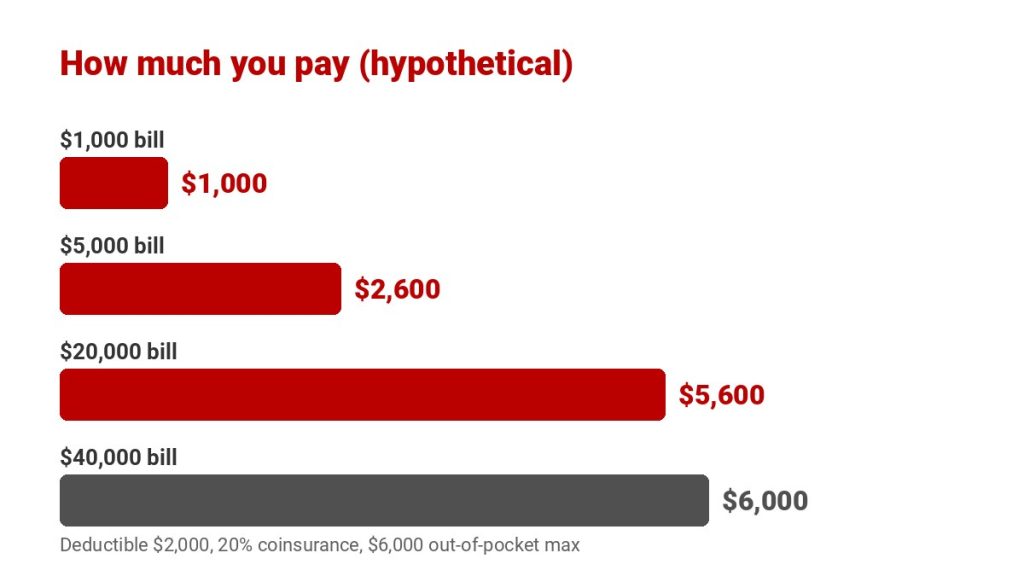
Real numbers depend on your plan, whether the provider is in network and whether the service is covered. Try your own plan with the calculator below.
Calculator: one medical bill, how much do you pay?
Legal protections worth knowing
The US healthcare system has a few rules that protect patients and that many newcomers never hear about:
- The emergency room cannot turn you away: hospitals with an emergency department that take part in Medicare must screen you and stabilize an emergency condition, whether or not you have insurance or money. The bill still comes later, but you will not be sent away while you are in danger.
- No Surprises Act: since 2022, for emergency care you generally pay only in-network cost sharing even if the hospital or doctor is out of network. It also covers certain non-emergency services from out-of-network providers at in-network facilities, and air ambulances. Ground ambulances are not covered by this law. If you are uninsured or paying yourself, you have the right to a Good Faith Estimate before scheduled care.
- Free preventive care: with most ACA-compliant plans, yearly checkups, many screenings and vaccines from in-network providers come with no copay or deductible. If the doctor also treats a separate problem during the visit, that part may be billed.
- Financial assistance: nonprofit hospitals must have a financial assistance policy for lower-income patients. If you get a large bill, ask the billing office about it and about a payment plan before ignoring the bill.
- Community health centers: federally supported community health centers charge on a sliding fee scale based on income and see people without insurance.

What if you have no health insurance?
You can still get care, but follow this order to keep costs down:
- Check whether you qualify for Medicaid (income-based, rules vary by state) or a Marketplace plan with subsidies. Losing a job, marriage, having a baby or moving usually opens a special enrollment period.
- Minor illness: use a community health center, a cash-price telehealth visit or urgent care. Ask for the self-pay price first.
- Real emergency: still call 911. Afterward, ask for financial assistance and a payment plan.
Nail techs, rideshare drivers and other 1099 workers usually have no coverage through work and must arrange their own. See nail tech 1099 vs W-2 for the costs you carry yourself.
Health insurance is not enough: lost income during a serious illness
Health insurance pays the hospital and the doctors. But after a stroke, cancer or a heart attack, families face costs health insurance does not pay: rent or mortgage, car payments and groceries during months off work, a caregiver, plus the deductible and out-of-pocket maximum each year. The US system is excellent at treatment, but it does not replace your income.
That is where living benefits in some life insurance policies come in: if you have a qualifying critical, chronic or terminal illness under the policy terms, you may be able to receive part of the death benefit early and use it as you choose. The early payment is discounted and reduces the death benefit, and each insurer has its own conditions and limits. Many term life and IUL policies include this feature, so ask about it when you compare.
Frequently asked questions
How does the US healthcare system work for newcomers?
Most people get health insurance, choose a primary care doctor in network, and see that doctor first. The primary care doctor refers you to specialists or tests when needed. Urgent care handles same-day minor problems and the emergency room handles life-threatening ones.
Should I go to urgent care or the emergency room?
Go to urgent care for problems that need care today but are not life-threatening, like fever, sprains or small cuts. For chest pain, trouble breathing, stroke signs or heavy bleeding, call 911 or go to the emergency room right away.
Will the emergency room treat me without insurance?
Yes. Hospitals with an emergency department that take part in Medicare must screen you and stabilize an emergency condition regardless of insurance or ability to pay. You will still get a bill, and you can ask for financial assistance and a payment plan.
Do I need a primary care doctor?
HMO plans usually require you to choose one and get referrals for specialists. PPO plans usually do not, but having a primary care doctor still helps with yearly checkups, chronic conditions and faster appointments when you get sick.
What is the difference between a deductible and an out-of-pocket maximum?
The deductible is what you pay before the plan starts sharing costs. The out-of-pocket maximum is the yearly cap on what you pay for in-network covered care, including deductible, copays and coinsurance; after you hit it, the plan pays 100% for the rest of the year.
Want to understand your family’s insurance protection?
Thinksmart Insurance explains life insurance and living benefits in English or Vietnamese, so you can plan for the months without income if serious illness strikes, at no cost. Contact us →








 Thinksmart Insurance