
Many people ask us why life insurance applications get declined when they feel healthy and work every day. In reality, most declines have clear reasons, and many can be known in advance or prepared for. This guide lists the 10 most common reasons insurers turn down applicants during underwriting, and how to lower your chances of a decline.

Why do insurers underwrite at all?
Life insurance is a promise to pay a large sum when the insured dies. To keep premiums fair, the insurer estimates the risk of each application. This process is called underwriting. The result can be a standard approval, a rated approval, a postponement, or a decline. See how insurers assign a life insurance risk class.
Beyond the application and the exam, insurers usually check the MIB database (where insurers share information from past applications), prescription history, driving records, and may request records from your doctors. Knowing why life insurance applications get declined helps you prepare correctly from the start.
10 reasons why life insurance applications get declined
1. A serious condition in treatment or a recent event
Cancer in active treatment, a recent heart attack or stroke, kidney failure or cirrhosis often lead to a decline or a postponement. After treatment and a period of stability, many people can reapply; see life insurance after cancer.
2. Pending tests or no diagnosis yet
If your doctor has ordered more tests or scans, or you have symptoms without a clear cause, insurers usually postpone until results are in. Applying while waiting for results is a very common reason for a decline or postponement.
3. Several conditions together, or poor control
One well-controlled condition (blood pressure, cholesterol, mild diabetes) is usually still approved. But poorly controlled diabetes, a very high BMI combined with high blood pressure and heart disease, or many conditions at once can exceed what an insurer accepts.
4. Answers that do not match records
Many people do not expect this one. The application says “no medications” but prescription history shows blood pressure pills, or it says “non-smoker” but the lab finds nicotine. The insurer may decline because it cannot trust the answers. And if a misstatement slips through, the insurer can deny a claim during the first 2 years; see why life insurance claims are denied.
5. Coverage above the income limit

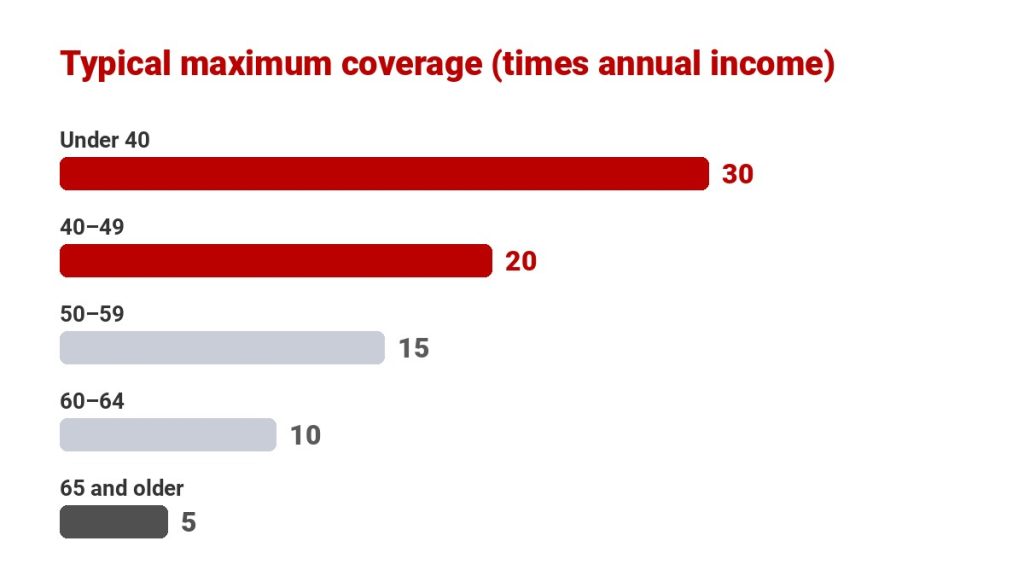
Insurers only issue coverage that matches your economic value (financial justification). A common reference is about 30 times annual income under age 40, decreasing with age. Hypothetical example: Binh, age 35, reports $60,000 of income on his tax return.
- Reference maximum: $60,000 × 30 = $1,800,000.
- If he applies for $2,000,000: over by $2,000,000 − $1,800,000 = $200,000, so the amount may be reduced or the application declined.
Self-employed workers, nail technicians and drivers who report low income on their tax returns often run into this. Insurers also count coverage you already have with other companies.
The same logic applies to a stay-at-home spouse: many insurers will cover a non-working spouse, often up to an amount tied to the working spouse’s coverage. For business owners, insurers may look at the business’s value and the owner’s share instead of salary alone. If your real income is higher than your tax return shows, the tax return still usually wins, so plan your coverage around the numbers you can document. Bringing the last two years of tax returns to the application avoids most surprises.
6. A poor driving record
A recent DUI, several serious violations, or a suspended license can lead to a decline or a wait of a few years.
7. Alcohol or drug abuse
A recent history of alcohol or drug abuse, or current treatment for it, is usually postponed or declined until there is a long enough period of stability.
8. Criminal record, probation or parole
People who are incarcerated, on probation or parole, or have a recent serious conviction are often not considered yet. After the sentence ends and some time passes, they may reapply.
9. Dangerous jobs, hobbies or travel
Private pilots, deep divers, climbers, racers, or people who travel often to war zones or unstable areas: many get a rating or an exclusion, but some are declined.
10. Residency, age and documents
Each insurer has its own rules for applicants without a green card, with only a visa or ITIN, about time living in the US, and about the maximum issue age for each product. Missing documents or choosing the wrong insurer is a very common reason in our community; see life insurance without a green card and life insurance with an ITIN.
Postponed vs declined vs rated: what is the difference?
These three words appear in insurer letters and are easy to confuse:
| Result | What it means | What to do |
|---|---|---|
| Postponed | The insurer will not decide now, usually because something is still changing (treatment, pending tests, a recent event). | Ask how long to wait, mark the date, collect follow-up records, then reapply. |
| Declined | The insurer will not offer coverage on this application. | Ask for the reason, check whether it was a records error, and compare other insurers. |
| Rated | Approved, but at a higher premium (table rating or flat extra). | Compare offers; ask whether the rating can be reviewed later if your health improves. |
A postponement is not a permanent no. Many people who were postponed for a recent condition are approved later, sometimes at standard rates, once enough time has passed and their records show stability. Keeping copies of every follow-up visit makes that second application much smoother.
Tool: check coverage against your income
Enter your age, income and desired coverage to see whether it is above the reference limit:
Tool: is the coverage you want above the usual income limit?
How to lower your chances of a decline

- Answer fully and accurately: medications, conditions, treatment dates, follow-up results. Answers that match records speed up underwriting.
- Do not apply while waiting for test results. Wait for a clear diagnosis first.
- Choose a coverage amount that fits your reported income; bring tax returns and asset documents for large amounts.
- Ask informally first: your agent sends a summary of your file to several insurers, with no formal application to be declined.
- Pick the right insurer: each one is stronger with certain groups (non-green-card holders, people with health conditions, older applicants).
Already declined? What now

A decline letter usually explains how to ask for the reason. You have the right to ask why and to request a copy of your MIB file. If the reason is an error (for example, a mixed-up prescription), you can send documents and ask for a review. If it is health related, ask how long to wait before reapplying. Meanwhile, consider group coverage at work or no medical exam programs.
Understanding why life insurance applications get declined is also a reminder: buying while young and healthy is always easier and cheaper. Learn how much life insurance you need, and see our Term Life and Thinksmart IUL pages.
Frequently asked questions
Why do life insurance applications get declined when I am healthy?
Often because of paperwork: answers that do not match prescription history or doctor records, coverage above the income limit, a poor driving record, or residency status that does not meet the insurer’s rules.
Will other insurers know if I was declined?
Information from your application may be recorded in the MIB database that insurers share. That is why an informal inquiry before a formal application helps, and why your answers should always be consistent.
Can I reapply after being declined?
Yes. Ask for the reason and how long to wait. Once the reason no longer applies (treatment finished, test results in, enough time after a DUI), you can reapply with the same or another insurer.
Can low income get me declined?
Low income itself is not a reason to decline, but coverage must match income. A common reference is about 30 times annual income under age 40, decreasing with age.
Can I find out in advance if I would be declined?
Yes. An agent can send an informal inquiry with a summary of your file to several insurers. It shows which insurers are likely to accept you and the expected class before you formally apply.
Worried your application might be declined?
Send your health, income and residency details to the Thinksmart Insurance team. We make informal inquiries with several insurers before you apply, explained in plain English or Vietnamese, free. Book a free consultation →






 Thinksmart Insurance