
Life insurance for non-citizens is one of the most common questions we hear from Vietnamese families who are new to the US: engineers on H-1B visas, E-2 business owners, international students, and couples waiting on a green card. The short answer: in many cases, yes, you can buy life insurance without a green card. But every insurer has its own rules about visa type, time in the US and documents. This guide walks through each situation, the paperwork to prepare and how to work out how much coverage you need.

Why insurers ask about your green card or visa
Life insurance is a long-term contract that can last 20 or 30 years, or for life. The insurer wants to know whether you plan to stay in the US, whether you have stable income to pay premiums, and whether it can verify medical records and a death certificate if a claim is filed. That is why residency status affects approval, the policy types you can choose and the maximum coverage. Your age, health and tobacco use still set the price, just as they do for everyone.
Life insurance for non-citizens: 5 situations
1. Green card holders (permanent residents)
Permanent residents are usually treated like US citizens and can choose almost any policy, from term life to IUL. A 2-year conditional green card (after marriage) is also commonly accepted.
2. Work visas: H-1B, L-1, O-1, TN
This is the easiest group to insure without a green card. Many insurers accept applicants who have a Social Security number, a US address and bank account, steady employment, and some time living in the US (often from a few months to a year, depending on the insurer). A pending green card case (I-140, I-485) usually helps.
3. Investor and business visas: E-2, EB-5
E-2 business owners and EB-5 investors usually have clear assets and income in the US, so many insurers will consider them, sometimes for large amounts. Expect requests for business documents, tax returns and proof of assets.
4. Students (F-1) and short-term visas
Life insurance for non-citizens on student visas is harder: income is low and the stay may be short. Some insurers still accept students, especially when a parent or spouse is a permanent resident, but usually with lower limits. Visitors on B-1/B-2 visas generally cannot buy a standard US life insurance policy.
5. Undocumented, with an ITIN only
Options are very limited. A small number of insurers review applications with an ITIN, a stable address and a US tax history, usually for smaller amounts. Be careful with offers that promise “no documents needed”, and always read the policy.
Documents to prepare without a green card

- Valid passport and visa, I-94, and work permit (EAD) if you have one.
- Social Security number or ITIN.
- A US address and US bank account for premium payments.
- Proof of income: W-2, employment letter, tax returns, business documents.
- Any pending immigration paperwork (I-140, I-485, I-130).
- A medical exam, usually done in the US, often at your home. See why a medical exam is required.
Tip: gather these documents before you apply, and make sure the name on every document matches exactly, including middle names and the order of family and given names. Vietnamese names are often written in different orders on a passport, a visa and a bank statement. Small mismatches like these are one of the most common reasons an application for life insurance for non-citizens slows down.
How much coverage do you need? A step-by-step example
How much to buy depends on your family’s needs, not on your green card. Example (hypothetical): Khoa, 34, an engineer in San Jose on an H-1B visa, earns $110,000 a year. His wife stays home with their two young children, and his employer provides group life equal to 1 times salary.
| What the family needs | How it is calculated | Amount |
|---|---|---|
| Income replacement | $110,000 × 10 years | $1,100,000 |
| Mortgage balance | From the statement | $350,000 |
| College for 2 kids | $50,000 × 2 | $100,000 |
| Final expenses | Estimate | $15,000 |
| Minus existing savings | −$60,000 | |
| Total need | $1,505,000 | |
| Minus employer coverage | $110,000 × 1 | −$110,000 |
| Coverage gap | $1,395,000 |
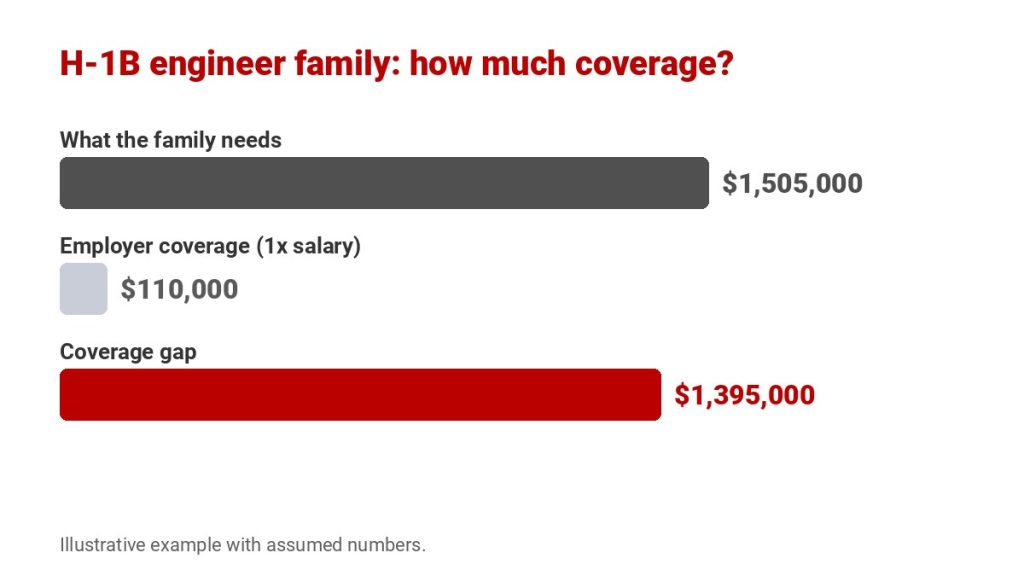
For work-visa holders, relying on employer coverage is riskier than usual: losing the job can mean losing the coverage and, soon after, having to leave the US. An individual policy keeps your family protected no matter where you work. For a fuller method, see how much life insurance do I need, or run your own numbers below.
Life insurance gap calculator
Coverage gap:
3 myths about life insurance for non-citizens
Myth 1: “You must be a citizen to buy life insurance.” Not true. Permanent residents are treated much like citizens, and many insurers accept work and investor visa holders. What matters most is whether you live in the US, have income here and can pass underwriting.
Myth 2: “My employer coverage is enough until I get my green card.” A green card can take years. During that time the employer policy is tied to one job, and on a work visa losing that job can change everything quickly. Buying an individual policy while you are young and healthy locks in your rate, and the policy does not depend on your employer.
Myth 3: “Non-citizens always pay more.” Your premium is based mainly on age, health, tobacco use and the amount of coverage. Some insurers limit the policy types or maximum amounts for certain visas, but an approved non-citizen in good health is often priced the same way as anyone else. Comparing several insurers makes the biggest difference, which is why working with an independent agency helps.
What if I move back to Vietnam later?
In general, a policy that has been approved and is fully paid stays in force when you move, even outside the US. Some insurers do have specific rules about living abroad long term, so ask before you sign. Keep a US bank account for premiums and keep your contact details up to date. Parents, a spouse or children living in Vietnam can usually be named as beneficiaries; use full legal names, dates of birth and relationships. Our guide to 7 life insurance mistakes covers other common errors.
Which policy fits if you don’t have a green card?

- Term life: lowest cost and easiest to qualify for; a good fit for young families who need a large amount for 10–30 years. See term life insurance.
- IUL: protection plus cash value, suited to people with steady income who plan to stay long term. Some insurers limit IUL for non-citizens. See IUL insurance.
- For children: if your child was born in the US, look at the Kid Millionaire plan.
The most important rule when buying life insurance without a green card is to state your visa and residency status accurately. Wrong information can lead to a claim review during the first 2 years. Read more about the waiting period in life insurance.
Frequently asked questions
Can non-citizens buy life insurance in the US?
In many cases, yes. Work and investor visa holders such as H-1B, L-1 and E-2 are accepted by many insurers if they have an SSN, a US address, a US bank account and US income. Students and ITIN-only applicants have fewer options.
What documents does an H-1B visa holder need for life insurance?
Usually a passport, visa, I-94, SSN, US address and bank account, proof of income (W-2 or employment letter), and any pending green card paperwork. The insurer may also require a medical exam in the US.
Can I get life insurance with an ITIN instead of an SSN?
A small number of insurers review applications with an ITIN, usually with a stable address, US tax history and lower coverage limits. Options are much narrower than with an SSN.
Will my policy be cancelled if I move back to Vietnam?
Generally an approved, fully paid policy stays in force when you move. Some insurers have specific rules for living abroad long term, so ask before you sign.
Can my beneficiary live in Vietnam?
Yes, parents, a spouse or children in Vietnam can usually be named. Use full legal names, dates of birth and relationships so the claim can be verified faster.
No green card yet? Find out which insurers will accept you
Thinksmart Insurance’s Vietnamese-speaking team works with many insurers and will review your visa situation for free. Book a free consultation →







 Thinksmart Insurance