
Real life insurance claim stories are the clearest way to see how life insurance works when a family actually needs it. Six Thinksmart Insurance clients agreed to share their journeys: five received living benefits during a serious illness, and one borrowed from the cash value of an IUL policy. This page sums up all six stories and the six lessons they hold for Vietnamese-American families.

The 6 stories at a glance
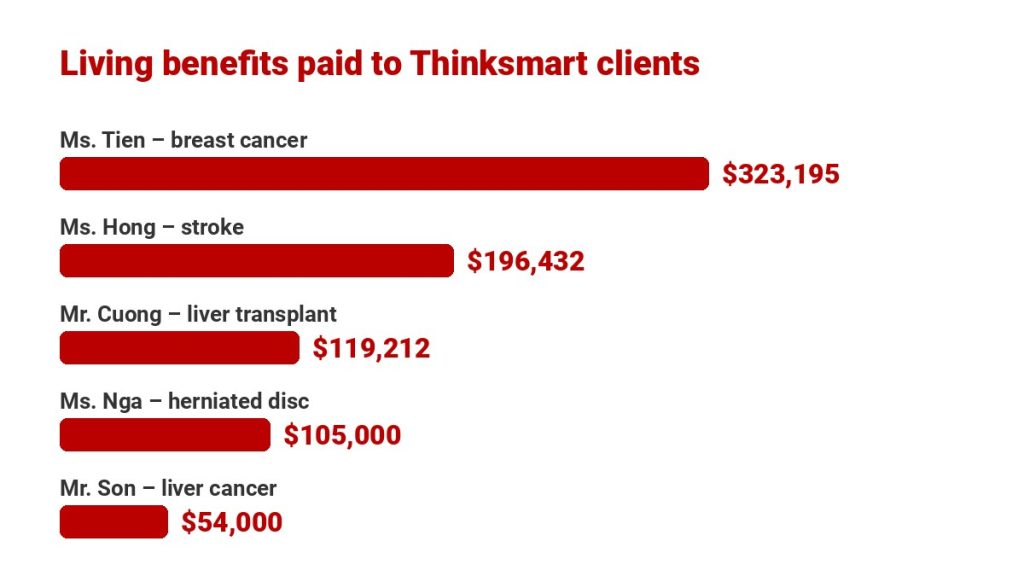
| Client | Event | Amount | Note |
|---|---|---|---|
| Ms. Tien, 40, Pennsylvania | Stage 4 breast cancer | $323,195 | Over 54% of $593,743 face amount |
| Ms. Hong, 47, California | Stroke | $196,432 | About 71% of $275,000 face amount |
| Mr. Cuong, 37, Washington | Liver failure, transplant | $119,212 | About 52% of $230,000 |
| Ms. Nga, 55, Nevada | Herniated disc | $105,000 | 3 payments × $35,000 |
| Mr. Son, 54, Iowa | Liver cancer | $54,000 | 54% of $100,000 |
| Ms. Dan, Georgia | Loan for home repairs | $20,000 | Received in about 48 hours |
1. Ms. Tien: stage 4 breast cancer, $323,195
Ms. Tien, a nail technician in Pennsylvania, bought a National Life Group IUL at 35 to plan for retirement. At 40 she was diagnosed with stage 4 breast cancer. Through the critical illness living benefit she was approved for $323,195, more than 54% of her face amount, with the first payment wired within three days of approval. Full story: Ms. Tien’s claim.
2. Ms. Hong: a stroke six months after joining
Ms. Hong, a nail technician in California, paid about $10 a day. Around six months after her policy started, she had a severe stroke. Because the policy was less than two years old, the insurer reviewed her original health answers, and the claim took about nine months. She received $196,432. Full story: Ms. Hong’s claim.
3. Mr. Cuong: a liver transplant before year two
Mr. Cuong, a 37-year-old nail technician in Washington, saved tips with his wife to pay premiums. About a year and four months after joining, he developed end-stage liver failure and needed a transplant. He received $119,212 in living benefits after a review of just over two months. Full story: Mr. Cuong’s claim.
4. Ms. Nga: a herniated disc, paid in three installments
Ms. Nga has worked in nails in Nevada for more than 20 years and bought an IUL in 2019 even though her husband and relatives objected. After two spinal surgeries she received $35,000 a year in 2022, 2023 and 2024 under the chronic illness benefit, $105,000 in total. The third request was nearly declined because her medical records were incomplete, and it was approved after her doctor re-evaluated her. Full story: Ms. Nga’s claim.
5. Mr. Son: a policy his wife kept for eight years
In 2017 Ms. Lan bought IULs for herself and her husband. When money got tight, she canceled her own policy but kept his. Almost eight years later, Mr. Son was diagnosed with liver cancer and received $54,000, 54% of his policy value, after about two weeks of review. Full story: Mr. Son’s claim.
6. Ms. Dan: a $20,000 loan from cash value
Ms. Dan, a self-employed nail technician in Georgia, has paid about $200 a month into her IUL since 2017. She first borrowed about $5,000 just to test the process, then borrowed $20,000 to repair her home and had the money in about 48 hours. Full story: Ms. Dan’s story.
What these stories have in common
Most of these clients are nail technicians or self-employed, without the employer benefits that office workers often have. Several were hesitant at first: some worried insurance was a scam, and some had family members telling them not to buy. They chose to sign while they were healthy, kept paying premiums, and when something serious happened, the benefits written in their policies were there. None of them expected to get sick, which is exactly why the coverage mattered.
6 lessons from these real life insurance claim stories
Lesson 1: Buy while you are healthy
All six clients bought coverage while they were in good health. Waiting until you are sick often means being declined or paying much more. Ms. Hong and Mr. Cuong became ill within months to just over a year of signing.
Lesson 2: Living benefits come in different types
Ms. Tien, Ms. Hong, Mr. Cuong and Mr. Son were paid under critical illness benefits (cancer, stroke, transplant). Ms. Nga was paid under a chronic illness benefit, which requires being unable to perform at least two of six activities of daily living. The amount depends on the severity of the illness and each policy’s terms.
Lesson 3: Answer health questions honestly
During the first two years, the insurer can review the application when a claim is filed. Because Ms. Hong and Mr. Cuong had answered truthfully, their claims were paid, even though the review took longer.
Lesson 4: Medical records decide the outcome

A diagnosis alone is not enough. Ms. Nga’s case shows that records must clearly describe how the condition limits daily life. Keep every exam, surgery and test record.
Lesson 5: Keep the policy through hard times
Keeping her husband’s policy gave Mr. Son’s family $54,000 when they needed it most. If money is tight, ask your agent about lowering the premium or adjusting the policy before you cancel.
Lesson 6: Cash value can help, but understand the trade-offs
Ms. Dan’s story shows how quickly you can borrow from an IUL. But loans charge interest and, if not repaid, reduce the account value and the death benefit. If a policy lapses with a loan outstanding, taxes may apply.
The 5-step claim process behind these real life insurance claim stories
The illnesses were different, but every one of these real life insurance claim stories followed the same basic process:
- Report the condition to your agent or the insurer as soon as there is a diagnosis.
- Open a claim with the insurance company.
- Complete the paperwork: claim form, ID, medical records, test results and a doctor’s statement.
- Insurer review: the insurer may contact doctors and hospitals to verify. Policies under two years old usually get a closer look.
- Payment: by wire transfer or check, sometimes in several installments, as with Ms. Tien and Ms. Nga.
What slowed claims the most in these stories was missing medical records or doctors who were slow to respond. So once you have a diagnosis, request copies of your medical records as early as you can, and keep a folder with every document the insurer asks for.
It also helps to know who to call. Write down your policy number, the insurer’s claims phone number and your agent’s contact details, and share them with a family member. If you are too sick to make calls, someone else can start the claim for you.
How Thinksmart helps with claims

In each of these stories, the Thinksmart team helped the client notify the insurer, open the claim, gather documents and follow up until the money arrived. Learn more on our insurance claims page or read who is Thinksmart Insurance.
If you want a policy with living benefits, take a look at IUL insurance or term life. Every policy has its own terms, so ask about each type of living benefit before you sign.
These stories are not a promise that every claim will be paid the same way. Each payout depended on the policy, the diagnosis and the medical records. What they do show is that the benefits written into a policy are real, and that preparation makes a big difference when the time comes.
Frequently asked questions
Are these real life insurance claim stories?
Yes. They are real Thinksmart Insurance clients who agreed to share their stories and videos. Each story has its own full article.
What are living benefits?
Living benefits pay part of the death benefit while the insured is still alive, after a serious illness such as cancer, a stroke, an organ transplant or a chronic illness, depending on the policy terms.
Can you get paid if the policy is only a few months old?
It is possible. Ms. Hong had a stroke about six months after joining and was paid. Policies under two years old are usually reviewed more closely, so it can take longer.
How long does a claim take?
In these stories, from about two weeks (Mr. Son) to about nine months (Ms. Hong). It depends on the policy’s age and whether the medical records are complete.
Does borrowing from an IUL have downsides?
Loans charge interest and reduce the account value and death benefit if not repaid. If the policy lapses with a loan outstanding, taxes may apply.
Want to know whether your policy has living benefits?
Our Vietnamese-speaking team at Thinksmart Insurance will review your policy and explain each benefit for free. Book a free consultation →









 Thinksmart Insurance