
Most life insurance mistakes do not show up on the day you sign. They show up when your family needs the money most: when a claim is reviewed, when the payout is not enough to cover the mortgage, or when the money goes to the wrong person. This guide covers the 7 mistakes the Thinksmart Insurance team sees most often among Vietnamese-American families, how to avoid each one, and a worked example you can follow.

Mistake 1: Relying only on employer life insurance
Many people with a job assume they are “already covered”. Group life through an employer is a nice benefit, but it is often only 1 to 2 times your annual salary. More importantly, it is tied to the job: if you quit, are laid off or change employers, the coverage can end, just when you are older and new coverage costs more.
How to avoid it: treat employer coverage as a bonus, not the foundation. Own at least one individual policy in your own name that does not depend on where you work.
Mistake 2: Buying too little life insurance
This is the most common of all mistakes when buying life insurance. People pick a number based on a premium that “feels affordable” instead of what the family would actually need if the breadwinner died. The better way is to work backwards from the needs: debts, income to replace, the house and the kids’ education.
Step-by-step example: the Tuan family
Tuan (a hypothetical example) is 38, lives in Garden Grove, earns $65,000 a year, and has a wife and two young children. He has employer coverage of 2 times his salary.
| What the family needs | How it is calculated | Amount |
|---|---|---|
| Income replacement | $65,000 × 10 years | $650,000 |
| Mortgage balance | From the statement | $280,000 |
| College for 2 kids | $50,000 × 2 | $100,000 |
| Final expenses | Estimate | $15,000 |
| Minus existing savings | −$40,000 | |
| Total need | $1,005,000 | |
| Minus employer coverage | $65,000 × 2 | −$130,000 |
| Coverage gap | $875,000 |
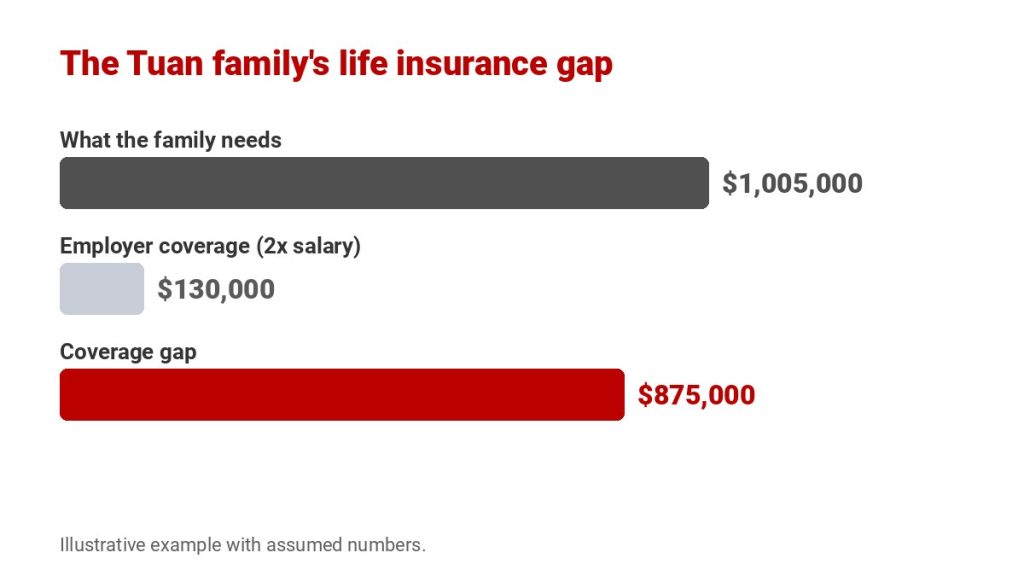
In other words, employer coverage alone protects only about 13% of what the Tuan family needs ($130,000 ÷ $1,005,000). For a fuller method, see how much life insurance do I need, or run your own numbers below.
Life insurance gap calculator
Coverage gap:
Mistake 3: Misstating your health or tobacco use
Some applicants leave out past smoking, high blood pressure, diabetes or a hospital stay because they fear a higher premium. This is one of the most dangerous life insurance mistakes. During roughly the first 2 years (the contestability period), the insurer usually reviews medical records if a claim is filed. Wrong answers can lead to a denied claim or a rescinded policy.
How to avoid it: answer every question fully and honestly, even if the premium is a bit higher. A slightly more expensive policy that will pay is far better than a cheap one that might not. Read more about the waiting period in life insurance and the medical exam.
Mistake 4: Waiting until you are older or sick
Life insurance premiums are based mainly on your age and health when you apply. Every year you wait, you are a year older, and a single new diagnosis such as diabetes, high blood pressure or a tumor can raise the price sharply or postpone approval. Many of our clients say the same thing: “I wish I had bought it while I was healthy.”
Waiting also has a hidden cost for Vietnamese-American families in particular. Many of us support parents, send money home or carry a mortgage on a family business. Those are exactly the years when a sudden loss would hurt the most, and exactly the years many people put life insurance off because “there is always next year”.
How to avoid it: buy while you are young and healthy to lock in your rate. If the budget is tight, start with low-cost term life insurance and add more later. Coverage you can afford today is worth more than perfect coverage you never buy.
Mistake 5: Naming the wrong beneficiary, or never updating it

The beneficiary decides who receives the money. Common errors in this part of the application:
- Naming a young child directly. Minors usually cannot receive a large payout themselves, and the family may need a court-appointed guardian. Ask about naming a custodian or setting up a trust for the child.
- Not updating after divorce, remarriage or a new baby. The money can still go to whoever is named on the policy, even if life has changed.
- Incomplete details. Writing only “my wife” or a nickname slows verification. Use full legal name, date of birth and relationship, including for relatives living in Vietnam.
- No contingent beneficiary. If the primary beneficiary dies first, the money may have to go through probate.
How to avoid it: review your beneficiaries once a year and after any major family change.
Mistake 6: Not understanding the type of policy you bought
Term life, whole life and IUL serve different goals. Term life is affordable but only covers a set number of years. Whole life and IUL offer lifelong protection and cash value, but cost more and need steady premiums. With IUL in particular, the illustration is a set of assumptions, not a promise: actual returns can differ.
How to avoid it: before signing, make sure you can answer three questions: how long does the coverage last, can the premium change, and what happens if I stop paying? See our comparison of term life vs whole life, and if you want protection plus savings, look at IUL insurance.
Mistake 7: Letting the policy lapse, or cancelling an old one too early
A policy only protects you while it is in force. A new bank card that breaks auto-pay, a move that stops the mail, or skipping a few payments when money is tight can all cause a lapse after the grace period (often about 30 days). Reinstating usually means proving your health again.
Lapses are more common than most people think, and they rarely happen on purpose. They usually start with something small: a changed email, a premium notice sent to an old address, or a family member who handled the payments moving out. Setting a yearly reminder to confirm your payment method and contact details takes five minutes and can save the whole policy.
Another error: cancelling an existing policy the moment you apply for a new one. If the new application is declined or delayed, your family can end up with no coverage at all.

How to avoid it: cancel the old policy only after the new one is approved and in force. If money is tight, call your agent before you stop paying: many policies let you lower the face amount or use cash value to keep coverage. Learn more about cancelling a life insurance policy.
A 5-minute checklist to avoid life insurance mistakes
- Your coverage amount is based on real needs (debts, income, home, kids), not a guess.
- You own at least one individual policy that does not depend on your job.
- Every health and tobacco question was answered truthfully.
- Primary and contingent beneficiaries have full names, dates of birth and relationships.
- You know how long the coverage lasts and whether the premium can change.
- Auto-pay and your mailing address are up to date.
Frequently asked questions
What is the most common life insurance mistake?
The most common are buying too little coverage and relying only on employer coverage. Group life is often just 1 to 2 times salary and can end when you leave the job.
What happens if I misstate my health on a life insurance application?
During roughly the first 2 years, the insurer usually reviews medical records if a claim is filed. Wrong answers can lead to a denied claim or a rescinded policy.
Should I name my young child as beneficiary?
You can, but minors usually cannot receive a large payout directly and a court-appointed guardian may be needed. Ask about naming a custodian or setting up a trust for the child.
Is life insurance through work enough?
Usually not. Add up your family’s needs (income to replace, debts, education, final expenses), then subtract employer coverage to see the gap.
What happens if I stop paying my life insurance premium?
After the grace period (often about 30 days) the policy can lapse, and reinstating usually requires proving your health again. Talk to your agent before you stop paying.
Want to check your own policy for these mistakes?
Thinksmart Insurance’s Vietnamese-speaking team will review your policy and calculate your coverage gap for free. Book a free consultation →









 Thinksmart Insurance