Max funded IUL vs 401k is one of the most common retirement questions we hear from families: “I already have a 401(k). Should I add an IUL, or even stop my 401(k) and buy an IUL instead?” One is a workplace retirement plan; the other is a life insurance policy designed to build cash value.
The short answer: they do not fully replace each other. Each is strong in a different place. This guide compares 7 key points and walks through a hypothetical example step by step. If you are new to the concept, start with how max funded IUL works.

Max funded IUL vs 401k: 7 differences at a glance
| Feature | 401(k) | Max funded IUL |
|---|---|---|
| 1. Tax going in | Traditional: pre-tax. Roth: after-tax | After-tax |
| 2. Employer match | Yes, if the plan offers one | None |
| 3. Contribution limit | Set by the IRS each year (2026: $24,500) | Set by Section 7702 and the MEC rules, based on age and death benefit |
| 4. Tax coming out | Traditional: taxed as ordinary income | Basis withdrawals and policy loans: not taxed if the policy stays in force and is not a MEC |
| 5. Access before 59½ | Usually a 10% additional tax (with exceptions) | No age penalty, but surrender charges in early years |
| 6. Required distributions | Yes, starting at 73 (not for Roth 401(k)) | None |
| 7. Risk | Market gains and losses, fund fees | Floor, but also caps, insurance charges and loan risk |
1. Taxes on the way in
With a traditional 401(k), contributions come out of your paycheck before federal income tax. Put in $10,000 and your taxable income that year drops by $10,000. With a Roth 401(k), you contribute after-tax money and qualified withdrawals later are tax-free.
Premiums for a max funded IUL are always paid with after-tax dollars; there is no deduction. On the way in, the traditional 401(k) has a clear advantage.
2. The employer match: the 401(k)’s biggest edge

Many employers match part of what you contribute, for example 50% of your contributions up to 6% of pay. That is close to an instant return that no other product offers. An IUL has no match. So if your job offers one, the common approach is to contribute at least enough to get the full match before considering other savings options.
3. Annual contribution limits
For 2026, the IRS lets each employee contribute up to $24,500 to a 401(k). People 50 and older can add a catch-up of $8,000, and people aged 60 to 63 can add up to $11,250 if the plan allows. Combined employee and employer contributions are capped at $72,000. Starting in 2026, workers whose prior-year wages exceeded $150,000 must make catch-up contributions as Roth.
A max funded IUL has no single IRS dollar limit. The maximum premium depends on your age, health and death benefit under Section 7702 and the 7-pay test (MEC rules, Section 7702A). Pay more than allowed and the policy becomes a MEC, losing its favorable tax treatment on loans and withdrawals. That is why some higher earners who already max out their 401(k) look at a max funded IUL as an additional place to save.
4. Taxes when you take money out in retirement

Withdrawals from a traditional 401(k) are taxed as ordinary income, both contributions and growth. If you are in the 22% bracket in retirement, each $1,000 withdrawn leaves about $780 before state tax. Qualified Roth 401(k) withdrawals are tax-free.
With a max funded IUL, people usually take money in this order: withdraw up to the total premiums paid (basis) without tax, then take policy loans using the cash value as collateral. Loans are not taxed as long as the policy stays in force and is not a MEC. If the policy lapses with a loan outstanding, the gain can become taxable all at once, sometimes a large amount. Withdrawals and loans also reduce the death benefit.
One detail many people miss: traditional 401(k) income can increase how much of your Social Security is taxed and can push up income-based Medicare premiums. Policy loans are not taxable income, so they do not have that effect.
5. Getting money before age 59½
Taking 401(k) money before 59½ usually means income tax plus a 10% additional tax, with some exceptions such as leaving your job in or after the year you turn 55. Many plans also allow loans of up to 50% of your vested balance, capped at $50,000, repaid through payroll (see should you borrow from your 401(k)).
A max funded IUL has no age-based penalty. But early years carry surrender charges and higher costs, so the value you can access is low at first. In practice an IUL usually needs 10 years or more to work efficiently. It is not the place for money you may need in the next few years.
6. Required minimum distributions
Traditional 401(k)s require minimum distributions (RMDs) starting at age 73, rising to 75 for people born in 1960 or later. Since 2024, Roth 401(k)s no longer require RMDs while the owner is alive. A max funded IUL has no RMDs: you decide when to take money, or leave it as a death benefit for your family. The death benefit is generally free of federal income tax for beneficiaries.
7. The risks on each side
- 401(k): money is usually invested in stock and bond funds. In a sharp market drop, the account can fall with it. There are fund fees and plan administration fees.
- Max funded IUL: interest is credited based on an index, with a floor (often 0%), so in a down year the credit is 0% but monthly charges are still deducted. In strong years, gains are limited by the cap. Caps and current charges can change within contract limits. Over-borrowing can cause a lapse. See cap, floor and participation rate and IUL fees explained.
Step-by-step example: $10,000 of pre-tax income
Minh (a hypothetical person) is 35, earns $80,000 a year and is in the 22% federal bracket. His employer matches 50% of his contributions up to 6% of pay. He wants to save $10,000 of pre-tax income each year.
- Traditional 401(k): the full $10,000 goes in before tax.
- Match: 6% × $80,000 = $4,800 of pay is eligible. At 50%: $4,800 × 50% = $2,400.
- Total going into the 401(k) that year: $10,000 + $2,400 = $12,400.
- Max funded IUL: the $10,000 is taxed first: $10,000 × 22% = $2,200, leaving $7,800 for premium.
- Assumed 8% premium charge: $7,800 × 8% = $624. Into cash value: $7,800 − $624 = $7,176 (before monthly insurance charges).
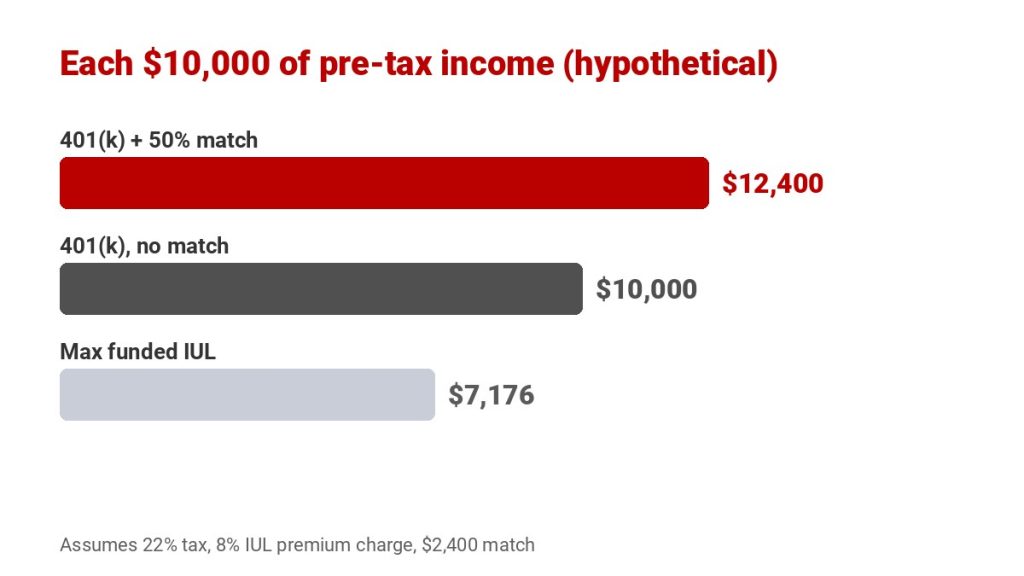
On the way in, the 401(k) is far ahead: $12,400 vs $7,176. In exchange, each $1,000 Minh later withdraws from a traditional 401(k) nets about $780 if he is still in the 22% bracket, while money taken from the IUL through basis withdrawals and properly managed loans is not taxed. Which comes out ahead depends on your tax rate in retirement, actual returns, actual charges and whether you keep the policy long enough. This example does not predict any product’s returns.
Calculator: how much of your pre-tax income gets invested (hypothetical)
So which should come first?
For many families, a sensible order is:
- Build an emergency fund and enough life insurance to protect the family (often term life on a tight budget).
- Contribute enough to the 401(k) to get the full match.
- If you still have long-term savings, stable income and want a tax-flexible source of retirement income, consider a max funded IUL, or additional 401(k)/IRA contributions depending on your situation.
Max funded IUL vs 401k does not have to be either-or. Do not stop a matched 401(k) just to buy an IUL. And if you have no workplace plan (many self-employed nail salon owners, rideshare drivers and restaurant owners do not), also compare options such as a Solo 401(k) or SEP IRA.
Further reading: is max funded IUL good, how much a max funded IUL costs, our earlier IUL vs 401(k) comparison, how to read an IUL illustration, or Thinksmart Max Funded IUL.
Frequently asked questions
Max funded IUL vs 401k: which is better?
There is no single answer. A 401(k) wins on the way in (pre-tax money, employer match). A max funded IUL can win on the way out (basis withdrawals and loans not taxed if handled correctly, no RMDs) and adds a death benefit. Many people use both.
Should I stop my 401(k) to buy an IUL?
Usually not, especially if your employer offers a match. A common approach is to contribute enough to get the full match first, then consider a max funded IUL with remaining long-term savings.
What is the 401(k) contribution limit for 2026?
For 2026 the employee limit is $24,500. People 50 and older can add $8,000, and people aged 60 to 63 can add up to $11,250 if the plan allows.
Are loans from a max funded IUL taxed?
Not as income, as long as the policy stays in force and is not a MEC. If the policy lapses with a loan outstanding, the gain may be taxed. Loan interest accrues and reduces the death benefit.
Can I move money from a 401(k) into an IUL?
Not as a direct rollover. Using 401(k) money for IUL premiums means withdrawing it, paying income tax and possibly a 10% additional tax before 59½. Talk to a tax professional first.
Want to see a max funded IUL next to your 401(k)?
Thinksmart Insurance compares illustrations from several insurers at the same premium and explains what is and is not guaranteed, in English or Vietnamese, at no cost. Contact us →








 Thinksmart Insurance