
Many nail techs ask Thinksmart the same question: nail tech 1099 vs W-2, which is better? Two people can work at the same salon, at the same table, and one gets a W-2 while the other gets a 1099. At tax time, the 1099 worker may owe thousands more and not know why. This guide explains the difference in plain words: taxes, benefits and insurance, with a step-by-step example and a calculator.

What does nail tech 1099 vs W-2 mean?
A W-2 is the form a salon sends an employee each January, showing total wages and taxes withheld. A W-2 nail tech is paid hourly or on commission, and the salon sets the schedule and prices and supplies the tools and the station.
A 1099 (usually Form 1099-NEC) goes to an independent contractor. For payments made after December 31, 2025, a salon only has to send a 1099-NEC when it pays you $2,000 or more in a year (it used to be $600), and that amount will be adjusted for inflation. Even without a form, you still have to report all of your income.
In US nail salons there are three common setups: employees on payroll (W-2), commission techs paid on a 1099, and booth renters who bring their own clients, set their own prices and pay rent to the salon. Only the third setup truly looks like an independent contractor.
The tax difference: 15.3% self-employment tax
The biggest difference is Social Security and Medicare tax:
- W-2 tech: pays 7.65% (6.2% Social Security + 1.45% Medicare). The salon pays another 7.65% on your behalf.
- 1099 tech: pays both halves, called self-employment tax: 15.3%, applied to 92.35% of net earnings after expenses.
The 12.4% Social Security part only applies up to the wage base: $184,500 for tax year 2026 and $192,300 for 2027. The Medicare part has no cap.
Step-by-step example
Lan (a hypothetical example) has $40,000 of net income in 2026:
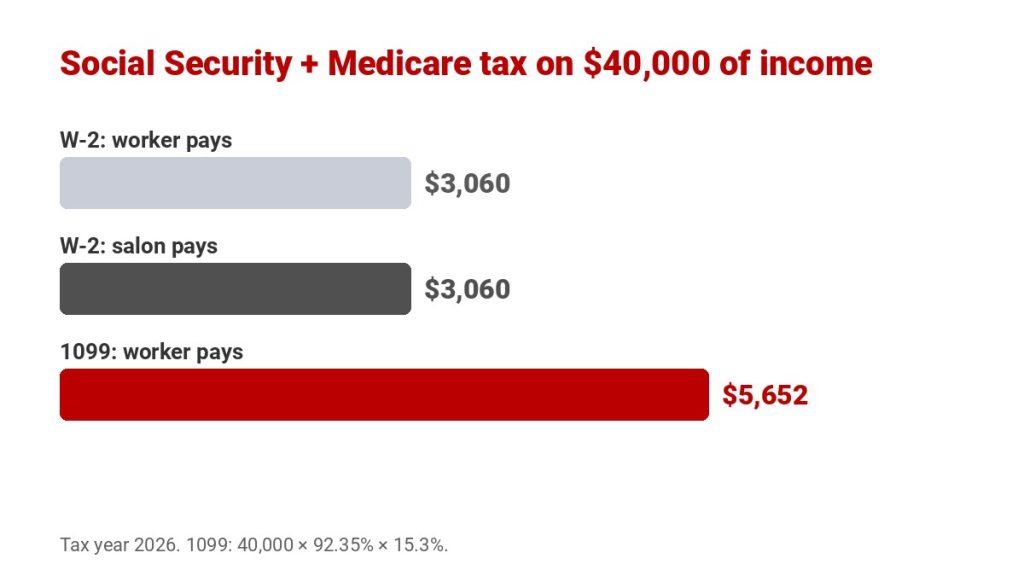
- As a W-2 tech: $40,000 × 7.65% = $3,060. The salon pays another $3,060.
- As a 1099 tech: $40,000 × 92.35% = $36,940 subject to self-employment tax.
- $36,940 × 15.3% = $5,652 of self-employment tax.
- Difference: $5,652 − $3,060 = $2,592 more per year for the 1099 tech.
On the other hand, a 1099 tech can deduct half of the self-employment tax and real business expenses (tools, supplies, booth rent, license renewal, liability insurance) when figuring income tax. Many can also take the qualified business income (QBI) deduction of up to 20% if they qualify. So the final tax bill varies from person to person.
Because the self-employment tax is a flat percentage, the gap grows with income. At $60,000 of net income, a 1099 tech pays about $3,888 more than a W-2 tech in Social Security and Medicare tax alone. That is why it pays to know your real status before you accept a 1099 arrangement.
Calculator: extra tax for a 1099 vs a W-2 tech
Enter your net income to see how much more Social Security and Medicare tax a 1099 worker pays:
Calculator: how much more Social Security and Medicare tax does a 1099 worker pay?
Tips and estimated taxes
Manicurists and pedicurists are on the list of occupations that qualify for the new tips deduction: for 2025 through 2028, each person can deduct up to $25,000 of qualified tips when figuring federal income tax. The deduction phases out above $150,000 of modified adjusted gross income, or $300,000 for joint filers. Tips are still subject to Social Security and Medicare tax, and for a 1099 tech the deduction cannot exceed net income from the business.

A W-2 tech has taxes withheld from each paycheck. A 1099 tech does not, so if you expect to owe $1,000 or more, you need to pay estimated taxes four times a year: usually April 15, June 15, September 15 and January 15 of the next year. Missing them can mean penalties and interest.
The benefits difference

| Benefit | W-2 tech | 1099 tech |
|---|---|---|
| Minimum wage and overtime | Yes, under federal and state law | No |
| Workers’ compensation | Salon provides | On your own |
| Unemployment benefits | Usually, if eligible | Usually not |
| Health insurance through work | If the salon offers a plan | Buy your own, e.g. on the ACA marketplace |
| Retirement | 401(k) if offered | Open a SEP IRA or Solo 401(k) |
| Control over hours, prices, clients | No | Yes (if truly independent) |
As an independent contractor or employee, the salon does not simply choose
The IRS looks at three areas: who controls how the work is done (schedule, prices, procedures), who invests money and bears profit or loss, and whether the relationship is ongoing and part of the salon’s main business. If the salon sets your schedule, sets prices, supplies tools and sends you clients, you are usually an employee even if you receive a 1099. Some states, such as California, use a stricter ABC test, which makes it very hard for a commission tech inside a salon to be a valid independent contractor.
If you think you are misclassified, you can file Form SS-8 to ask the IRS for a determination, and use Form 8919 to pay only the employee share of Social Security and Medicare tax. Talk to a tax professional first.
Insurance: what a 1099 tech must arrange alone

A W-2 tech gets some protection through work. A 1099 tech does not, so plan for:
- Health insurance: buy on the ACA marketplace, with possible subsidies based on income; see ACA subsidies 2027.
- Disability income insurance: nail work depends on your hands, wrists, back and eyes. Without workers’ comp, a month off is a month without pay.
- Life insurance: no group coverage from work. Many policies include living benefits that pay early for a serious illness. See how much life insurance you need.
- Liability insurance: booth renters should carry their own professional liability; see what insurance a nail salon needs.
One point people often miss: life insurers usually look at net income on your tax return (Schedule C), not gross receipts. A 1099 tech who deducts a lot and reports low income can only qualify for a lower amount of coverage; see why life insurance applications get declined.
What to do if you receive a 1099
- Open a separate account and set aside about 25–30% of each payment for taxes (depending on income and state).
- Keep receipts for business expenses all year.
- Put the four estimated tax due dates on your calendar.
- Review your own health, disability and life coverage.
- Ask a tax professional if you work like an employee but receive a 1099.
Whether you are a W-2 employee or an independent contractor, the goal is the same: keep more of what you earn and protect your family if you cannot work. A short review once a year, before tax season, is usually enough to catch problems early.
If you are a booth renter who truly runs your own small business, being a 1099 independent contractor can work well: you set your own prices, keep your own clients and deduct real costs. The key is to treat it like a business, with a budget for self-employment tax, insurance and retirement savings, instead of treating every payment as take-home pay.
See also our Term Life and Thinksmart IUL pages.
Frequently asked questions
Nail tech 1099 vs W-2: which is better?
W-2 comes with more benefits, and the salon pays half of Social Security and Medicare tax. A 1099 offers more control and business deductions, but you pay the full 15.3% self-employment tax and arrange your own insurance. Your status depends on how you actually work.
If the salon does not send a 1099, do I still report the income?
Yes. Starting with 2026 payments, a 1099-NEC is only required for $2,000 or more, but all income must be reported, including cash and tips.
How much self-employment tax does a 1099 tech pay?
15.3% on 92.35% of net earnings. For $40,000 of net income: $40,000 × 92.35% × 15.3% = $5,652, before income tax.
Are nail tech tips tax free?
For 2025 through 2028, manicurists and pedicurists can deduct up to $25,000 of qualified tips for federal income tax, with a phase-out at higher incomes. Tips are still subject to Social Security and Medicare tax.
Can a 1099 tech buy life insurance?
Yes. Insurers usually base the maximum coverage on net income from your tax return, so reporting income accurately helps you qualify for the protection you need.
A 1099 tech who needs insurance advice?
Thinksmart Insurance helps nail techs and self-employed workers choose coverage that fits their real income, in English or Vietnamese, at no cost. Contact us →









 Thinksmart Insurance