
A life insurance risk class is the category an insurer places you in after reviewing your health, lifestyle and family history. Two people of the same age buying the same $500,000 policy can pay premiums that differ by half or even double just because of their class. This guide explains each class, what underwriting looks at and how to prepare for a better result.

What is a life insurance risk class?
When you apply, an underwriter estimates your risk compared with other people your age. The result is your risk class, also called a rate class. The better the class, the lower the premium. With an IUL, a better class also means lower cost of insurance charges, so cash value can grow better; see IUL fees explained.
Names differ by insurer (Super Preferred, Preferred Best, Elite…), but the structure is usually similar.
Why does the class matter so much? The premium is built on the expected cost of paying claims for people like you. Someone in the top class is expected, on average, to live longer than someone in the Standard class of the same age, so the insurer can charge less. Your class is not a judgment about you as a person; it is simply the price bracket that best matches the information in your file. Clear, complete information usually leads to a fairer class.
Common life insurance risk class tiers
| Class | Usually for |
|---|---|
| Preferred Plus | Excellent health, ideal weight, great blood pressure and cholesterol without medication or very well controlled, no family history of early death from heart disease or cancer. |
| Preferred | Good health; maybe a slightly elevated reading or blood pressure or cholesterol medication with good results. |
| Standard Plus | Better than average but not quite Preferred. |
| Standard | Average health: common conditions well controlled (blood pressure, cholesterol, mild diabetes), minor history stable for a few years, weight slightly off. |
| Table (rated) | Higher risk than Standard; each table commonly adds about 25% of the Standard premium. |
| Tobacco (Preferred / Standard) | Smokers and nicotine users; separate classes with much higher prices. |
Some insurers also have an in-between class for files that need a closer look, such as diabetes with a controlled A1C, stable hepatitis B, asthma or sleep apnea, a high BMI, or several minor conditions together. For these files, choosing the right insurer can make a big difference.
What underwriting looks at
- Height and weight (BMI): each class has a maximum weight for your height.
- Blood pressure and cholesterol: readings at the exam and whether you take medication.
- Blood and urine tests: blood sugar, A1C, liver and kidney function, nicotine.
- Medical history: conditions, how long they have been stable, current medications.
- Family history: a parent or sibling who died of heart disease or cancer before about age 60 often rules out the top class.
- Tobacco and nicotine: cigarettes, vaping, chewing tobacco, sometimes nicotine patches (depends on the insurer).
- Driving record: a recent DUI or serious violations often cost you the best class.
- Job and hobbies: scuba diving, climbing, flying private planes.
If you prefer to skip the exam, see no medical exam life insurance programs.
Hypothetical example: how much a life insurance risk class changes the price
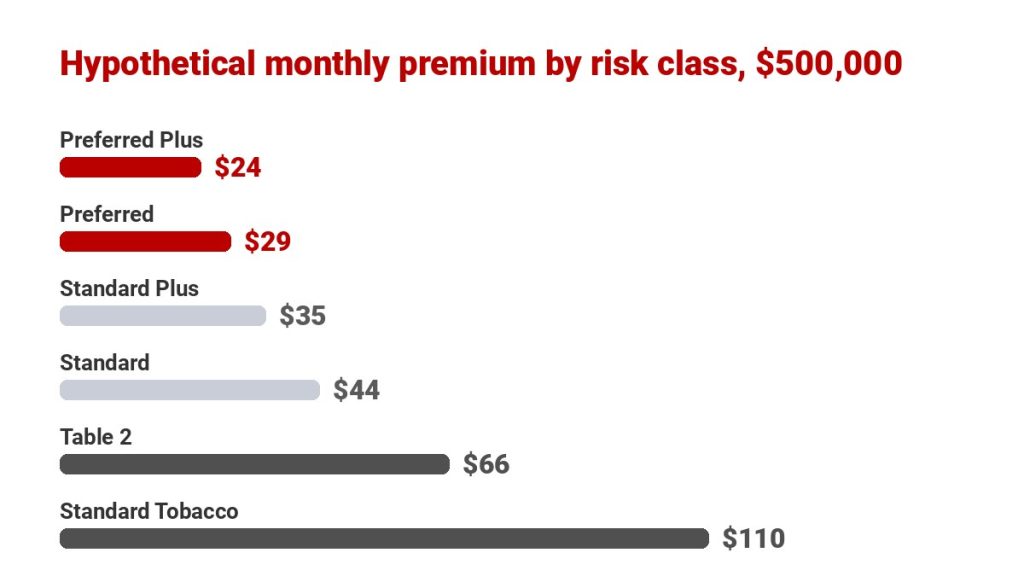
Minh, age 35, buys a 20-year, $500,000 term policy. Suppose the quotes by class are:
- Preferred Plus: $24/month; Preferred: $29/month.
- Standard Plus: $35/month; Standard: $44/month.
- Table 2: $44 × 1.5 = $66/month.
- Standard Tobacco: $110/month.
If Minh gets Preferred instead of Standard:
- Difference per month: $44 − $29 = $15.
- Difference per year: $15 × 12 = $180.
- Over 20 years: $180 × 20 = $3,600.
And if he smokes: $110 − $44 = $66/month, or $66 × 12 × 20 = $15,840 over 20 years, in premiums alone.

Calculator: the cost gap between two classes
Enter the premiums your agent quoted for two classes and see the total difference over the payment period:
Calculator: what does a lower risk class cost you?
Life insurance risk class: common situations for Vietnamese Americans
After years of helping our community apply, we see a few situations again and again when it comes to a life insurance risk class:
- Hepatitis B: fairly common among Asian Americans. If it is inactive, liver function is stable and a doctor follows it regularly, many insurers still consider Standard or an in-between class. Bring your latest lab results.
- Cholesterol and blood sugar: many people have a slightly high cholesterol or A1C without knowing it. A checkup before you apply lets you find out early and adjust.
- Family history in Vietnam: many people do not know exactly what their parents or siblings died of, or at what age. Ask relatives so you can answer accurately, because this affects your class.
- Medical records from Vietnam: if you were treated in Vietnam, keep the paperwork and have it translated into English when needed.
- Nail technicians and drivers: these jobs usually do not lower your health class, but report income accurately so the coverage amount can be approved.
One general tip: do not guess your class and give up. Many clients are sure they will be “Standard” and end up Preferred, and the other way around.
How to prepare for a better life insurance risk class
- Sleep well and fast 8 to 12 hours before the blood draw (follow the examiner’s instructions), and drink water.
- Skip coffee, tobacco, alcohol and hard workouts before the exam, since they can temporarily raise blood pressure or liver enzymes.
- Take your medication as usual if you treat blood pressure or cholesterol; bring medication names and doses.
- Answer fully and honestly: follow-up records showing a condition is stable help you get placed correctly.
- Quit nicotine: most insurers want at least 12 months nicotine-free for non-tobacco rates; the top class may require longer.
- Shop several insurers informally: each has its own underwriting guidelines, and the same file can get different classes.
Can your life insurance risk class change after you buy?

Your class is locked when the policy is issued. If you get sick later, the insurer cannot raise your premium or lower your class for that reason, as long as you answered truthfully and keep paying. If your health improves (weight loss, quitting tobacco long enough), some insurers let you request a reconsideration for a better class and lower premium. Some carriers also run time-limited class upgrade programs, which usually exclude rated policies.
With a convertible term policy, converting to permanent coverage within the allowed window usually keeps your original class with no new exam; see what happens when term life expires. That is one more reason buying young and healthy saves money for decades.
Got a lower class than expected? What to do

- Ask exactly which reading or condition caused the class, and request the underwriting notes in writing if possible.
- If it was temporary (high blood pressure on exam day), ask for a re-check or send results from your own doctor.
- Compare with other insurers before accepting.
- If you need coverage now, accept the policy and request a reconsideration once your health improves.
Read more on how much life insurance costs in the US, life insurance after cancer, and our Term Life and Thinksmart IUL pages.
Frequently asked questions
What is the best life insurance risk class?
Usually Preferred Plus (also called Super Preferred or Preferred Best). It is for people in excellent health, at an ideal weight, nicotine-free and without a family history of early death from heart disease or cancer.
Can I get Preferred if I take blood pressure medication?
Possibly. Many insurers still offer Preferred if blood pressure is well controlled with medication. Each insurer has its own limits.
Does vaping count as tobacco for life insurance?
Usually yes. Most insurers treat any nicotine as tobacco. You generally need at least 12 months nicotine-free to qualify for non-tobacco rates.
Will my premium go up if I get sick after buying?
No, as long as you answered the application truthfully and keep paying. Your risk class is locked when the policy is issued.
Can I get a better class after I buy?
Some insurers allow a reconsideration if your health improves, such as weight loss or quitting tobacco long enough. Ask your agent about your insurer’s rules.
Want to know which class you might get?
Send your height, weight, medications and health history to the Thinksmart Insurance team. We make informal inquiries with several insurers before you apply, explained in plain English or Vietnamese, free. Book a free consultation →







 Thinksmart Insurance