
“I had cancer. Can I still get life insurance?” is one of the most common questions our clients ask. The short answer: life insurance after cancer is often possible, but not always right away, and the premium may be higher. This guide explains what insurers look at, the possible outcomes, how a rated premium is calculated and what to do if you are declined.

Life insurance after cancer: what insurers look at
When you apply, the insurer underwrites the application to estimate risk. For a cancer survivor, underwriters usually look at five things:
- Type of cancer: some types have a very good outlook, such as certain non-melanoma skin cancers or cancers caught very early; others carry a higher risk of coming back.
- Stage and extent: an early stage, small tumor with no lymph node involvement is usually easier to approve.
- Treatment: surgery, radiation, chemotherapy, hormone therapy; whether treatment is finished or ongoing.
- Time since treatment: counted from the end of treatment. The longer with no recurrence, the better.
- Current health: follow-up results, weight, blood pressure, tobacco use and family history.
The insurer may also request records from your doctors and check the MIB database, where insurers share health information from past applications. So “leaving it off the form” does not work.
4 possible outcomes
| Outcome | What it means | Typical situation |
|---|---|---|
| Standard approval | Same price as someone with no history | Mild type, found early, cancer-free for years |
| Rated approval | Table rating or flat extra added | In remission but not long enough, or a moderate-risk type |
| Postpone | No decision now; reapply later | In treatment or just finished |
| Decline | The insurer will not offer coverage | Advanced or metastatic cancer, or a recurrence |
Each insurer has its own underwriting guidelines, so the same file can get a better offer from one company than another. That is why it helps to work with an agent who can shop several carriers instead of applying everywhere yourself. Every formal application leaves a trace in the MIB database, so an informal inquiry first is often the smarter move.
With life insurance after cancer, choosing the right carrier from the start can make a real difference: one company may postpone you while another approves you with a mild table rating.
How long after cancer can you buy?

There is no single number. Insurers usually want to see a period with no recurrence after treatment ends: sometimes only months for a very low-risk type, sometimes several years for more serious ones. During that waiting period the application is usually postponed. After that, a rating may apply for the first years and then come down as more time passes.
Something many people miss: if you accepted a policy with a table rating, after a few healthy years you can ask the insurer to reconsider the rating, if the company allows it. Keep your follow-up records for this.
A practical tip: ask your oncologist’s office for a short summary letter that lists the diagnosis, stage, treatment dates and the date of your last clear scan. Underwriters read many files every day, and a clear one-page summary often helps them place your case correctly the first time. It also saves weeks of waiting while the insurer requests records from several clinics.
Table rating and flat extras: how rated premiums work
When an insurer charges more, it usually uses one or both of these:
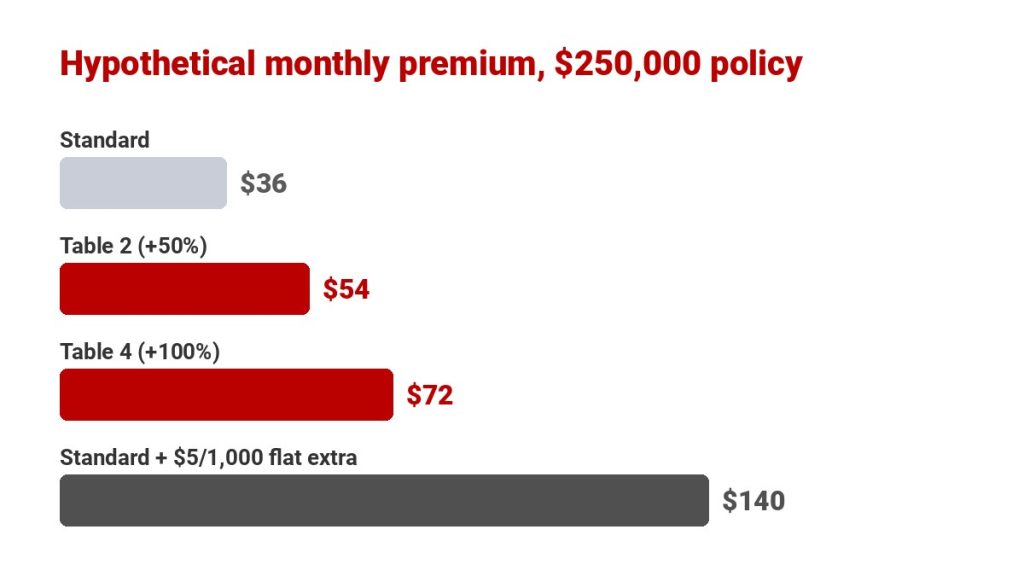
- Table rating: each table commonly adds about 25% of the standard premium. Table 2 is +50%, Table 4 is +100%.
- Flat extra: an added charge per $1,000 of coverage per year, often only for a set number of years.
Hypothetical example: Tuan, age 45, applies for a $250,000 term policy with a standard premium of, say, $36/month.
- At Table 2: $36 × (1 + 0.25 × 2) = $36 × 1.5 = $54/month.
- At Table 4: $36 × (1 + 0.25 × 4) = $36 × 2 = $72/month.
- At standard with a $5 per $1,000 flat extra: $250,000 ÷ 1,000 × $5 = $1,250/year, or $1,250 ÷ 12 = $104.17/month.
- Total during the flat extra years: $36 + $104.17 = $140.17/month. When the flat extra ends, the premium goes back to $36.
Calculator: estimate a rated premium
Enter the standard premium your agent quoted, pick a table rating and any flat extra to see the estimate:
Calculator: life insurance after cancer with a rating
Declined or postponed: what are your options?
Being turned down for life insurance after cancer does not leave your family with no protection. Consider:
- Group life insurance at work: many employers offer a basic amount with no health questions if you enroll on time. Amounts are usually modest and may end when you leave the job.
- Simplified issue (no medical exam): health questions only, no blood test. Some policies only ask about recent years. See no medical exam life insurance programs.
- Guaranteed issue: no health questions, usually for older ages, small amounts (often in the tens of thousands, enough for final expenses). A guaranteed issue policy usually has a 2 to 3 year waiting period: if death from illness happens during that time, the insurer typically refunds premiums plus some interest instead of the full benefit.
- Accidental death insurance: pays only for death by accident, not illness. Cheap, but not a replacement for life insurance.
- Wait and reapply: if postponed, ask exactly how long the insurer wants you to wait, mark the date, keep your follow-up records and reapply.
Documents to prepare

A complete file helps the underwriter judge your case fairly, instead of assuming the worst because something is missing:
- Pathology report: type, size and stage.
- Date of diagnosis, and start and end dates of each treatment.
- Latest follow-up exams, scans and lab results showing no recurrence.
- If another insurer postponed, declined or rated you before, note the company and the date.
- Current medications, for example hormone therapy after breast cancer.
- Contact details of the oncologist following your care.
Be honest: why hiding cancer backfires
For the first 2 years, a policy has a contestability period. If the insured dies during that time, the insurer can review the application, and if it finds a cancer history was misstated, it can deny the claim or rescind the policy. Hiding an illness to get a lower premium can cost your family the entire death benefit. See why life insurance claims are denied and diseases not covered by life insurance.
What if you get cancer after you already have a policy?

If your policy is in force and you answered the application truthfully, the insurer cannot cancel it or raise your premium just because you are diagnosed with cancer later, as long as you keep paying. Many policies also include living benefits that let you access part of the death benefit early for a serious illness; see living benefits explained.
The biggest lesson: buying while you are healthy is always cheaper and easier. If cancer runs in your family, do not wait for a test result to start looking. See how much life insurance you need, and our Term Life and Thinksmart IUL pages.
Frequently asked questions
Can you get life insurance after cancer?
Often yes, depending on the type of cancer, stage, treatment and how long you have been cancer-free. People in active treatment are usually postponed. Survivors of a low-risk cancer who have been cancer-free for years may qualify at standard rates.
Can I get life insurance while being treated for cancer?
Most insurers will postpone until treatment is finished and some follow-up time has passed. Meanwhile, group coverage at work or a small guaranteed issue policy may be options.
What is a table rating?
It is an increase over the standard premium. Each table commonly adds about 25%. For example, a $36/month standard premium becomes about $54/month at Table 2.
Should I leave cancer off my application?
No. Insurers can check medical records and the MIB database. If a misstatement is found in the first 2 years, the insurer can deny the claim or rescind the policy.
Does guaranteed issue life insurance pay if I die of cancer?
There is usually a 2 to 3 year waiting period. If death from illness happens during that time, the insurer typically refunds premiums plus some interest. After the waiting period, the full benefit is paid.
Had cancer and want to know your chances?
Send your diagnosis and treatment details to the Thinksmart Insurance team. We will get informal opinions from several insurers before you formally apply, explained in plain English or Vietnamese, free. Book a free consultation →







 Thinksmart Insurance