
Learning how to read an IUL illustration is one of the most useful things you can do before buying indexed universal life. Many people look only at the biggest number in the last column and sign. That is the easiest way to misunderstand the policy. This guide walks through each key column, explains guaranteed vs non-guaranteed values, and gives a hypothetical example and a calculator so you can read one row of an illustration yourself.

What is an IUL illustration?
An IUL illustration shows how a policy might perform year by year if you pay the planned premium and if interest credits match the assumptions. It helps you compare and plan, but it does not promise results. The real credit each year depends on the index (often the S&P 500), the cap, the floor and the participation rate. See IUL cap rate, floor and participation rate explained if those terms are new.
In the US, the National Association of Insurance Commissioners (NAIC) guideline AG 49-A limits the maximum rate an insurer can use in an illustration. That keeps numbers from being unlimited, but the maximum is still only an assumption.
The first pages: policy details
The first page usually summarizes the insured’s age and sex, the health rating (risk class), the face amount, the death benefit option (Option A level or Option B increasing), the planned premium, how many years you pay, the index strategy and the illustrated rate. Check that these match you. If the health rating is wrong, the whole illustration changes once the real policy is issued.
Columns 1 and 2: policy year and age
Each row is one policy year and the matching age. When you read, pick a few milestones that matter to your family: year 10, your retirement age (for example 65), and age 85 or 90. Do not look only at the last row.
Column 3: premium outlay
This is what you plan to pay each year. If there is a cumulative premium column, it shows the total you have paid up to that year, which is handy to compare with the cash surrender value. If you pay less than the illustration assumes, the later columns will be lower and the policy may lapse sooner.
Guaranteed vs non-guaranteed columns in an IUL illustration
This is the most important part of learning how to read an IUL illustration. Most illustrations have at least two groups of columns:
- Guaranteed: assumes the insurer charges the maximum costs allowed in the contract and credits only the minimum guaranteed interest. Think of it as a worst-case stress test.
- Non-guaranteed / illustrated: uses current charges and the illustrated rate. The numbers look better but are not certain.
- Some illustrations add an alternate or midpoint column with a lower rate, so you can see results in a weaker market.
Find the year the guaranteed column drops to zero. If the policy lapses on a guaranteed basis while you are in your early 70s, it means the policy needs close monitoring and may need more premium later if real credits are low.
Accumulated value and cash surrender value
Accumulated value (some insurers call it account value) is the money in the policy after premiums and interest credits are added and charges are taken out. Cash surrender value is what you actually receive if you cancel the policy that year, after the surrender charge.
During roughly the first 10 years, surrender charges are usually high, so the cash surrender value is lower than the accumulated value and often lower than the total premiums paid. That is why IUL is a long-term plan. Surrendering early usually means a loss.
Net death benefit
This is what your beneficiaries receive if the insured dies that year, minus any outstanding loan. With Option A it usually stays level; with Option B it rises with the accumulated value. If the illustration shows policy loans for retirement income, the death benefit falls as the loans grow.
Hypothetical example: reading one row in year 10
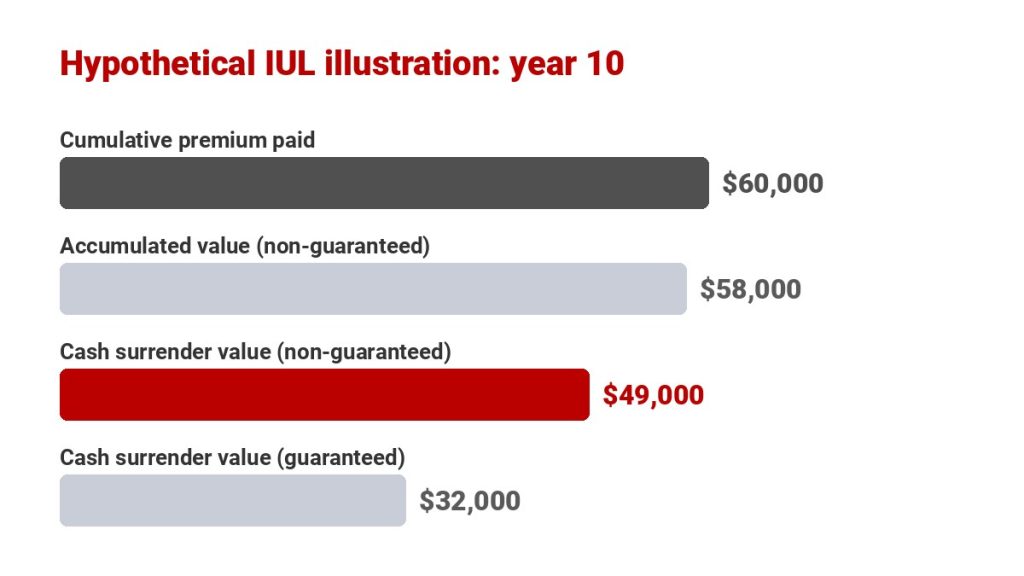
Suppose Tuan is 45 and pays $500 a month ($6,000 a year). Row 10 (age 55) of a hypothetical illustration might look like this:
| Column (year 10, age 55) | Hypothetical value |
|---|---|
| Cumulative premium paid | $60,000 |
| Accumulated value (non-guaranteed) | $58,000 |
| Cash surrender value (non-guaranteed) | $49,000 |
| Cash surrender value (guaranteed) | $32,000 |
| Death benefit | $250,000 |
How to read it step by step:
- Surrender charge in year 10: $58,000 − $49,000 = $9,000.
- Surrendering in year 10 on the non-guaranteed basis: $49,000 − $60,000 = a $11,000 loss versus premiums paid.
- On the guaranteed basis: $32,000 − $60,000 = a $28,000 loss. That is the bad-case view.
- Throughout those 10 years, the family is protected by a $250,000 death benefit.
Use the calculator below to read one row of your own illustration:
Quick reader for one row of an IUL illustration
Surrender charge in that year:
The policy charges page
Many illustrations include a page that lists charges by year: the premium expense charge on each payment, the cost of insurance that rises with age, a monthly policy fee, expense charges in the early years and rider charges. Charges are usually highest in about the first 10 years and then fall. Ask for this page if you do not see it. IUL insurance returns: high or low? explains why charges matter so much.
Red flags when you read an IUL illustration

- The illustrated rate is the maximum allowed: ask for another version at a lower rate, for example 1 to 2 percentage points lower.
- The guaranteed column lapses early: ask how much more you would need to pay to keep the policy if rates are low.
- Very large loans for retirement income: ask about the loan rate, loan type, and what happens after several 0% index years in a row.
- Premium far below the recommended level: the policy may lapse more easily.
- No review plan: ask for an updated in-force illustration every year or every few years.
After you buy: the in-force illustration
An illustration is not only for the day you buy. Once the policy is in force, you can ask the insurer for an in-force illustration at any time. It starts from your real accumulated value today, uses current charges and rates, and projects forward again. Comparing it with the original illustration shows whether the policy is on track.
If the in-force illustration shows the policy lapsing earlier than planned, you still have options while there is time: pay a little more, change the index strategy, lower the death benefit, or slow down planned loans. Waiting until the policy is close to lapsing leaves far fewer choices. A good habit is to review it every year when you receive your annual statement, using the same steps you used to read the first illustration.
How to read an IUL illustration with your advisor: 5 questions

- What rate does this illustration use, and what happens if it is 2% lower?
- On the guaranteed basis, to what age does the policy stay in force?
- How many years do surrender charges last?
- If I have to stop paying for a few years, what happens?
- Does the policy include living benefits, and do they change this illustration?
Knowing how to read an IUL illustration helps you pick the right product. Compare it with other types of life insurance, or read VUL vs IUL.

Learn more on the Thinksmart IUL page.
Frequently asked questions
Is an IUL illustration a promise from the insurer?
No. An IUL illustration is a projection based on assumptions. Only the guaranteed column and the terms of the contract are promises. Non-guaranteed values may end up higher or lower.
What is the difference between accumulated value and cash surrender value?
Accumulated value is the money inside the policy. Cash surrender value is what you actually receive if you cancel, after the surrender charge. In the early years the surrender value is usually much lower.
Why is the guaranteed column so much lower?
Because it assumes maximum contract charges and minimum interest. It is a bad-case scenario that shows the risk, not a forecast.
Should I trust the numbers in the last column?
Treat them as one scenario. Ask for a version at a lower rate, look at the guaranteed column, and request updated in-force illustrations after you buy.
How often should I review my IUL illustration?
Ask for an in-force illustration every year or every few years, especially when actual credits differ from the assumptions or you change how you pay premiums.
Have an IUL illustration you don’t fully understand?
Send it to the Thinksmart Insurance team and we will explain each column in plain English or Vietnamese, free and with no pressure to buy. Book a free consultation →









 Thinksmart Insurance