
When you use a max funded IUL for retirement income, most of the money usually comes out as policy loans. At that point you will be asked to choose: IUL fixed vs indexed loan? It sounds like a technical detail, but the choice can mean tens of thousands of dollars of difference over 10 to 20 years.
This guide explains both loan types in plain language, walks through a 10-year example step by step, covers the risks of each, and shows how to choose. If you are new to IUL loans, read IUL policy loans first.

IUL fixed vs indexed loan: the basics
When you borrow from an IUL, you do not take money out of your account. The insurer lends you its own money and uses your account value as collateral. The question is how the collateral portion of your account earns interest. The two loan types answer it differently:
| Feature | Fixed loan | Indexed loan |
|---|---|---|
| Collateral | Moved to a separate collateral account | Stays in the index strategies |
| What the collateral earns | A fixed credited rate close to the loan rate | Index credits, from 0% up to the cap |
| Net yearly cost | Small and known (for example 0.5%) | Varies: can gain or lose |
| Loan rate | Usually fixed | Fixed with a maximum, or variable |
| Best for | People who need steady income | People who accept swings for upside |
When you compare an IUL fixed vs indexed loan, note that names vary by insurer: a fixed loan may be called a standard or wash loan; an indexed loan may be called a participating, alternate or variable loan. One sample illustration from an insurer listed four options: a participating loan at a declared rate (currently 5.5%, maximum 8%), a participating fixed loan at 5%, a participating variable loan (currently 5.8%), and a standard loan credited at the loan rate minus 0.5% in the first 10 years.
5 key differences in an IUL fixed vs indexed loan
1. Net cost: known or variable
With a fixed loan, if the loan rate is 5.5% and the credited rate is 5.0%, your net cost is 0.5% a year. Some policies reduce this spread to 0% after a number of years. With an indexed loan, your net result equals that year’s index credit minus the loan rate, so it changes every year.
2. Zero-credit years
This is the biggest risk of an indexed loan. When the index falls, your credit is 0% but you still owe 5.5% loan interest. On a $100,000 loan, that is $5,500 negative in one year. See how past down years played out in what happens to IUL in a market crash.
3. Fixed or variable loan rate
A variable loan rate usually follows a published corporate bond yield average and has a maximum in the contract. When market rates rise, your borrowing cost rises too, shrinking any favorable spread.
4. Caps and participation rates can fall
An indexed loan depends on index credits. If the insurer lowers caps within contract limits, average credits fall, while the loan rate may not. See how caps work in IUL cap rate and participation rate.
5. Switching loan types
Many policies let you switch between loan types, often limited to a set number of times a year or only on the policy anniversary. Rules vary by insurer, so ask before you start taking income.
IUL fixed vs indexed loan: a 10-year example, step by step

Simple assumptions: you borrow $100,000 and keep the loan level for 10 years, paying interest each year, with no compounding.
Fixed loan
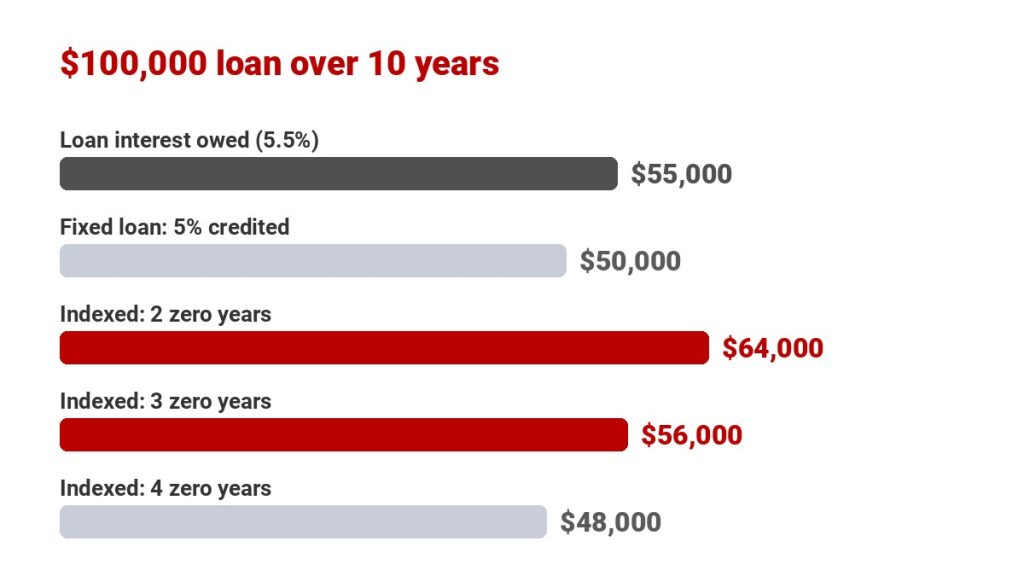
- Loan interest: 5.5% × $100,000 = $5,500 a year, or $55,000 over 10 years.
- Credit on the collateral: 5.0% × $100,000 = $5,000 a year, or $50,000 over 10 years.
- Net result: $50,000 − $55,000 = −$5,000, known from day one.
Indexed loan
Loan interest is still 5.5%, or $55,000 over 10 years. Assume good years credit 8% and bad years 0%:
- 2 zero years: 8 years × $8,000 = $64,000. Net: $64,000 − $55,000 = +$9,000.
- 3 zero years: 7 × $8,000 = $56,000. Net: +$1,000.
- 4 zero years: 6 × $8,000 = $48,000. Net: −$7,000.
- 5 zero years: 5 × $8,000 = $40,000. Net: −$15,000.
This IUL fixed vs indexed loan example shows that one or two extra zero years turn the indexed loan from a winner into a loser against the fixed loan. In real life, retirement loans usually grow every year and interest compounds, so the real gap can be much larger.
Calculator: fixed vs indexed loan, what is the 10-year difference?
IUL fixed vs indexed loan: when to choose which

- Consider a fixed loan when: you live mainly on IUL income, need steady numbers, your loan is already large compared with the account, or you do not want to worry about bad market years.
- Consider an indexed loan when: the loan is still small compared with the account, you have other income, you can accept negative years, and the illustration still holds up at low rates.
- Combine them: some people use an indexed loan in early years while the account has plenty of room, then switch to a fixed loan as the loan grows, if the policy allows.
Whichever IUL fixed vs indexed loan you choose, a loan that grows too large can still make the policy lapse and trigger tax. Read IUL lapse and review your illustration every year.
What to check before choosing an IUL fixed vs indexed loan
- Current and maximum loan rates in the contract for each loan type.
- The credited rate on fixed loans and whether the spread drops to 0% after a certain year.
- Run the illustration at a low rate (for example 4% or lower) with an indexed loan and see how long the policy lasts.
- Switching rules: how often you can switch and whether there is a fee.
- Overloan protection rider: whether you have one and its conditions.
See how to read an IUL illustration. For the bigger max funded picture, read max funded IUL for retirement and is max funded IUL good.
Taxes on an IUL fixed vs indexed loan: the same
For taxes, fixed and indexed loans are treated the same: loans are generally not taxed while the policy stays in force and is not a MEC. The tax risk comes if the policy lapses or is surrendered with a loan outstanding. So the loan type affects taxes indirectly: the type more likely to drain your policy carries more tax risk.
Bottom line on IUL fixed vs indexed loan
In an IUL fixed vs indexed loan decision, a fixed loan gives you a small, known cost. An indexed loan offers a chance to earn more but can lose in 0% index years. For a max funded IUL used for retirement income, stability usually matters more than a few extra percent. Choose based on illustrations at several rates, not only the best-looking column.
Frequently asked questions
What is the difference between a fixed and an indexed IUL loan?
A fixed loan moves the borrowed amount to a collateral account with a fixed credited rate, so the net cost is small and known. An indexed loan leaves the money in index strategies, so it can beat the loan rate in good years but loses in 0% years.
Does an indexed loan always beat a fixed loan?
No. It only wins when average credits over many years exceed the loan rate. A few 0% years can make it lose to a fixed loan.
Can I switch from an indexed loan to a fixed loan?
Many policies allow it, often limited in frequency or only on the policy anniversary. Rules vary by insurer.
Does the loan type affect taxes?
The tax treatment is the same. But a loan type more likely to drain the policy raises the tax risk if the policy lapses.
Which loan type suits a max funded IUL?
It depends on your goal. People who need steady income often suit a fixed loan. People who accept swings may use an indexed loan while the loan is small, after testing the illustration at low rates.
About to take retirement income from your IUL and unsure which loan to use?
Thinksmart Insurance helps you read your illustration and compare fixed and indexed loans at several rates, in English or Vietnamese, with no fee for advice. Contact us →








 Thinksmart Insurance