
“My parents in Vietnam sold land and sent me $120,000. Do I owe tax?” Many Vietnamese-American families face this question. The good news about a Form 3520 foreign inheritance or gift from parents abroad is that you usually owe no income tax on the money itself. But you may have to report it to the IRS, and missing the report can bring very large penalties.
This guide explains the 3 forms that come up most (Form 3520, FBAR, Form 8938), the filing thresholds, step-by-step examples and a calculator to check yourself.

Is a foreign inheritance from Vietnam taxable in the US?
According to the IRS, gifts and bequests received from a foreign person are not taxable income to the recipient. Parents, grandparents or siblings living in Vietnam who are not US citizens or residents are “nonresident aliens” under tax law.
Two things to remember:
- No tax does not mean no reporting. Above the threshold, you still file an information return.
- Later income is taxable. US citizens and residents pay tax on worldwide income. Interest on a Vietnamese savings account, rent from a house and gains from selling inherited land all go on your US tax return.
The federal estate tax is a separate topic, based on the estate of a US person who dies. See US estate tax guide.
Form 3520 foreign inheritance over $100,000
Form 3520 is an information return, not a tax payment. You file it when:
| Who gives | Reporting threshold for the year |
|---|---|
| Foreign individual or foreign estate | More than $100,000 in total (related people, such as mom and dad, are added together) |
| Foreign corporation or partnership | More than $20,573 for 2026 (adjusted for inflation each year) |
Once you pass $100,000, each gift over $5,000 must be listed separately. The due date is the same as your tax return (usually April 15), and it extends to October 15 with your return extension.
Step-by-step example
Hypothetical example: H. lives in Texas, and her mother in Vietnam sells land and sends money twice in 2026:
- $60,000 in March and another $50,000 in October.
- Total for the year: $60,000 + $50,000 = $110,000.
- Compare with the threshold: $110,000 > $100,000, so she must file Form 3520 by April 15, 2027, listing both gifts (each is over $5,000).
- Income tax owed on the $110,000: $0.
If her father sent $60,000 and her mother sent $50,000, the IRS still adds them together because they are related, so the result is the same.
Penalty for missing Form 3520
If you do not file on time, the penalty is 5% of the gift for each month, up to 25%, unless you have reasonable cause. In the example, the maximum penalty could reach $110,000 × 25% = $27,500, even though the money itself is not taxed. That surprises many families.
FBAR: when you keep accounts in Vietnam
Many people receive a foreign inheritance by keeping the savings book or bank account in Vietnam. Then remember the FBAR (FinCEN Form 114):
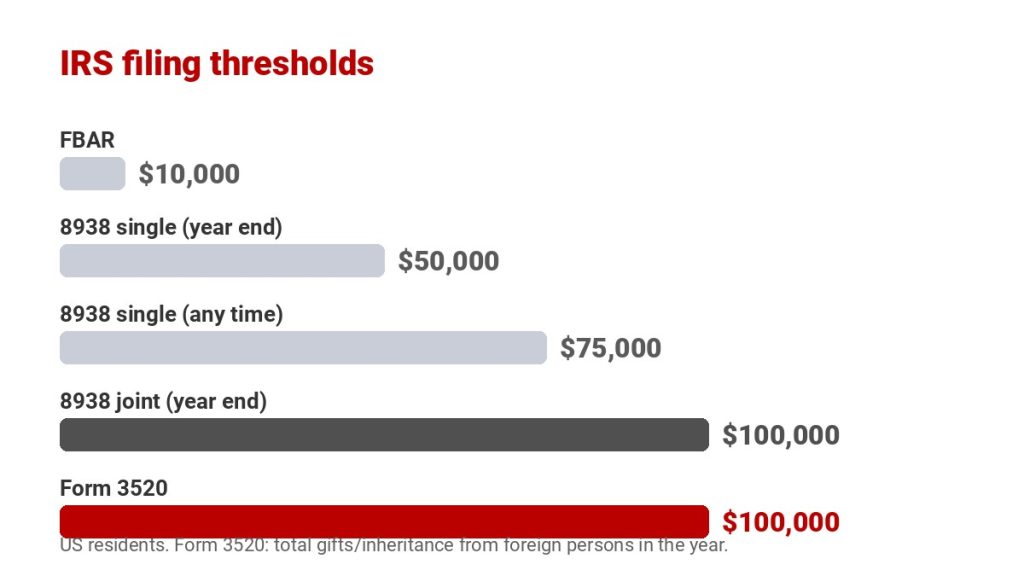
- Threshold: the combined value of all your foreign financial accounts exceeds $10,000 at any time during the year.
- Where to file: online with FinCEN, not with your tax return.
- Due date: April 15, with an automatic extension to October 15.
- Penalties: severe for willful failure, adjusted for inflation each year.
Example: you have 2 savings books in Vietnam, one peaking at 150 million dong and one at 200 million dong. Converted to dollars at the year-end rate, if the total passes $10,000 you must file an FBAR, even if you withdrew part of it before year end.
Form 8938: larger foreign financial assets
Form 8938 is attached to your tax return and applies to larger foreign financial assets. Thresholds for people living in the US:
| Filing status | Last day of the year | Any time during the year |
|---|---|---|
| Single, married filing separately | More than $50,000 | More than $75,000 |
| Married filing jointly | More than $100,000 | More than $150,000 |
The penalty for not filing Form 8938 is up to $10,000, plus more if you still do not file after an IRS notice, up to $60,000. You may need to file both the FBAR and Form 8938 for the same account.
Calculator: do you need to file Form 3520, FBAR or Form 8938 this year?
What about an inherited house or land in Vietnam?
- Real estate held directly in your name is not a “financial account,” so it is not counted for the FBAR or Form 8938.
- Renting it out: rent is income on your US return. Tax paid in Vietnam may be creditable; ask a tax professional.
- Selling it: the gain is reported in the US. For inherited property, the basis is generally the value at the date of death, so keep valuation papers.
- Moving sale proceeds to the US: once it is your inherited money, it is no longer a “gift,” but if it sits in a Vietnamese account first, remember the FBAR.
Documents to keep when receiving money from Vietnam

- Bank wire confirmations (date, amount, sender).
- Inheritance or gift papers, with translations if needed.
- Statements for your Vietnamese accounts, to know the highest balance in the year.
- Sale contracts and valuations if you sell inherited property.
US banks may ask where a large incoming wire came from. Having documents ready makes things faster and safer. Be careful with strangers who promise to “move money without reporting.” See 2027 tax brackets for next year’s income tax.
Common mistakes with a Form 3520 foreign inheritance
- Splitting the money into smaller wires. The IRS looks at the total you received during the year, and gifts from related people are added together. Ten wires of $11,000 still count as $110,000.
- Thinking “no tax” means “no form”. The gift itself is not taxed, but the report is still required once you pass the threshold.
- Forgetting the Vietnamese account. If the money sat in your own account in Vietnam before you moved it, the highest balance may trigger an FBAR.
- Ignoring the interest. Interest earned in a Vietnamese savings account is income and goes on your US tax return.
Each mistake is easy to avoid if you write down every transfer and check the thresholds once a year.
You received a large sum. What next?
An inheritance is a chance to secure your family’s future. Many people use part of it to pay down a mortgage, build an emergency fund, fund retirement accounts, or buy life insurance to protect their children. For long-term tax-advantaged savings, see Roth IRA vs IUL. If you are unsure, talk to a tax professional first, then decide how to invest.
Bottom line: Form 3520 foreign inheritance and 3 numbers to remember
When you receive a foreign inheritance or a gift from parents in Vietnam, you usually owe no income tax. But remember 3 numbers: $100,000 (Form 3520), $10,000 (FBAR) and $50,000 / $100,000 (Form 8938 for people living in the US). File on time to avoid penalties that can exceed any tax.
Frequently asked questions
Is money from my parents in Vietnam taxable in the US?
Usually not. Gifts and inheritances from foreign persons are not taxable income, but you may need to file Form 3520 if the total for the year is more than $100,000.
When is Form 3520 due?
On the same date as your tax return, usually April 15 of the next year, extended to October 15 if you extend your return.
What is the penalty for not filing Form 3520 for a foreign inheritance?
5% of the amount received for each month it is late, up to 25%, unless there is reasonable cause.
Do I report a savings account in Vietnam?
If your foreign accounts together exceed $10,000 at any time during the year, you must file an FBAR with FinCEN. Interest earned is also reported on your US tax return.
Do I report an inherited house in Vietnam on the FBAR?
No. Real estate held directly is not a financial account. But rent and any gain on a sale must be reported on your US return.
Just received a large sum and want to protect your family?
Thinksmart Insurance walks you through protection and savings options in English or Vietnamese, compares several carriers and charges nothing for advice. Contact us →









 Thinksmart Insurance