
Knowing how to check if an insurance company is legit is worth doing before you sign any policy, especially when an agent recommends a name you have never heard. There are hundreds of life insurers in the US. Many are old and financially strong but advertise very little, so “never heard of it” does not mean “not trustworthy.” This guide shows 5 checks you can do in about 15 minutes, plus the scam warning signs to watch for.

Why check if an insurance company is legit?
Life insurance is a promise that lasts 20 or 30 years or a lifetime. The insurer must still be strong enough to pay when your family needs it. Scammers also sometimes use an official-sounding company name to collect premiums. A few simple checks give you peace of mind and protect your money.
Step 1: Check the license with your state insurance department

Every state has a Department of Insurance that regulates insurers. Its website usually has a company lookup tool. Search the company name to see whether it is licensed to sell life insurance in your state. If you cannot find it, call the department’s consumer help line.
Note: many insurers have similar names. Match the full legal name printed on the application or policy, including words like “of New York” or “of the Southwest,” because those can be different subsidiaries.
Step 2: Look at financial strength ratings
Independent rating agencies grade how well an insurer can pay future claims. The best known in insurance is AM Best; S&P, Moody’s and Fitch also rate insurers.
| AM Best rating | Meaning |
|---|---|
| A++, A+ | Superior |
| A, A- | Excellent |
| B++, B+ | Good |
| B and below | Look more carefully |
Ratings can change, so check the latest one. Each agency uses its own scale, so do not compare an “A” from one agency directly with an “A” from another.
Why does this matter so much for life insurance? A term policy may last 20 or 30 years, and a permanent policy may last 50 years or more. You are trusting the insurer to be around and able to pay long after you sign. A strong rating today does not guarantee the future, but it tells you the company currently has solid finances, careful management and enough reserves to meet its promises.
Step 3: Check consumer complaints
The National Association of Insurance Commissioners (NAIC) has a consumer lookup tool that shows each insurer’s complaint index. An index of 1.00 is the baseline. Below 1.00 means fewer complaints than expected for the company’s size; above 1.00 means more. Look at several years and at the right product line, because one year on its own may not tell the whole story.
Step 4: Learn the company’s history and size
A company that has been around for decades and through several economic cycles usually earns more confidence. Find out when it was founded, who the parent company is, whether it is a mutual company (owned by policyholders) or a stock company, and whether it has merged recently. A merger usually does not change the benefits in existing policies, as explained in our article on the Corebridge and Equitable merger.
Thinksmart also has profiles of specific insurers, including National Life Group, Allianz and AIG.
Step 5: Check the agent’s license

A strong insurer sold by an unlicensed person is still a risk. A life insurance agent must be licensed in your state and is usually appointed by the insurer to sell its products. You can look up agent licenses on your state insurance department’s website. Ask for the agent’s license number and check it; a legitimate agent will not mind.
State guaranty associations: an extra layer of protection
If a licensed insurer becomes insolvent, every state has a guaranty association that protects policyholders up to set limits. In most states the minimum protection is about:
- $300,000 in life insurance death benefits.
- $100,000 in cash surrender value.
- $250,000 in annuity benefits.
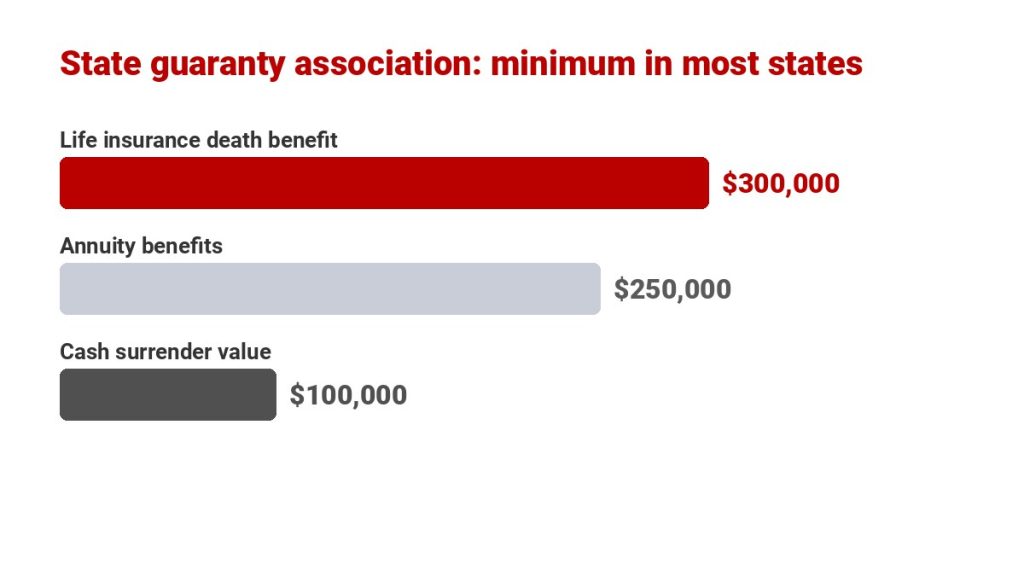
Exact limits vary by state. The protection only applies to insurers licensed in your state, which is one more reason to do Step 1. It is a last-resort safety net, not a reason to choose a weak insurer.
Big name or lesser-known insurer: which is better?
An insurer that advertises on TV is not automatically the best choice for your family. Each insurer has different strengths. Some are easier on certain health conditions such as diabetes or high blood pressure, some have broader living benefits, and some have competitive term life prices at certain ages. A lesser-known insurer that is licensed, well rated and has few complaints can be a perfectly sound choice.
On the other hand, a famous insurer may not fit if its products do not match your needs or its price is higher for your health class. What matters is comparing the specific product after you check if an insurance company is legit, not choosing on name recognition alone.
Questions to ask your agent about an unfamiliar insurer
- What is the full legal name of the company issuing the policy, and who is the parent company?
- Is it licensed in my state, and what is its latest AM Best rating?
- Why did you choose this insurer for my situation instead of another one?
- When my family needs to file a claim, who do they contact and how does it work?
- How do I pay premiums directly to the insurer?
Clear answers backed by documents are a good sign. If the agent avoids the questions or says there is no need to check, stop and do your own checks first.
What if you already bought a policy?
It is never too late to check. Find the insurer’s full name on your policy or annual statement and run the same five steps. If something looks wrong, such as the company not appearing in your state’s lookup or premiums going to a personal account, contact your state insurance department right away. If everything checks out, keep your policy documents in a safe place and make sure your beneficiaries know which company to call.
Warning signs when you check if an insurance company is legit
- You are asked to pay in cash, with gift cards, or into the seller’s personal account.
- Checks must be made out to the agent instead of the insurance company.
- Unusually high “guaranteed” returns, or pressure to sign today.
- No written application, policy or paperwork.
- The company is not listed by your state insurance department.
After you receive a policy, most states give you a free look period, often 10 to 30 days, to cancel and get your premium back if you are not satisfied. See also 7 life insurance mistakes.
A 15-minute checklist
| What to check | What you want to see |
|---|---|
| Insurer license in your state | Yes, under the full legal name |
| AM Best rating | Usually A- or higher |
| NAIC complaint index | Around or below 1.00 |
| Company history | Many years, clear information |
| Agent license | Active in your state |
| How you pay | Directly to the insurer |

Once you have done these checks, you can focus on choosing the right type of life insurance, such as term life or IUL. Learn more about who Thinksmart Insurance is.
Taking the time to check if an insurance company is legit is a small step that protects a promise your family may rely on for decades.
Frequently asked questions
How do I check if an insurance company is legit?
Check its license with your state insurance department, look at financial strength ratings (AM Best, S&P, Moody’s, Fitch), review the NAIC complaint index, learn the company’s history and check the agent’s license.
What is a good AM Best rating?
A++ and A+ are Superior, A and A- are Excellent, and B++ and B+ are Good. Many people choose insurers rated A- or higher for long-term policies.
What happens to my policy if the insurer goes bankrupt?
For licensed insurers, the state guaranty association protects policyholders up to set limits, in most states about $300,000 in death benefits and $100,000 in cash value. Policies are often transferred to another insurer.
Should I buy from an insurer I have never heard of?
Not knowing the name does not mean it is not trustworthy. Many long-standing insurers advertise very little. Check the license, ratings and complaints before you decide.
Can I cancel a policy after I sign?
Most states have a free look period, often 10 to 30 days after you receive the policy, when you can cancel and get your premium back. The exact period is stated in the policy.
Want help checking a specific insurance company?
Send the company name to the Thinksmart Insurance team and we will review its license, ratings and key points with you, free of charge. Book a free consultation →







 Thinksmart Insurance