
The IUL cap rate, floor and participation rate appear on every indexed universal life illustration, yet few people get them explained properly. Together they decide how much interest your policy is credited each year when an index such as the S&P 500 goes up or down. This guide explains each term in plain English, walks through step-by-step examples and gives you a calculator to try your own numbers.

How an IUL credits interest
An IUL is permanent life insurance with cash value. Each premium pays for the cost of insurance and policy charges, and the rest goes into the account value. That money is not invested in stocks. Instead, the insurer credits interest based on the movement of an index, most often the S&P 500, using a formula built from the cap, par and floor.
Because you are not invested directly, the index change used is usually the price change only, without dividends. That matters when people compare an IUL with buying an index fund themselves.
What is an IUL cap rate?
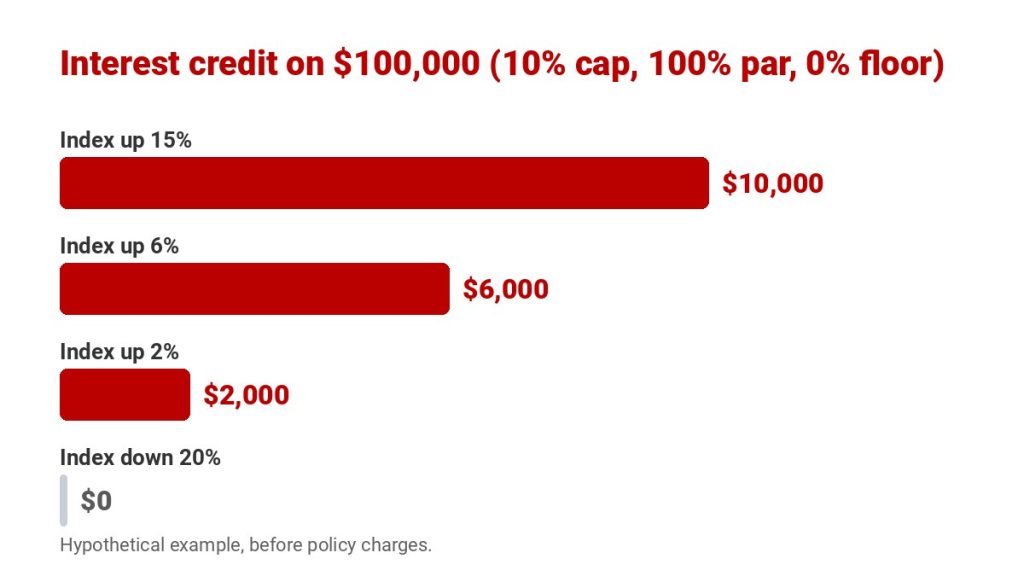
The IUL cap rate is the ceiling on your interest credit. Say the IUL cap rate is 10%. In a year the index gains 15%, your policy is credited 10%. In a year it gains 6%, you get 6% (with 100% participation).
An IUL cap rate is not fixed forever. The insurer sets a cap for each strategy and can change it over time, often depending on interest rates and the cost of the options it buys. The contract only guarantees a minimum cap stated in the policy. So the IUL cap rate on today’s illustration is not a promise for the next 20 years.
What is the floor?
The floor is the minimum credit, usually 0%, sometimes 1%. If the index drops 20%, your credit is 0%, not −20%. That is the main difference between an IUL and investing directly in the market.
But be clear about what the floor protects: the interest credit, not the whole account value. In a 0% year, charges such as the cost of insurance and policy fees are still deducted, so the account value can still go down. For more on fees, see IUL insurance returns: high or low.
What is the participation rate?
The participation rate tells you what percentage of the index gain is counted. A 100% par counts the full gain (before the cap). A 140% par multiplies the gain by 1.4. A 50% par counts only half.
There is usually a trade-off: strategies with a higher par come with a lower cap, and vice versa. Some strategies use volatility-controlled indices with very high participation and no cap, because those indices move more slowly than the S&P 500.
How interest is credited, step by step
The general formula: credit = index gain × par, no higher than the cap and no lower than the floor. A hypothetical example with a $100,000 account value, a 10% IUL cap rate, 100% par and a 0% floor:
| Index for the year | Calculation | Interest credit |
|---|---|---|
| Up 15% | 15% × 100% = 15%, above cap → 10% | $10,000 |
| Up 6% | 6% × 100% = 6% | $6,000 |
| Up 2% | 2% × 100% = 2% | $2,000 |
| Down 20% | Negative, below floor → 0% | $0 |
Now take a strategy with a 140% par and an 8.25% cap. If the index gains 15%: 15% × 140% = 21%, above the cap, so you get 8.25%. If the index gains 5%: 5% × 140% = 7%, below the cap, so you get 7%, more than the 5% from the 100% par strategy. That is why higher-par strategies tend to do better in years of moderate gains.
IUL interest credit calculator (cap, par and floor)
Interest credited this year:
A long-term example from a sample illustration
A sample illustration from one insurer (hypothetical, 11% cap, 100% par, 0% floor) back-tested 2001–2025. The average credit was about 7.00% a year, while the S&P 500 price growth (excluding dividends) averaged about 6.80%. In the big down years, 2001, 2002, 2008 and 2022 (roughly −13% to −38%), the credit was 0%.
On the same illustration, a higher-par strategy (8.25% cap, 140% par) averaged about 5.60%, and a 1% floor strategy (8.5% cap) about 5.90%. These are hypothetical past results, not a guarantee of future performance, and they are before policy charges. Insurance rules also limit the maximum rate an illustration may use, so illustrated rates are usually lower than back-tested numbers like these.
When does an IUL cap rate change, and why does it matter?
Insurers review the IUL cap rate and participation rate on a regular schedule. When interest rates rise, the insurer has more money to buy index options, so caps can go up; when rates fall, caps can come down. A new rate usually applies to the next crediting period, while the current period keeps the rate declared when it started.
Hypothetical example: an account value of $100,000 and an index gain of 12% for the year. With a 10% cap, the credit is $10,000. If the cap is lowered to 8%, the credit becomes $8,000, which is $2,000 less. Over many years that difference compounds. That is why it is worth asking your agent to run the illustration at a lower assumed rate too.
It also helps to know the guaranteed minimum cap and participation rate written in the contract. Those are the worst-case numbers the insurer can use, and they are often well below the current rates shown on a sales illustration.
4 questions to ask before choosing an index strategy

- What are the current cap and par, and what are the guaranteed minimums? Only the guaranteed numbers are certain.
- How long is the crediting period? One-year point-to-point is common; some strategies use two years or monthly averaging.
- Does the strategy have its own charge? Some offer a multiplier or interest bonus in exchange for an extra yearly fee.
- Can I switch strategies? Usually on the policy anniversary; some policies also offer an index lock feature.
Common misunderstandings about the IUL cap rate
- “A 0% floor means I can never lose money.” Not true. Charges are still deducted, and surrendering early can trigger surrender charges.
- “A higher cap is always better.” Not necessarily. Look at it together with the par, any strategy fee and the guaranteed minimum.
- “An IUL earns the same as the S&P 500.” No. It excludes dividends and is limited by the cap, but you get the floor in return.
- “The illustration shows what I will get.” An illustration is a projection under assumptions. Always look at the guaranteed column as well as the non-guaranteed one.
To learn more about the index itself, read what is the S&P 500 index.
Is an IUL right for your family?

An IUL suits people with steady income who want both protection and long-term cash value and who accept that the yearly credit is not fixed. If you mainly need affordable protection, term life may fit better. To explore a savings-focused plan, see IUL insurance.
Whatever you choose, ask your agent to show you the same illustration at a lower assumed rate as well. If the policy still works when the credit is lower than expected, it is built on solid ground.
Frequently asked questions
What is an IUL cap rate?
The cap rate is the maximum interest an IUL policy can be credited in a period, usually one year. With a 10% cap, if the index rises 15%, the policy is credited 10%.
Does a 0% floor mean I can’t lose money?
A 0% floor means the interest credit won’t be negative when the index falls. Policy charges are still deducted monthly, so the account value can still decline, especially in the early years.
What does a 140% participation rate mean?
The index gain is multiplied by 1.4 before the cap applies. A 5% index gain becomes 7%. Higher-participation strategies usually have lower caps.
Can the insurer lower my cap rate?
Yes. Current caps and participation rates are not guaranteed and can be changed under the policy terms. Only the minimum stated in the contract is guaranteed.
Does an IUL include S&P 500 dividends?
Usually not. Interest is based on the index price change without dividends, because the money in an IUL is not invested directly in stocks.
Want to see the cap, par and floor on your own illustration?
Our Vietnamese-speaking team at Thinksmart Insurance will go through your IUL illustration line by line with you, for free. Book a free consultation →









 Thinksmart Insurance