
The Social Security COLA 2027 is 3.6%, the largest cost-of-living adjustment in four years. It applies to about 72 million Social Security beneficiaries starting in January 2027. This guide explains how much your check will rise, the other new numbers for 2027, and the question many families ask: should you claim at 62, 67 or 70?

How much is the Social Security COLA 2027?
The Social Security COLA 2027 is 3.6%, based on the increase in the Consumer Price Index (CPI-W) from the third quarter of 2025 to the third quarter of 2026. The math is simple: multiply your current benefit by 1.036.
- Current benefit: $1,800 a month.
- $1,800 × 1.036 = $1,864.80, rounded down to $1,864 a month.
- That is about $64 more a month, or about $770 a year.
| Average monthly benefit | Before COLA | After COLA |
|---|---|---|
| Retired worker | $2,095 | $2,170 |
| Aged couple, both receiving | $3,238 | $3,355 |
When will you see the Social Security COLA 2027 increase?
About 72 million Social Security beneficiaries will see the Social Security COLA 2027 increase in their January 2027 payment. About 7.3 million people who receive SSI get theirs earlier, on December 31, 2026. Your new benefit amount will appear in the Message Center of your my Social Security account starting in late November if you have signed up for online notices, and paper notices are mailed in December.
Note: many people have their Medicare Part B premium deducted from their Social Security check, which affects how much of the Social Security COLA 2027 they actually keep. If the 2027 Part B premium goes up, your net increase will be smaller than 3.6%. Check your notice for the exact amount. See also our guide to ACA health insurance changes for 2027.
Other numbers that change with the Social Security COLA 2027

| Item (2027) | New amount |
|---|---|
| Maximum earnings subject to Social Security tax | $192,300 a year |
| Earnings limit, under full retirement age | $25,560 a year ($2,130 a month) |
| Earnings limit, year you reach full retirement age | $67,920 a year ($5,660 a month) |
| Earnings needed for one credit | $1,970 |
| Maximum benefit at full retirement age | $4,188 a month |
| Federal SSI: individual / couple | $1,029 / $1,544 a month |
These limits rise each year along with wages, just as benefits rise with the Social Security COLA 2027. You need 40 credits, usually about 10 years of work with Social Security taxes, to qualify for retirement benefits. You can earn up to 4 credits a year.
Working while receiving Social Security
If you claim before full retirement age and keep working, earnings above the limit cause some benefits to be withheld for a while:
- Under full retirement age: $1 withheld for every $2 earned above $25,560.
- In the year you reach full retirement age: $1 withheld for every $3 above $67,920, counting only months before your birthday month.
- From the month you reach full retirement age: no limit.
Withheld benefits are not lost. At full retirement age, Social Security recalculates and raises your monthly benefit to account for them.
After the Social Security COLA 2027: claim at 62, 67 or 70?
For anyone born in 1960 or later, full retirement age is 67. Claiming early at 62 permanently reduces your monthly benefit by about 30%. Waiting past 67 adds 8% a year in delayed retirement credits, up to about 124% at 70. There is no extra increase after 70.
Example: Hai expects $2,000 a month if he claims at 67.
- Claim at 62: $2,000 × 70% = $1,400 a month.
- Claim at 67: $2,000 a month.
- Claim at 70: $2,000 × 124% = $2,480 a month.
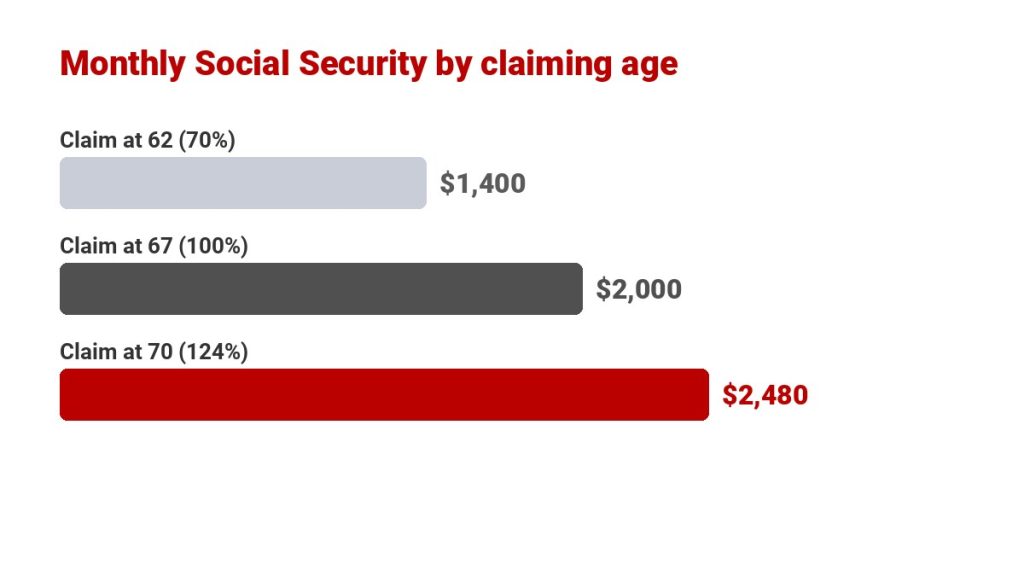
Claiming at 70 pays more each month but starts eight years later than 62. In simple terms (ignoring COLAs), the total collected from 70 catches up with the total collected from 62 at about age 80 ($1,400 × 96 months of waiting = $134,400; divided by the $1,080 monthly difference ≈ 124 months after 70). If you live longer than that, waiting usually pays off.
Social Security 2027 calculator
Monthly benefit from January 2027 (3.6% COLA):
Who might claim early, and who might wait?
- Consider claiming earlier: poor health, an immediate need for income, no other income sources, or already fully retired.
- Consider waiting: good health, a family history of long life, still working, or savings to live on in the meantime.
- Married couples: when the higher earner waits longer, the surviving spouse may receive a larger survivor benefit later.
Social Security benefits can also be subject to federal income tax. If your combined income is above $25,000 (single) or $32,000 (married filing jointly), part of your benefits, up to 85%, may be taxable.
Social Security COLA 2027 for spouses and survivors
The Social Security COLA 2027 is not only for retired workers. A spouse can receive a spousal benefit based on the other spouse’s record, up to about 50% of that spouse’s full retirement age benefit, if it is higher than their own. Claiming a spousal benefit before full retirement age also reduces it.
When a spouse dies, the survivor can receive a survivor benefit of up to 100% of what the deceased was receiving or entitled to. A widow or widower can start reduced survivor benefits as early as 60. Children under 18 may also qualify. The 3.6% Social Security COLA 2027 applies to all of these benefits.
3 common myths about the Social Security COLA 2027
“Social Security is running out, so claim early to be safe.” The trust fund is under pressure, but payroll taxes from current workers continue to fund most benefits. Base your claiming age on your health and finances, not on fear alone.
“A 3.6% raise means my deposit rises exactly 3.6%.” Not always. Medicare Part B premiums and tax withholding can reduce the net increase.
“If I work, I lose Social Security.” Benefits are only withheld temporarily when you earn above the limit before full retirement age, and they are credited back later.
Is Social Security enough to live on?

Even after the Social Security COLA 2027, for many Vietnamese-American families the honest answer is no. An average of about $2,170 a month is hard to stretch over rent, food and medicine in many cities. Self-employed workers, nail salon workers and people paid in cash often report lower income, which means lower Social Security later.
That is why it helps to build other sources: a workplace plan such as a 401(k), an IRA, and permanent life insurance with cash value such as IUL. See IUL for retirement and retirement savings for a comfortable old age.
Social Security also pays survivor benefits, but they rarely replace a breadwinner’s full income. Work out how much life insurance you need so your family is not left short.
What to do now

- Create or sign in to your my Social Security account to see your new amount and earnings record.
- Check that your earnings history is correct. Missing years can lower your benefit.
- Read your COLA notice in December to see your net payment after Medicare.
- If you are close to 62, sit down with your family and choose the claiming age that fits.
The Social Security COLA 2027 helps protect your income from rising prices, but your claiming decision and your other savings matter even more for a comfortable retirement.
Frequently asked questions
What is the Social Security COLA for 2027?
The Social Security COLA 2027 is 3.6%. The average retired worker benefit rises from $2,095 to about $2,170 a month.
When does the 2027 COLA start?
Social Security beneficiaries see the increase in their January 2027 payment. SSI recipients get the increase starting December 31, 2026.
How much is Social Security reduced if I claim at 62?
For people born in 1960 or later, full retirement age is 67. Claiming at 62 pays about 70% of the full benefit, a permanent reduction of about 30%.
Can I work and collect Social Security in 2027?
Yes. If you are under full retirement age, earnings above $25,560 in 2027 cause $1 in benefits to be withheld for every $2 over the limit. Withheld benefits are credited back when you reach full retirement age.
Is Social Security taxable?
It can be. If your combined income is above $25,000 (single) or $32,000 (married filing jointly), up to 85% of your benefits may be subject to federal income tax.
Worried Social Security won’t be enough?
The Thinksmart Insurance team can help you estimate your retirement gap and the options to fill it, in English or Vietnamese, free of charge. Book a free consultation →









 Thinksmart Insurance